 Oceania & Pacific · Modernised and illustrated edition
Cook's Last Voyage, Volume I: The Cape of Good Hope, the Kerguelen Islands and New Zealand
Modernized, illustrated English edition of A Voyage to the Pacific Ocean by James Cook (1776-1780). 254 pages.
February 1776: Cook sets out again for the Pacific. Tenerife, the Cape of Good Hope, Kerguelen, then New Zealand, where a chief accused of murder faces the crew. Account rewritten in modern English, maps and illustrations.
Read more ↓- 254 pages
- Paperback · Ebook (EPUB)
- English
- 18th century
About this book
February 1776. James Cook is forty-seven years old, holds an honorary post at Greenwich, and has every right never to go to sea again. He sets out once more. Two sloops are fitted out on the Thames to seek, this time by way of the Pacific, the passage Europe has been hunting for two centuries north of America. Aboard are a herd of livestock given by the king, a painter, a surgeon naturalist, and Omai, the young Raiatean whom London had claimed for two years and who must now be returned to his islands.
This first volume is the year of approach. Tenerife and its peak against the sky, the breakers of Bonavista skimmed by night, the Cape of Good Hope where a second ship is awaited and does not come, then the descent toward the ice. On Christmas Day 1776, the Resolution anchors at the head of a southern harbor covered in penguins, without a single tree or shrub: among the rocks, a sailor finds a sealed bottle proving that Frenchmen have been there before.
Then comes New Zealand, and with it a question the whole crew carries in silence. Four years earlier, ten English sailors were killed and eaten in a nearby cove. The chief who killed them comes aboard, unarmed, and stands before the captain. His own people demand his death. Omai demands it louder than anyone. What Cook decides that day says more about him than three hundred pages of soundings and bearings.
The text follows the official journal of this third voyage, published in London in 1784 by John Douglas from the captain's own notebooks, and completed throughout by the observations of the surgeon naturalist William Anderson: the flora and fauna of Kerguelen's Land, the natural history of Van Diemen's Land, then a meticulous ethnographic portrait of the people of Queen Charlotte's Sound. Two voices, two ways of seeing, one voyage.
This Volume I corresponds to Book I of the original edition: from the fitting out of the ships at Deptford in February 1776 to the departure from Queen Charlotte's Sound at the end of February 1777, with two young New Zealanders aboard, setting out to accompany Omai to his native islands. The following volumes continue the route toward Tahiti, then north to the Bering Strait, beyond the scope of this first volume.
The first complete modern rewriting for today's reader, making this account accessible without betraying anything of the voyage. Four original illustrations and four redrawn maps bring the route to life, while a set of reference materials (glossary, timeline, index, editor's note, afterword, and further reading) and selected passages from the original text illuminate the reading.
Product details
- Publisher
- Itinerarium Éditions
- Series
- Oceania & Pacific
- The author
- James Cook
- Date of the journey
- 1776-1777
- Modern edition by
- Isabelle Perol
- Language
- English
- Format
- Paperback, 6 × 9 in (15.2 × 22.9 cm)
- Pages
- 254
- ISBN
- 978-2-489331-23-3
- Published
- August 2026
The author
James Cook
A sailor at heart and passionate about ancient civilisations, Isabelle Perol has roamed the coasts of South America, West Africa, the South Pacific and the Indian Ocean. Trained in maritime anthropology, she is drawn to accounts in which the sea is not a mere backdrop but a character in its own right. She brings to the project a sensitivity for oceanic cultures and forgotten voyages. She works on the Wild Americas, Oceania & Pacific, Uncharted Africa and East Indies collections.
All books by James Cook →A Voyage to the Pacific Ocean: Our editorial work
This volume opens James Cook's third and last voyage. It gives Book I of the official account, titled in the original Transactions from the Beginning of the Voyage till our Departure from New Zealand: from taking command at Deptford, in February 1776, to leaving Queen Charlotte's Sound on 25 February 1777. The source text is A Voyage to the Pacific Ocean, Undertaken by the Command of His Majesty, for Making Discoveries in the Northern Hemisphere, published in London in 1784, in three volumes, under the direction of Canon John Douglas, to whom the Admiralty entrusted the captain's journals after his death. It is this original edition, the first, that has served as the basis for the present rewriting. The entire voyage occupies six volumes in our series; the last two will no longer be by Cook's hand, but by that of Captain James King, who took up the pen after 14 February 1779.
The 1784 edition arranges Book I into eight chapters numbered in Roman numerals, each preceded by an argument that announces in one sentence everything the reader is about to discover. This architecture belongs to the printed book of the eighteenth century: it assumes a reader who consults rather than reads. These arguments have disappeared, along with the Book and chapter headings, because they give everything away and belong to the printer rather than to the sailor.
Before / after
Omai left London with a mixture of regret and satisfaction. When we talked about England, and about those who, during his stay, had honoured him with their protection or friendship, I could observe that his spirits were sensibly affected, and that it was with difficulty he could refrain from tears. But, the instant the conversation turned to his own islands, his eyes began to sparkle with joy. He was deeply impressed with a sense of the good treatment he had met with in England, and entertained the highest ideas of the country and of the people.
I watched him throughout those days. Omai left with a divided heart. Whenever England was spoken of, and those who had protected him or honoured him with their friendship during his stay, I saw his soul stirred, and he held back his tears with great difficulty. But let the talk turn back to his own islands, and his eyes lit up with joy. He kept a deep impression of the welcome he had received among us, and formed the highest idea of the country and its people.
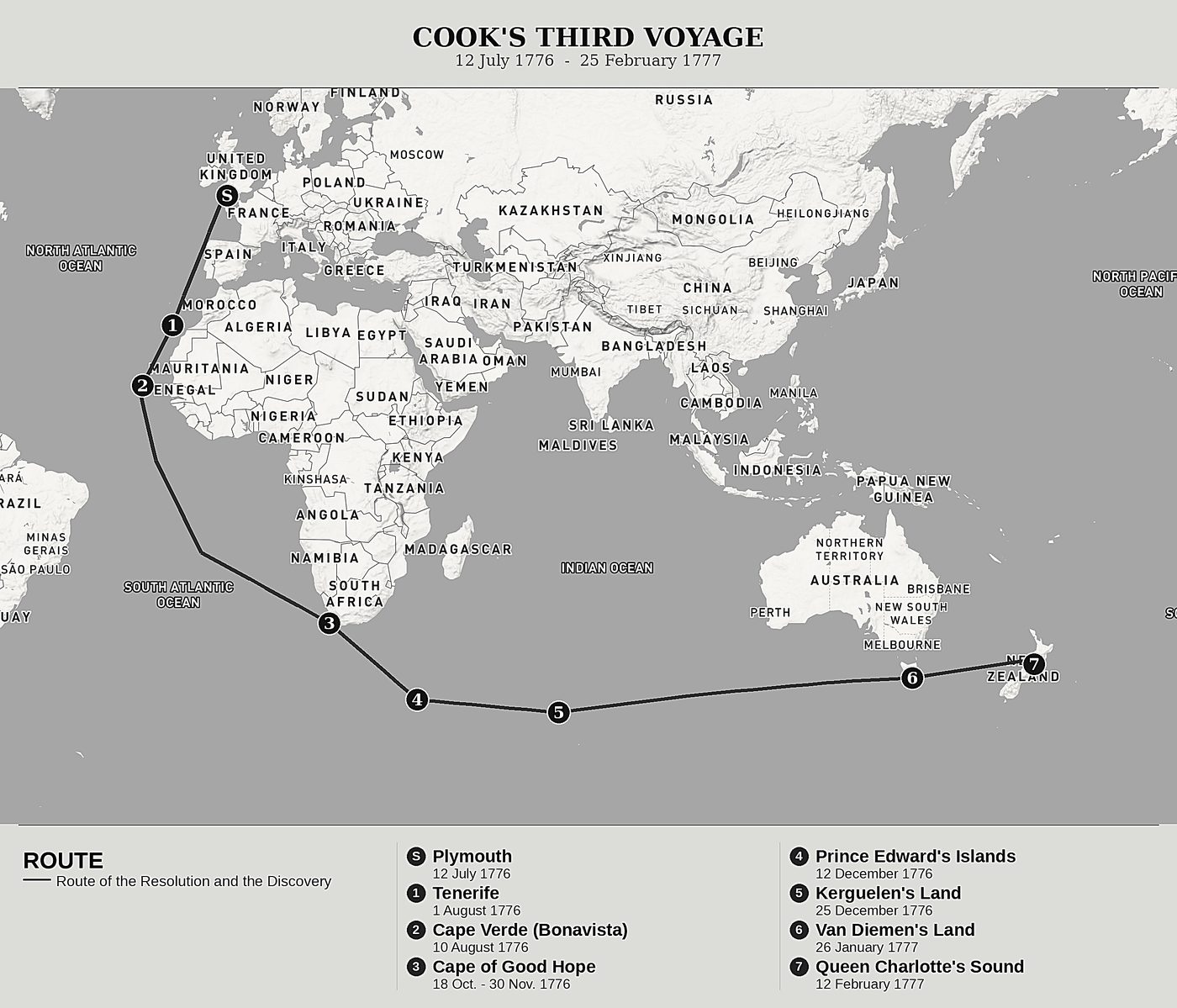
The journey mapped
The modern editor

More in this series
See all →