 Oceania & Pacific · Modernised and illustrated edition
Cook's Last Voyage, Volume III: Tahiti, the Society Islands, and the Discovery of Hawaii
Modernized, illustrated English edition of A Voyage to the Pacific Ocean by James Cook (1776-1780). 362 pages.
August 1777: Cook returns to Tahiti, attends the sacrifice at Attahooroo, settles Omai at Huahine, then discovers the Sandwich Islands. Volume III of the last voyage, rewritten in modern English.
Read more ↓- 362 pages
- Paperback · Ebook (EPUB)
- English
- 18th century
About this book
August 1777. The Resolution and the Discovery anchor at last off Tahiti. James Cook brings back Omai, the Raiatean whom London had claimed for two years, laden with suits of armor, globes, and fireworks. No one on the beach pays him any attention. Then someone catches sight of his red feathers, and everything changes.
Six weeks follow, among the densest of the whole voyage. Cook attends, over two days, the sacrifice of a man on the great morai of Attahooroo, and counts forty-nine skulls at the foot of the altar. He reviews some sixty war canoes drawn up in Matavai Bay. He watches a people astonished before the first horses ever to set foot on their land. Then, at Moorea, he has houses and canoes burned over two stolen goats, and weighs for himself the price of his own harshness.
There follow the settling of Omai in his house at Huahine and the tearful farewell of the Tahitian traveler, the desertions at Raiatea where Cook holds Chief Oreo's children hostage, and the bargain at Bora Bora, where he buys back from old Opoony the anchor Bougainville had lost ten years before. Between anchorages, the surgeon William Anderson composes his long portrait of Tahiti: seasons and gardens, language and remedies, kava, arioi, atua, and kingship, one of the most complete documents the eighteenth century left on Tahitian society.
Then comes the course north, and the unknown. On Christmas Eve 1777, a deserted atoll rises out of the ocean: turtles are caught there, a solar eclipse observed, two lost sailors nearly die of thirst. Three weeks later, on the 18th of January 1778, two lands rise on the horizon and men come aboard speaking the language of Tahiti, sixteen hundred leagues away. Cook names them the Sandwich Islands. He does not yet know he will die there. The volume ends with the long run up to the coast of New Albion and the anchorage in Nootka Sound, in March 1778.
Isabelle Perol here rewrites in today's English Book III of A Voyage to the Pacific Ocean (London, 1784), Cook's own journal and the essay of his naturalist William Anderson. The text is stripped of its period heaviness, but faithful to fact, to measurement, and to the seamen's own eye: no summarizing, no abridging, no commentary slipped into the narrative.
This edition adds an introduction, a set of reference matter (glossary, chronology, index, editor's note, afterword), selected passages from the original text, route maps, and original illustrations that let the reader see the course followed. Third of the six volumes devoted to James Cook's third and last voyage, in the Forgotten Travel Journals collection. Each volume can be read on its own.
Product details
- Publisher
- Itinerarium Éditions
- Series
- Oceania & Pacific
- The author
- James Cook
- Date of the journey
- 1777-1778
- Modern edition by
- Isabelle Perol
- Language
- English
- Format
- Paperback, 6 × 9 in (15.2 × 22.9 cm)
- Pages
- 362
- ISBN
- 978-2-489331-44-8
- Published
- August 2026
The author
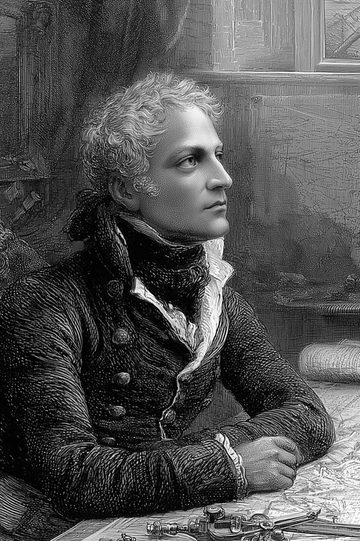
James Cook
An officer of the British Royal Navy, James Cook (1728-1779) commanded the Resolution on his third and last voyage around the world, from 1776 to 1779. The son of a Yorkshire farm laborer who became the finest navigator of his age through his work as a cartographer during the Seven Years' War, he received from the Admiralty a twofold mission: to bring the Tahitian Omai home, then to seek, north of America, the passage that would link the two oceans. This third volume shows him at Tahiti and in the Society Islands, before he discovers the archipelago he names the Sandwich Islands, today Hawaii, where he will meet his death in February 1779. His journal, kept day by day, remains a major source on eighteenth-century Polynesia.
All books by James Cook →A Voyage to the Pacific Ocean: Our editorial work
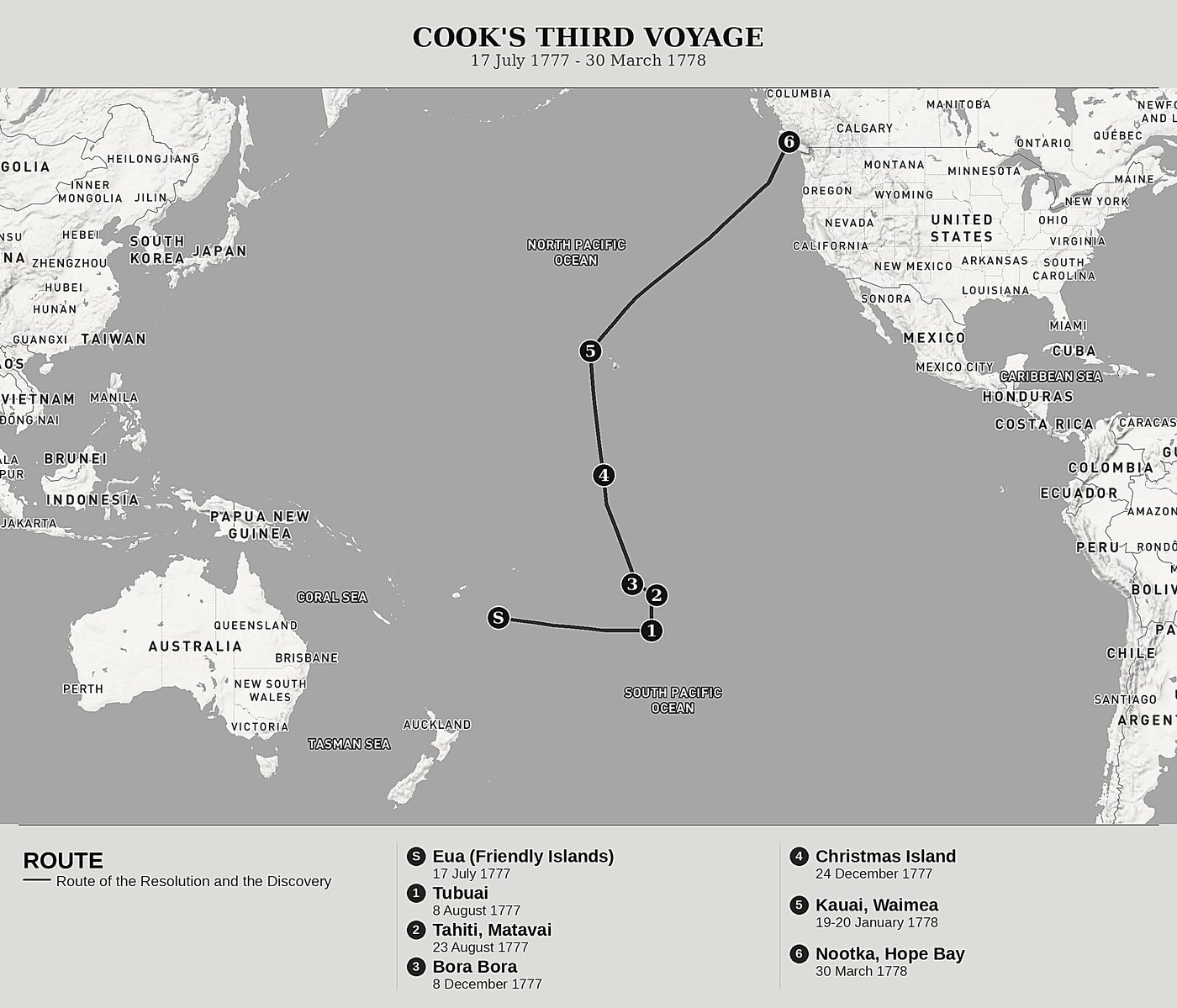
This third volume contains Book III of the official account: eight and a half months of sailing, from the last farewell to the Friendly Islands, on the 17th of July, 1777, to the anchorage in Nootka Sound, on the American coast, on the 30th of March, 1778. Between these two dates come the return to Tahiti, the settling of Omai at Huahine, and the discovery of Hawaii, which Cook named the Sandwich Islands. The material fills the second volume of the Voyage to the Pacific Ocean printed in London in 1784, the one Canon Douglas had put in order from the ship's journals; the rules set out at the opening of the series still hold, and we return to them here only to say what this volume required that was particular to it.
The chapters had first to be counted. The 1784 volume prints two of them under a mistaken number: page 190 repeats CHAP. X where the eleventh should come, page 221 gives CHAP. XI for the twelfth, and the errata bound with the volume itself flags this compositor's slip. We have followed it, along with the table of contents: Book III has thirteen chapters, neither twelve nor fourteen.
These thirteen chapters have become sixteen. Three of them, overlong, each carried two matters the text separates of its own accord: the essay on Tahiti now forms two chapters, the account of Kauai splits off from that of Niihau, the portrait of the Sandwich Islands divides between the land and the people. The split was made at these visible seams, with nothing merged and nothing moved: the order of the journal has stayed intact. What has disappeared, on the other hand, are the summaries that preceded each chapter before it was read, and the notes Douglas set at the foot of the page; what they contributed of substance has moved to the reference matter at the back of the volume.
Before / after
The longitude of the three several places is deduced from the mean of 145 sets of observations made on shore; some at one place, and some at another; and carried on to each of the stations, by the time-keeper. Without pretending to say which of the two computations is the nearest the truth, the longitude of 210° 22' 28", or, which is the same thing, 208° 25' 22", will be the longitude we shall reckon from with the time-keeper, allowing it to be losing, on mean time, 1",69 each day, as found by the mean of all the observations made at these islands, for that purpose.
Without presuming to decide which of the two reckonings comes closer to the truth, we shall take as our reference the longitude of 210 degrees, 22 minutes, 28 seconds. That is, which comes to the same thing, 208 degrees, 25 minutes, 22 seconds by the timekeeper. This loses 1.69 seconds a day in mean time, that is, by the equal hours of clocks and not by the sun's own time. This rate of loss is the mean of every observation made at these islands for that purpose.
The journey mapped
The modern editor

More in this series
See all →