 Oceania & Pacific · Modernised and illustrated edition
Cook Towards the South Pole, Volume I: The Antarctic Circle, New Zealand and Tahiti
Modernized, illustrated English edition of A Voyage Towards the South Pole and Round the World by James Cook (1772-1775). 316 pages.
July 1772: Cook sets sail to settle the question of the southern continent. The first to cross the Antarctic Circle, he discovers Dusky Bay and Tahiti. A period account rewritten in modern English, with maps and illustrations.
Read more ↓- 316 pages
- Paperback · Kindle
- English
- 18th century
About this book
July 1772, Plymouth. Two converted coal ships set sail to prove that a continent does not exist. Learned Europe has drawn it for two centuries at the bottom of its maps: vast, populated, fertile. James Cook, a laborer's son who became the finest navigator in the kingdom, receives orders to sail as close to the pole as the ice will allow, until the question falls silent.
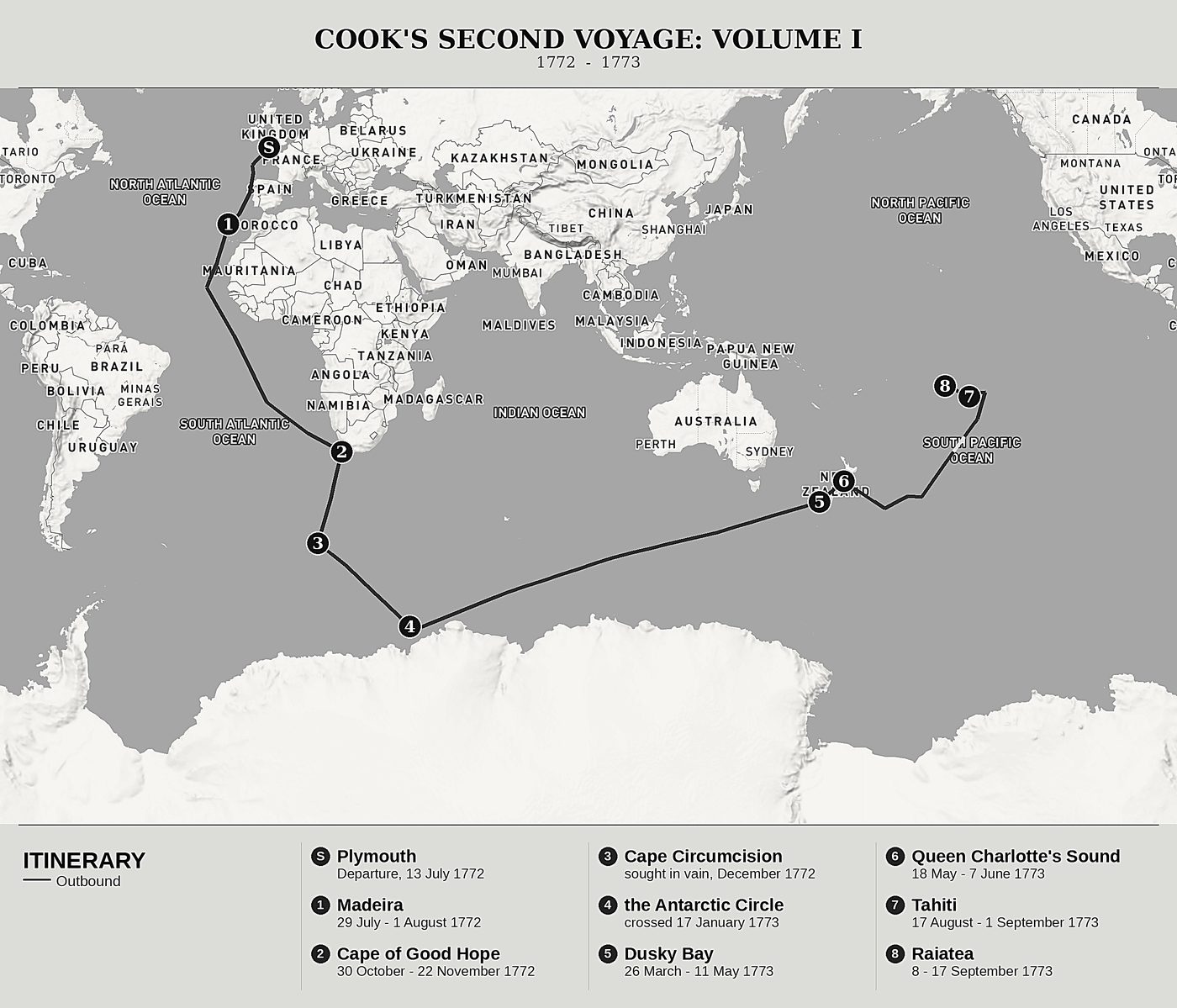
The Resolution and the Adventure round the Cape of Good Hope, then plunge into a white world no ship had ever entered. On January 17, 1773, they cross the Antarctic Circle, a first in the history of navigation. That same evening, the field ice closes the horizon from east to west. Cook turns north, loses his companion ship in a storm, and reaches New Zealand alone after one hundred and seventeen days at sea without sighting land, without a single man lost to scurvy.
Then comes the opposite of cold: Dusky Bay and its waterfalls, Queen Charlotte's Sound and its severed head, then Tahiti, the reef narrowly cleared, King Otoo, the festivities of Huahine and Raiatea, two young islanders who come aboard for a world they cannot imagine. And, at the very end of this first volume, news that chills the captain more surely than the ice ever could: a ship has passed this way before him, and no one knows under what flag.
This second voyage of Cook's is commissioned by the Admiralty and the Royal Society to settle, once and for all, the question of the great southern continent that geographers have placed at the bottom of their maps since antiquity. On board, the astronomer William Wales keeps watch over Kendall's chronometer, while the naturalists Johann Reinhold Forster and his son George Forster describe unknown plants, shores, and peoples. By crossing the Antarctic Circle, Cook sails farther south than any ship before him, and in the same stroke demolishes two thousand years of learned speculation about a populated and fertile Terra Australis.
The other victory of this volume is a quiet one: across a full crew, not a single man dies of scurvy, the disease that had until then decimated great voyages. Sauerkraut, malt wort, and strict discipline in the shipboard diet prove their worth here, a turning point for the British navy. The first volume of the trilogy devoted to Cook's second voyage (1772-1775), part of the Forgotten Travel Journals collection, Oceania & Pacific series, this volume follows the outward journey, from Plymouth to the Society Islands; the following volumes will carry the crossing of the South Pacific through to the return to England.
This is the first complete modern rewriting for today's reader, one that makes this account readable without betraying anything of the voyage. Twenty original illustrations and ten redrawn maps bring the itinerary to life, while a set of reference materials (glossary, timeline, index, further reading, editor's note, afterword) and selected passages from the original text accompany the reading.
Product details
- Publisher
- Itinerarium Éditions
- Series
- Oceania & Pacific
- The author
- James Cook
- Date of the journey
- 1772-1775
- Modern edition by
- Isabelle Perol
- Language
- English
- Format
- Paperback, 6 × 9 in (15.2 × 22.9 cm)
- Pages
- 316
- ISBN
- 978-2-489330-53-3
- Published
- July 2026
The author
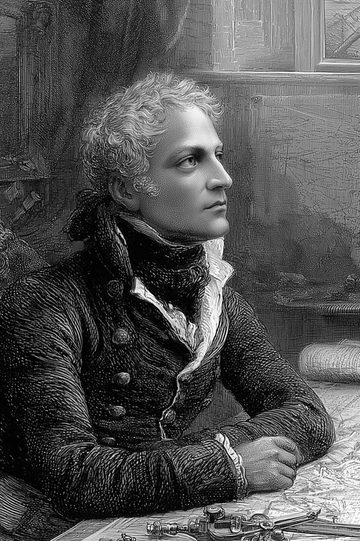
James Cook
An officer in the British Royal Navy, James Cook (1728-1779) commanded the Resolution during his second great voyage around the world, from 1772 to 1775. The son of a Yorkshire laborer who became the finest navigator of his time through his work as a cartographer during the Seven Years' War, he was given the task by the Admiralty and the Royal Society of settling, once and for all, the question of the southern continent. On January 17, 1773, he became the first navigator to cross the Antarctic Circle, demolishing two thousand years of learned speculation about a populated and fertile southern land. His personal account, written day by day, precedes a third voyage that would make him the greatest explorer of his century.
All books by James Cook →A Voyage Towards the South Pole and Round the World: Our editorial work
This volume gives the first third of the account James Cook wrote himself of his second voyage: Book I, from the departure down the Thames to the departure from the Society Islands. The source text is A Voyage Towards the South Pole and Round the World, performed in His Majesty's Ships the Resolution and Adventure, in the Years 1772-1775, published in London in 1777 by W. Strahan and T. Cadell, in two volumes. It is the first edition, the one Cook saw and corrected, and it is the only one we have worked from.
Cook arranged his Book I into fourteen chapters numbered in Roman numerals, each preceded by an argument that gives away in a single sentence everything that follows. This architecture belongs to the printed book of the eighteenth century: it assumes a reader who consults rather than reads, and who wants to know in advance where the narrative is taking him. We have kept the number and the boundaries of these chapters, with one exception: chapters V and VI, the nautical description of Dusky Bay and then the crossing to Queen Charlotte's Sound, form here a single chapter, the fifth, because the first is too short to stand alone and the second follows directly from it. Fourteen original chapters thus become thirteen modern chapters. No material has been moved from one chapter to another, and no episode has changed its place in time: the order of the logbook is the order of the book.
Before / after
and on the 17th, between eleven and twelve o'clock, we crossed the Antarctic Circle in the longitude of 39 deg. 35' E., for at noon we were by observation in the latitude of 66 deg. 36' 30" S. The weather was now become tolerably clear, so that we could see several leagues round us; and yet we had only seen one island of ice since the morning. But about four p.m. as we were steering to the south, we observed the whole sea in a manner covered with ice, from the direction of S.E., round by the S. to W.
The wind remaining fixed, without change, at east and east-southeast, I went on steering south. On the 17th, between eleven and noon, we crossed the Antarctic Circle in longitude 39°35′ east: at noon, indeed, we were, by observation, in latitude 66°36′30″ south. The weather had turned fine enough for the view to carry several leagues around us, and since morning we had seen but a single ice island. The sea was ours.
The journey mapped
The modern editor

More in this series
See all →