 Oceania & Pacific · Modernised and illustrated edition
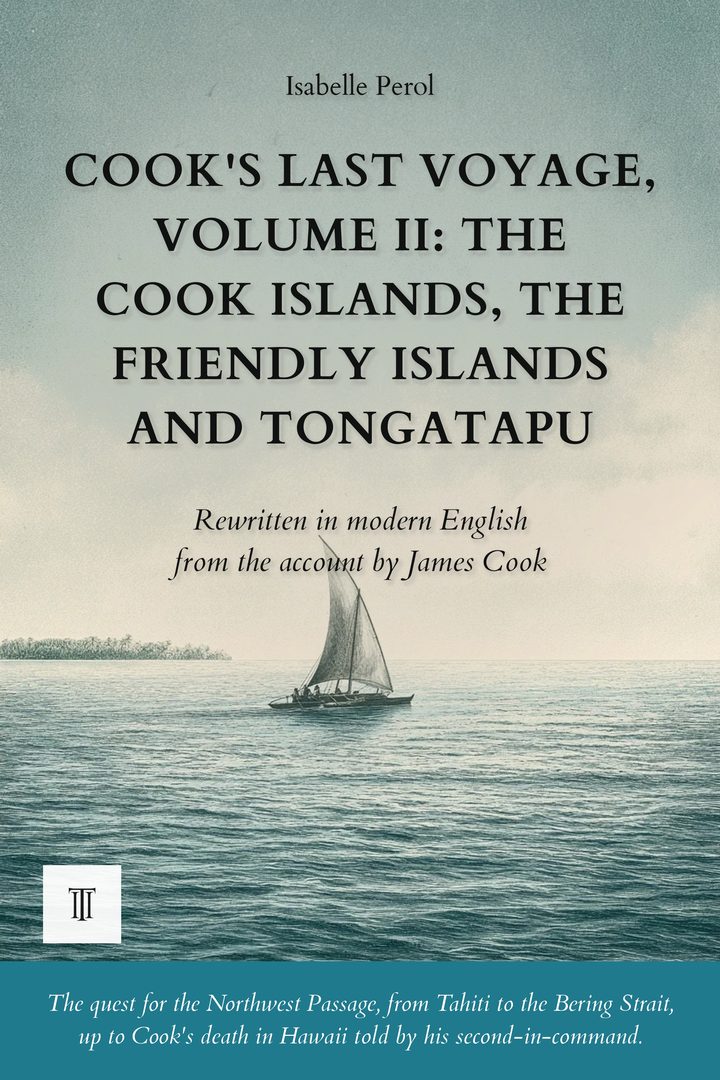
Cook's Last Voyage, Volume II: The Cook Islands, the Friendly Islands and Tongatapu
Modernized, illustrated English edition of A Voyage to the Pacific Ocean by James Cook (1776-1780). 306 pages.
February 1777: deprived of his Arctic season, Cook sets a course for the Friendly Islands. Two and a half months in a lavish and impenetrable Polynesia, amid colossal feasts and kings who are not kings at all.
Read more ↓- 306 pages
- Paperback · Ebook (EPUB)
- English
- 18th century
About this book
February 1777. The Resolution and the Discovery leave New Zealand, bound north. James Cook, at the height of his fame, must reach the Arctic before summer to force the Northwest Passage that Europe has been hunting for two centuries. But easterly winds set relentlessly against him, the season melts away amid endless tacking, and the captain realizes he has already lost his year. He sets a course for the Friendly Islands, determined to build up his strength there before attempting the far north the following summer.
Along the way come the first unknown lands: Mangaia and Atiu, where a handful of men very nearly remain prisoners of a crowd's curiosity, then the coral lagoon of Palmerston. There begins one of the strangest stays in the whole history of the great voyages of discovery. For two and a half months, the English are the guests of a sumptuous and closed Polynesia.
At Lifuka, a chief named Feenou lays out mountains of yams and pigs, club fights, women boxers as skilled as the men, and a dance of a hundred and five warriors that leaves the crew speechless. He is taken for the king. He is not. Then come Tongatapu and the true sovereign, the huge and placid Poulaho, the kava ceremony governed by secret laws, the empire of taboo, and the forbidden rite of the Natche, where the heir to the throne is recognized. Cook slips in bare-chested among the officiants, understanding nothing of the oath he watches being sworn.
Between reefs skimmed by night, endless petty thefts, and a kingship whose rules he never manages to grasp, the captain ends by taking the king and his chiefs hostage to recover what has been stolen from him. This second volume is the account of a man who still believes he observes everything, and whom the Pacific observes in turn: an encounter in which the Europe of the Enlightenment collides with a world order that entirely escapes it.
Isabelle Perol here rewrites in today's English Book II of A Voyage to the Pacific Ocean (London, 1784), the very journal of Cook and his naturalist William Anderson. The text is stripped of its period heaviness but remains faithful to the facts, the measured tone, and the outlook of the sailors themselves. The edition adds an introduction, a complete critical apparatus (glossary, timeline, index, editor's note, afterword), route maps, and original engraved illustrations.
The second of six volumes devoted to James Cook's third and final voyage, in the Forgotten Travel Journals collection. Each volume can be read on its own.
Product details
- Publisher
- Itinerarium Éditions
- Series
- Oceania & Pacific
- The author
- James Cook
- Date of the journey
- 1777
- Modern edition by
- Isabelle Perol
- Language
- English
- Format
- Paperback, 6 × 9 in (15.2 × 22.9 cm)
- Pages
- 306
- ISBN
- 978-2-489331-32-5
- Published
- August 2026
The author
James Cook
A sailor at heart and passionate about ancient civilisations, Isabelle Perol has roamed the coasts of South America, West Africa, the South Pacific and the Indian Ocean. Trained in maritime anthropology, she is drawn to accounts in which the sea is not a mere backdrop but a character in its own right. She brings to the project a sensitivity for oceanic cultures and forgotten voyages. She works on the Wild Americas, Oceania & Pacific, Uncharted Africa and East Indies collections.
All books by James Cook →A Voyage to the Pacific Ocean: Our editorial work
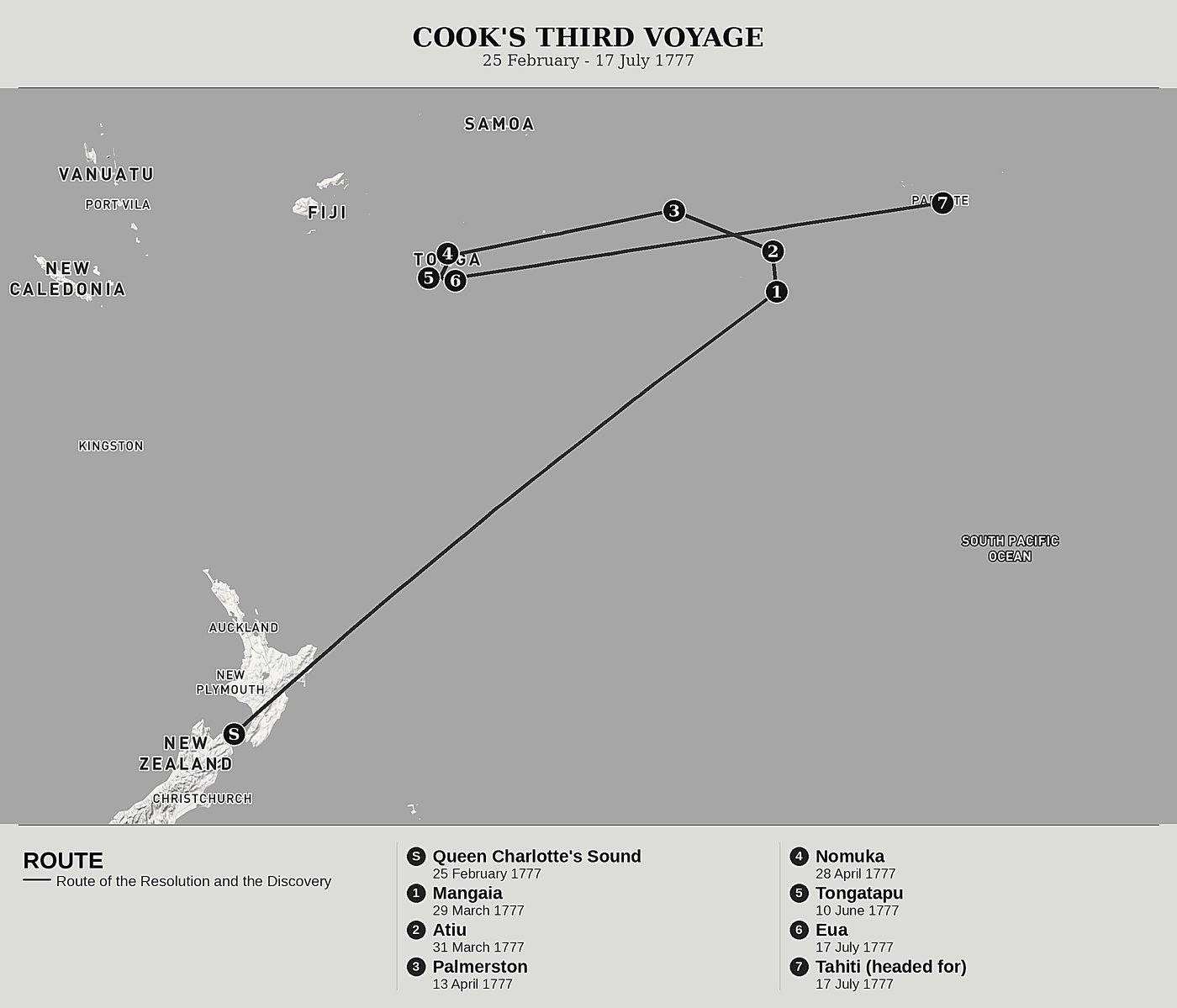
This second volume gives Book II of the official account of the third voyage: five months of sea and landfalls, from the departure out of New Zealand, on 25 February 1777, to the farewell at Eua, on 17 July of the same year. The source text remains that of the previous volume, the original edition published in London in 1784 under the title A Voyage to the Pacific Ocean, which Canon John Douglas established from the captain's journals. The principles set out at the opening of the series have not changed: the order of the journal commands, the ship's measures remain fathoms and leagues, and every wavering spelling of the source has been fixed once and for all.
The 1784 edition divides this material into eleven chapters, of which the last two no longer narrate: in them Cook draws up an account of the archipelago, its map, its arts, its religion, its government. We have redistributed the whole into fourteen chapters of comparable proportions, splitting the composite chapters wherever the journal changes place or subject: the settling in at Tongatapu is separated from Mareewagee's festivities, the weeks at Mu'a from the Natche, the arts of daily life from the empire of taboo. No episode has changed place: each modern chapter follows a continuous slice of the original text, headed by a short title that names a moment or a figure without giving away its outcome.
Before / after
We had no sooner lost sight of the land than our two New Zealand adventurers, the sea sickness they now experienced giving a turn to their reflections, repented heartily of the step they had taken. All the soothing encouragement we could think of, availed but little. They wept, both in public and in private; and made their lamentations in a kind of song, which, as far as we could comprehend the meaning of the words, was expressive of their praises of their country and people, from which they were to be separated for ever.
Our two young New Zealanders, the boys we were bringing with us, had barely seen the land vanish below the horizon when seasickness took hold of them, and their thoughts turned with it. They repented bitterly of having followed us. Though we did all we could to surround them and offer every word of comfort, nothing served. They wept, before us and apart, and rolled their sorrow into a kind of song. As far as we could make out its meaning, this song celebrated their homeland and their people, from whom they believed themselves parted forever.
The journey mapped
The modern editor

More in this series
See all →