 Oceania & Pacific · Modernised and illustrated edition
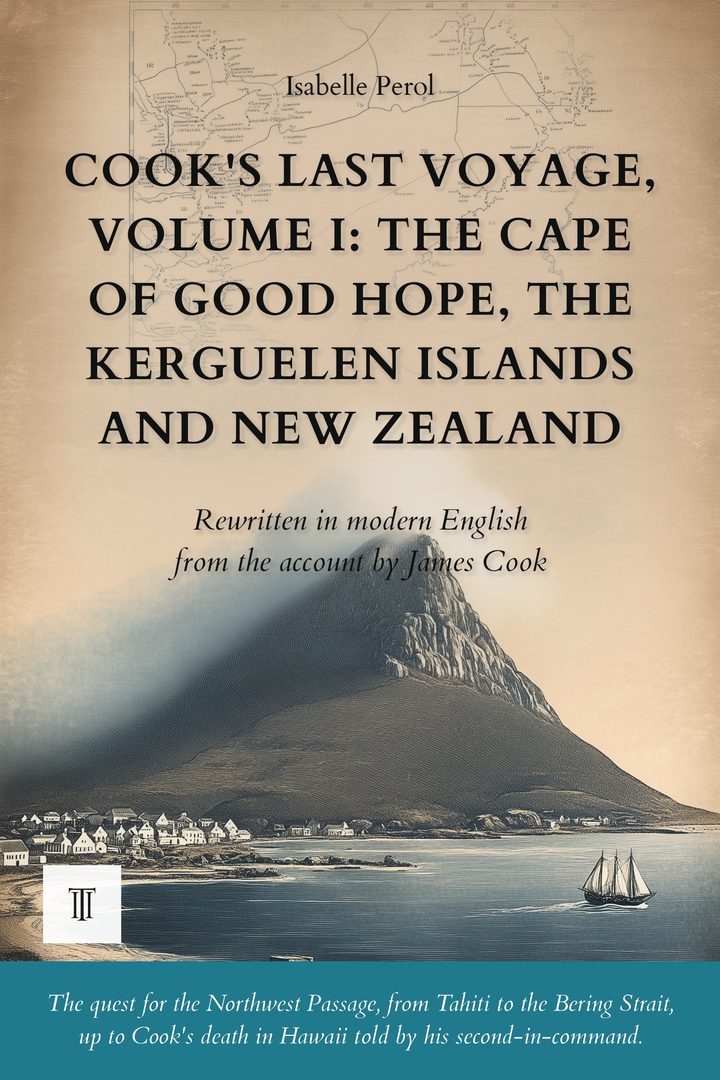
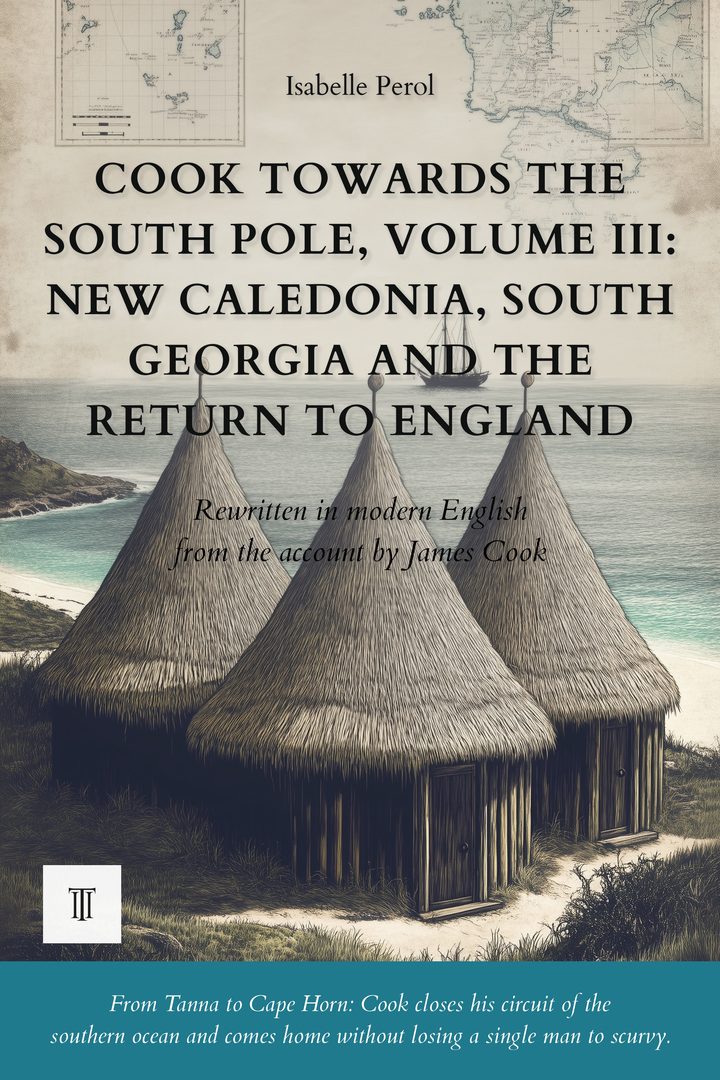
Cook Towards the South Pole, Volume III: New Caledonia, South Georgia and the Return to England
Modernized, illustrated English edition of A Voyage Towards the South Pole and Round the World by James Cook (1772-1775). 382 pages.
Cook discovers New Caledonia, rounds Cape Horn amid the southern ice, closes the question of the southern continent, and returns without losing a single man to scurvy. Rewritten in modern English.
Read more ↓- 382 pages
- Paperback · Kindle
- English
- 18th century
About this book
August 1774. The Resolution anchors beneath a volcano that glows red in the night: at Tanna, in the New Hebrides, thousands of armed men watch for the stranger who has come from the sea.
From there, Cook sails south and discovers a great unknown land, New Caledonia, whose treacherous reefs he charts before judging its people the most honest of any he has met in this sea. The ship then surveys Norfolk Isle, deserted and covered in pines, before making a final call at New Zealand, where a terrible rumor is circulating: an English crew is said to have been killed and eaten. Not knowing what has become of his second ship, the Adventure, Cook sets off south again without certainty.
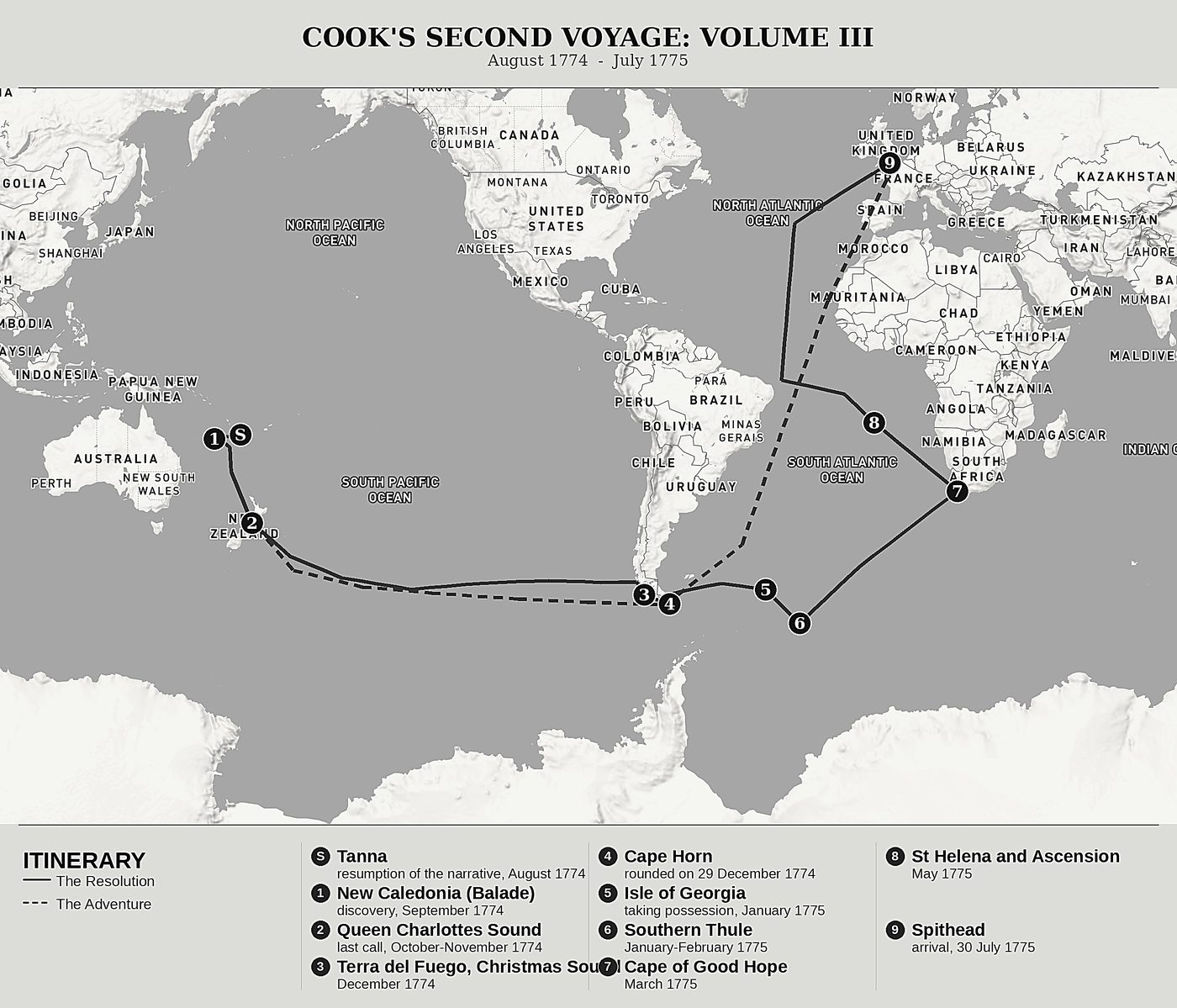
So begins the final dash through the ice. Terra del Fuego, Cape Horn rounded at the height of the southern summer, the discovery of the Isle of Georgia without a single tree or river, then that of Southern Thule lost in the fog: Cook closes the circuit of the southern ocean he had begun two years earlier and settles the question that had haunted Europe for two centuries. The great southern continent does not exist, or at least is nowhere accessible to any ship that might reach it.
All that remained was to come home. The call at the Cape of Good Hope finally reveals to Cook the fate of ten men of the Adventure, killed in New Zealand, and the voyage then closes with Saint Helena, Ascension Island, and the Azores. Three years and eighteen days after setting out, the Resolution anchors at Spithead without having lost a single man to scurvy, a feat that will earn Cook the Copley Medal of the Royal Society. This volume also gives voice to Captain Furneaux, who recounts the separation of the two ships and the massacre of the Adventure's boat at Grass Cove, as reported by Lieutenant Burney.
The third and final volume of the trilogy devoted to Cook's second voyage (1772-1775), part of the Forgotten Travel Journals collection, Oceania & Pacific series, this volume closes the journey opened by the two previous volumes, from the New Hebrides to the return to England by way of the southern ice.
The first complete modern rewriting for today's reader, making this account accessible without betraying anything of the voyage. Twenty original illustrations and ten redrawn maps bring the route to life, while a set of reference materials (glossary, timeline, index, further reading, editor's note, afterword) and selected passages from the original text illuminate the reading.
Product details
- Publisher
- Itinerarium Éditions
- Series
- Oceania & Pacific
- The author
- James Cook
- Date of the journey
- 1772-1775
- Modern edition by
- Isabelle Perol
- Language
- English
- Format
- Paperback, 6 × 9 in (15.2 × 22.9 cm)
- Pages
- 382
- ISBN
- 978-2-489331-11-0
- Published
- August 2026
The author
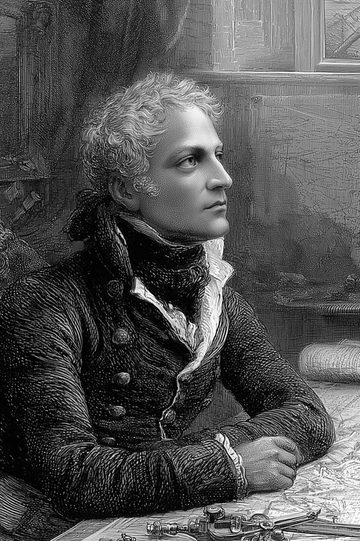
James Cook
A Royal Navy officer, James Cook (1728-1779) commanded the Resolution on his second great voyage around the world, from 1772 to 1775. The son of a Yorkshire day laborer who became the finest navigator of his age through his work as a cartographer during the Seven Years' War, he received from the Admiralty and the Royal Society the task of settling, once and for all, the question of the southern continent. This third and final volume follows him as he completes his circuit of the southern ocean, concludes that no habitable southern land exists, and returns home without having lost a single man to scurvy, a feat honored with the Copley Medal of the Royal Society. He set out again three years later on a third voyage, which would prove fatal to him.
All books by James Cook →A Voyage Towards the South Pole and Round the World: Our editorial work
This volume is the third and final one in a series that follows, volume by volume, James Cook's second voyage around the world. It covers the end of Book III and the whole of Book IV of the original account, the last act of the expedition: the call under the volcano at Tanna, the discovery of New Caledonia and its reefs, the final stop in New Zealand where rumor spread of a massacred crew, then the dash through the southern ice, Cape Horn, the Isle of Georgia and Southern Thule, up to the finding that closes a century of speculation: the great southern continent does not exist. The volume opens at the threshold of Tanna, where Volume II left the voyage suspended, and closes with the arrival at Spithead. This seam is not Cook's own: it is an editorial choice, one that preferred to break the volumes on land just glimpsed rather than cut in the middle of an archipelago.
Before / after
Thus I was obliged, as it were by necessity, for the first time, to leave a coast I had discovered, before it was fully explored. I called it New Caledonia; and, if we except New Zealand, it is perhaps the largest island in the South Pacific Ocean. It is a country full of hills and valleys, of various extent both for height and depth. To judge of the whole by the parts we were on, from these hills spring vast numbers of little rivulets, which greatly contribute to fertilize the plains, and to supply all the wants of the inhabitants.
I found myself thus compelled, almost by necessity, and for the first time since the beginning of my voyages, to abandon a coast I had discovered without having fully explored it. I had already given it its name: New Caledonia. Excepting New Zealand, it is perhaps the largest island in the whole of the South Pacific Ocean. It runs from 19°37' to 22°30' latitude south, and from 163°37' to 167°14' longitude east, lying nearly north-west by west and south-east by east; on that line, it measures some eighty-seven leagues in length. Its breadth, however, is nothing considerable, and nowhere exceeds ten leagues.
The journey mapped
The modern editor

More in this series
See all →