 Oceania & Pacific · Modernised and illustrated edition
Sumatra, by the Cape Route
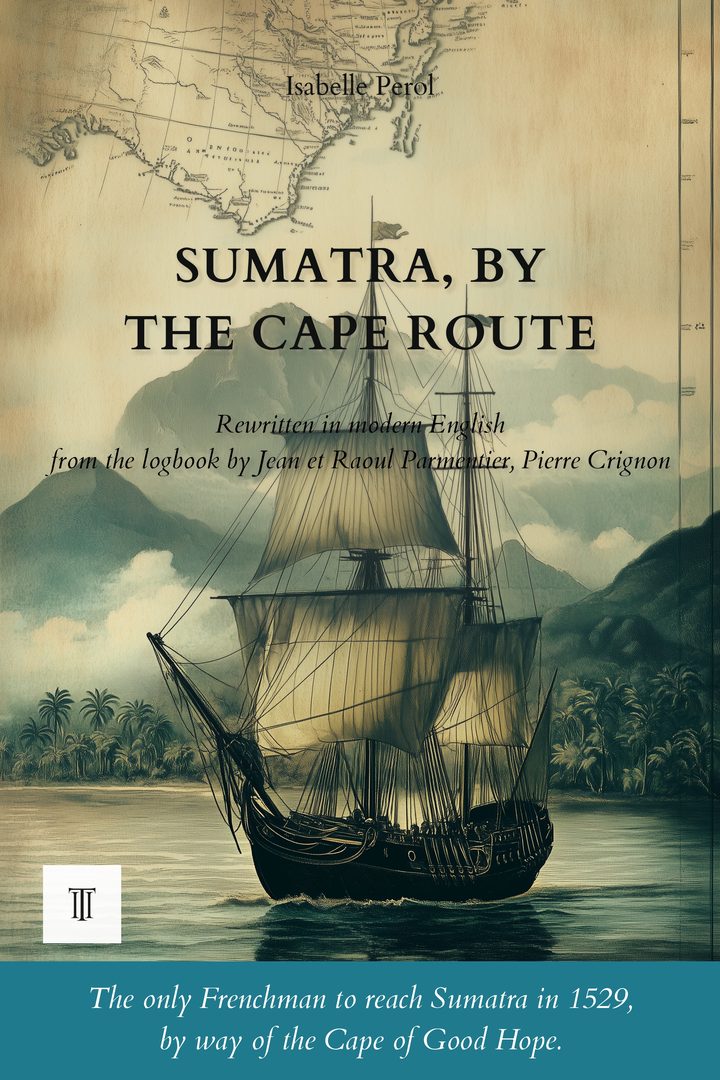
Modernized, illustrated English edition of Le Discours de la navigation by Jean et Raoul Parmentier, Pierre Crignon (1529). 168 pages.
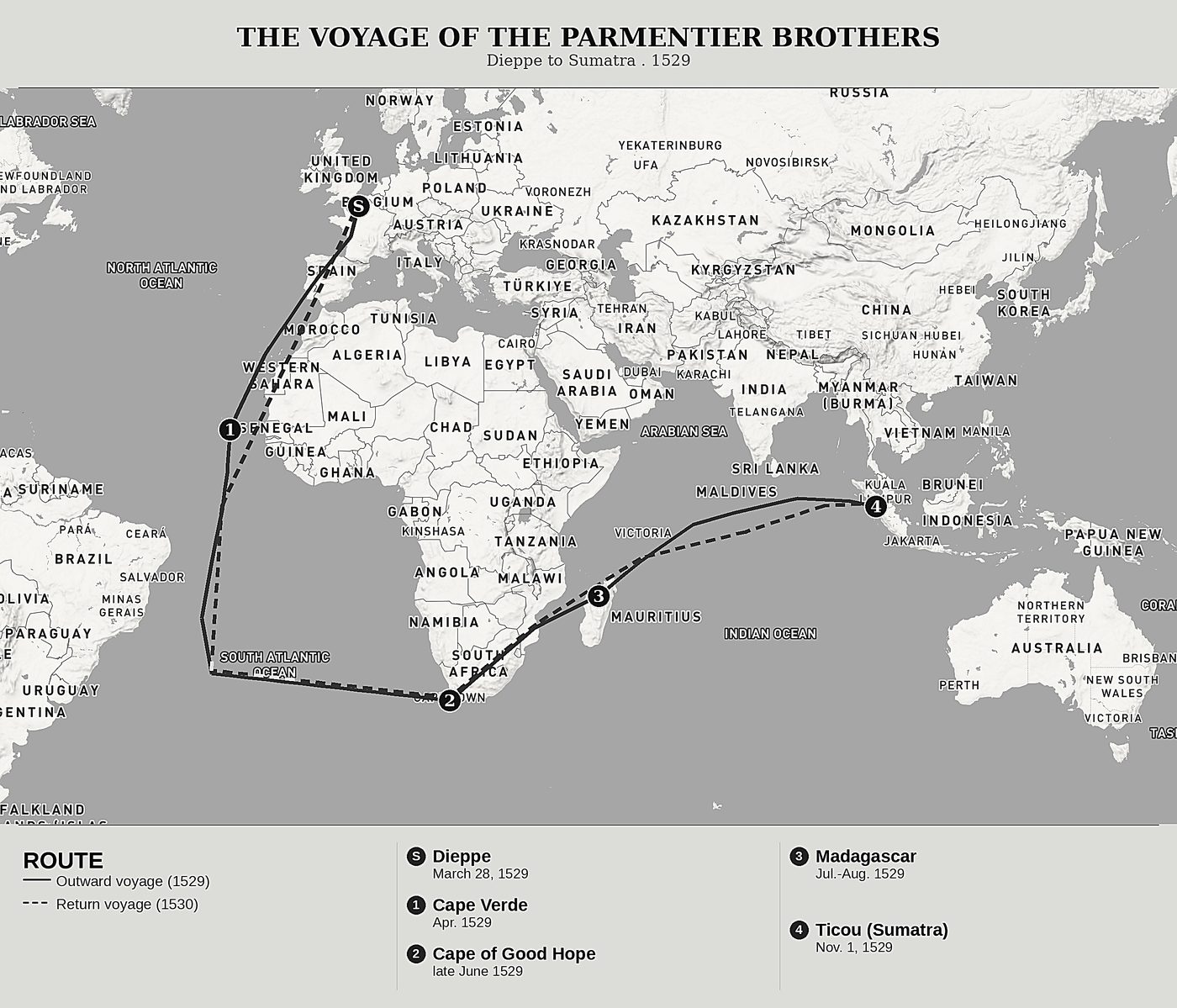
In 1529, the Parmentier brothers left Dieppe for Sumatra by way of the Cape of Good Hope, the first French voyage to the East Indies, told day by day by the pilot Pierre Crignon.
Read more ↓- 168 pages
- Paperback · Ebook (EPUB)
- English
- 16th century
About this book
Dieppe, Easter morning, 1529. Two ships, the Pensée and the Sacre, set a course south to attempt what no Frenchman had yet dared: to reach Sumatra by the Cape route, defying the monopoly that Portugal guarded with arms along the road to the Indies.
At their head sailed the brothers Jean and Raoul Parmentier, captains, poets and geographers, financed by the wealthy Dieppe merchant Jean Ango. On board, the pilot Pierre Crignon kept the log day after day. The voyage meant running the length of the Atlantic, crossing the equator through deadly calms where water and provisions ran short, rounding the Cape of Good Hope through its storms, then crossing the Indian Ocean with almost no landmark to steer by. Off the coast of Madagascar, an ambush claimed three men; elsewhere, scurvy and the fear of the unknown wore the crews down, far from any friendly shore and any hope of relief.
Then, at last, the long-sought land appeared: Ticou, on the western coast of Sumatra, where the Parmentier brothers forged with a Malay king an alliance and a trade beyond anything imagined, built around pepper, gold and fine cloth. Crignon recorded it all: the beauty of the shores, the monsoon rains, the customs of a people until then unknown to the French. But at the edge of the world, fever struck: the two brothers died within days of one another, and the crew, left without its leaders, had to decide alone on the way home. A second account carries the voyage onward to the coasts of Hispaniola and the mainland of the Spanish Caribbean.
The only French account of this first voyage, Crignon's journal is a rare voice in the literature of the great discoveries: with no empire to celebrate and no conquest to claim, it offers simply the gaze of one man set upon an immense world opening before him. In it one hears the astonishment of Norman sailors discovering, at the cost of their lives, the far side of the earth, caught between learned observation, wonder and grief before such immensity, and never once losing the plain honesty of an eyewitness.
The first complete modern rewriting for today's reader, restoring this account to full readability without betraying anything of the voyage. Twenty original illustrations and eight maps of the journey bring the route to life, while a full critical apparatus (glossary, timeline, index and afterword) and selected passages from the original text illuminate the reading and set it in its time.
Product details
- Publisher
- Itinerarium Éditions
- Series
- Oceania & Pacific
- The author
- Jean et Raoul Parmentier, Pierre Crignon
- Date of the journey
- 1529
- Modern edition by
- Isabelle Perol
- Language
- English
- Format
- Paperback, 6 × 9 in (15.2 × 22.9 cm)
- Pages
- 168
- ISBN
- 978-2-489330-93-9
- Published
- July 2026
The author
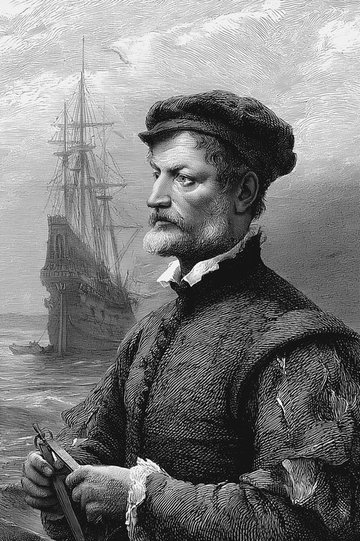
Jean et Raoul Parmentier, Pierre Crignon
Jean Parmentier (c. 1494-1529) and his brother Raoul were the first French navigators to reach Sumatra. Financed by the Dieppe shipowner Jean Ango, they set sail from Dieppe on 28 March 1529 aboard the Pensée and the Sacre, rounded the Cape of Good Hope and reached the city of Ticou on the coast of Sumatra in November. Jean, a captain, poet and geographer, died of fever on 3 December 1529 before seeing the voyage's return. The ship's log, kept by the pilot Pierre Crignon, a mathematician and likewise a poet, remains the only direct account of this first French voyage to the East Indies, first published in 1883 by Charles Schefer from the manuscript.
All books by Jean et Raoul Parmentier, Pierre Crignon →Le Discours de la navigation: Our editorial work
The text just read brings together several pieces born of a single expedition. The main one is the logbook kept day after day by Pierre Crignon aboard the Pensée, supplemented by his description of Ticou. To it is added a second volume, left unfinished, devoted to the coasts of Hispaniola and the Tierra Firme, which this edition attaches to Jean Parmentier's voyage. Our task has been to render this material readable to a reader of today without stripping it of its voice.
The first decision concerned the division into chapters. The original logbook unfolds as one long sequence of daily entries, dated one after another, with no chapters and no pause for breath. We have reorganized it into nine chapters that follow the great turning points of the voyage: the departure from Dieppe, the crossing of the equator, the ambush at Madagascar, the crossing of the Indian Ocean, the arrival and stay at Ticou, the death of the two brothers and the return, then the two Caribbean chapters of the second volume. This division moves nothing: it simply sets thresholds where the narrative itself called for them.
Crignon's language is that of the first third of the sixteenth century, still close to the Middle Ages. We have modernized the spelling, untangled the syntax, and restored the word order to the natural sense of contemporary English, sentence by sentence, to spare the reader the heaviness of archaic phrasing. Where the sailor wrote "issir," we have written "to get underway" or "to set sail"; "la hauteur" has become, depending on context, the latitude taken by the sun. This work was done by hand, weighing each sentence, cutting what repeated itself and unfolding what was too elliptical, without ever weighing down or impoverishing the whole.
Before / after
PREMIEREMENT. Nous issismes du havre de Dieppe le jour de Pasques xxviii^e jour de mars 1529, environ deux heures après midy, que notre nef la Pensée fut mise en rade honnestement, sans toucher; mais le Sacre toucha, et ne put issir de cette marée; et issit et fut mis en rade la marée ensuivant, après midy …
We sailed out of the harbor of Dieppe on Easter day, the twenty-eighth day of March in the year 1529, some two hours after noon. The tide was carrying us, and it had to be taken when God gave it to us. The Pensée slipped out of the channel without touching anything, and stood off in the roadstead as is proper, and we waited for our companion. But the Sacre, heavier or less fortunate, touched bottom on the way out and could not get underway on that tide. She had to remain there, held fast, until the next tide, when she in turn came out and joined us in the roadstead in the afternoon.
The journey mapped
The modern editor

More in this series
See all →