 Oceania & Pacific · Modernised and illustrated edition
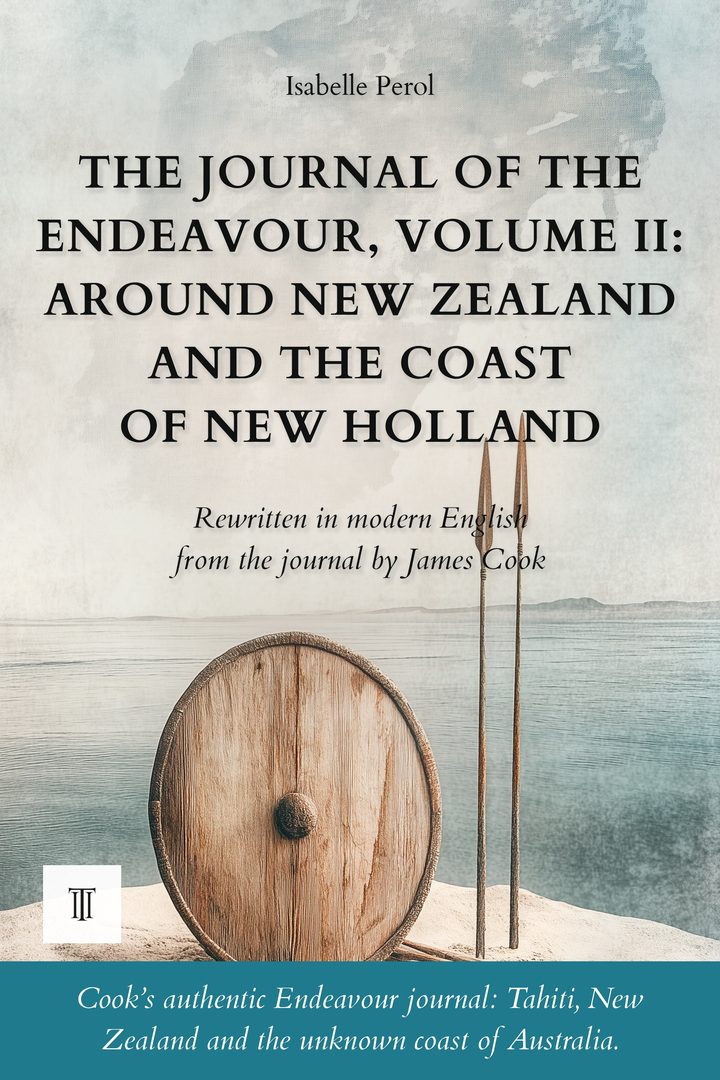
The Journal of the Endeavour, Volume II: Around New Zealand and the Coast of New Holland
Modernized, illustrated English edition of Captain Cook's Journal by James Cook (1768-1771). 236 pages.
Cook completes the circumnavigation of New Zealand, crosses the Tasman Sea and discovers the east coast of Australia, from Botany Bay to Cape Tribulation. Second volume of the authentic Endeavour journal (1769-1770).
Read more ↓- 236 pages
- Paperback · Kindle
- English
- 18th century
About this book
November 1769. Off Mercury Bay, the Endeavour resumes her course northward and completes the circuit of New Zealand begun in the first volume. Cook names a river the Thames, anchors in the Bay of Islands, rounds North Cape in a gale, then careens his ship in Queen Charlotte Sound, where he takes possession of the land in the name of the king.
What remains is to prove what Cook has suspected for weeks: a strait truly separates the two islands. With the circuit of the South Island complete, the council of officers decides at Admiralty Bay and sets a course west, toward a land still absent from every European chart. After a long crossing of the Tasman Sea, an unknown coast rises at last at Point Hicks: New Holland.
At Botany Bay, the first encounter breaks down: Aboriginal people brandish their darts before the English boats, a sailor dies and is buried beneath the sand. The Endeavour then sails north along an entire coast still unnamed by Europeans, scattering christenings on every headland, until reaching the point Cook calls Tribulation, because there, he writes, all his troubles began.
This second volume of Cook's authentic journal carries the reader, day by day, from Maori bays to Australian reefs, along the thread of a discovery where every headland rounded opens a new peril, until the moment the Endeavour enters the narrow waters of the Great Barrier Reef.
This stretch of the voyage marks a turning point: it is here, at Botany Bay and then along several hundred kilometres of coastline entirely unknown to Europeans, that Cook's expedition sets foot for the first time on the soil of what will become Australia. Cook names the bay after the unprecedented botanical harvest that naturalist Joseph Banks and Swedish botanist Daniel Solander gather there, while every headland rounded receives an English name that still appears on maps today.
The text followed here is Cook's personal journal, written day by day aboard the Endeavour, distinct from the reworked accounts that editor John Hawkesworth would publish in 1773 for the general public. Here one finds the direct voice of a meticulous sailor, more attentive to headlands, winds and men than to literary effect, which makes it a firsthand source on the very first contacts between Europeans and Aboriginal Australians.
The first complete modern rewriting for today's reader, making this account accessible without betraying anything of the voyage. Twenty original illustrations and redrawn maps bring the route to life, while a set of reference materials (glossary, chronology, index, further reading, editor's note, afterword) and selected passages from the original text accompany the reading.
Product details
- Publisher
- Itinerarium Éditions
- Series
- Oceania & Pacific
- The author
- James Cook
- Date of the journey
- 1768-1771
- Modern edition by
- Isabelle Perol
- Language
- English
- Format
- Paperback, 6 × 9 in (15.2 × 22.9 cm)
- Pages
- 236
- ISBN
- 978-2-489330-38-0
- Published
- July 2026
The author
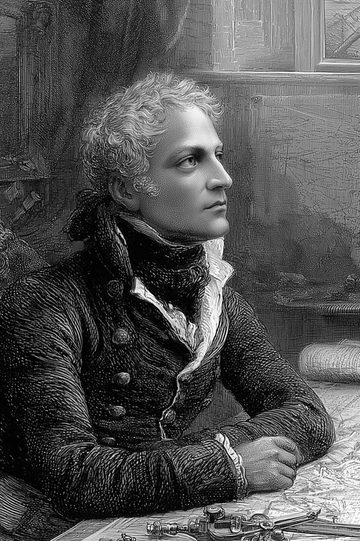
James Cook
A Royal Navy officer, James Cook (1728-1779) commanded the Endeavour on his first great voyage around the world, from 1768 to 1771. The son of a farmer who became an outstanding surveyor during the Seven Years' War, he was chosen by the Admiralty and the Royal Society to observe the transit of Venus at Tahiti and to search for the southern continent. This second volume of his journal sees him complete the circumnavigation of New Zealand, prove the existence of the strait that now bears his name, and reach the east coast of New Holland, where he was the first among European navigators to set foot at Botany Bay, before two further voyages that would make him the greatest navigator of his century.
All books by James Cook →Captain Cook’s Journal During His First Voyage Round the World: Our editorial work
There are several Cooks. There is the one the public discovered in 1773, when John Hawkesworth rewrote the journals of the great voyages into an elegant, rounded prose, lending the navigator reflections he had never set down on paper. There is Admiral Wharton's Cook, who in 1893 produced the first scholarly edition of the logbook. And there is the true Cook, the one preserved in the manuscript kept aboard, in his own hand, day after day. It is this last Cook we have chosen. The present edition follows neither Hawkesworth nor Wharton: it rests on the literal transcription of the Endeavour's autograph manuscript, established by the South Seas project of the National Library of Australia, in Canberra, from the document known as MS 1. In it one hears the sailor's bare voice, before others polished it.
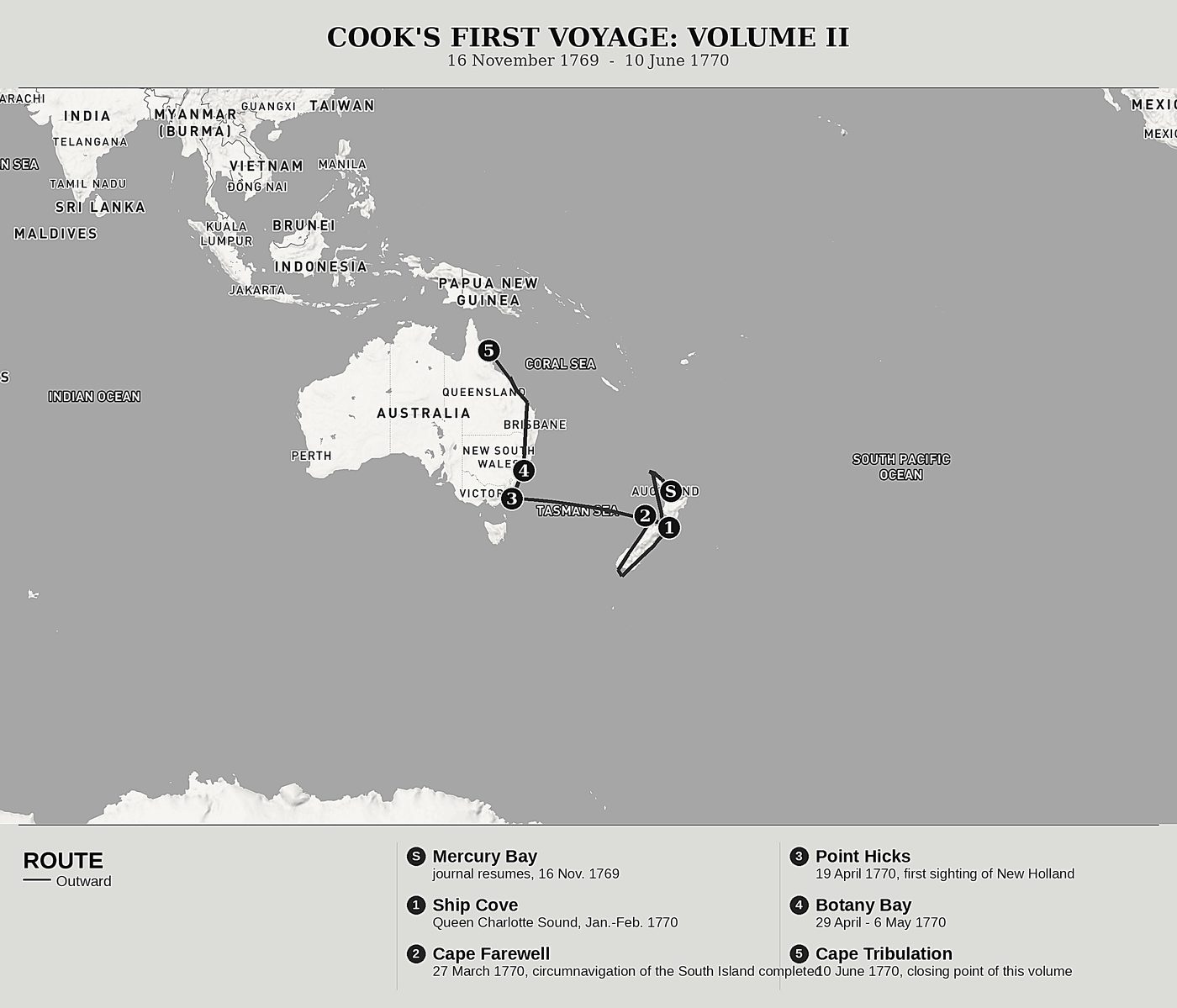
This journal could not fit into a single volume. We have divided it into three volumes, following the great stages of the voyage. The first carried the reader from departure to the transit of Mercury, at Mercury Bay. This second volume picks up the narrative at that anchorage, on 16 November 1769, and carries it to Cape Tribulation, on 10 June 1770: the completion of the circuit of New Zealand, the proof that Cook Strait indeed separates two islands, the crossing of the Tasman Sea, and then the first shores of New Holland. Since the manuscript is a logbook and not a composed narrative, each day opens its own entry, preceded by a date and the ship's position, and followed by navigation tables lining up the winds, the heading and the latitude. We have gathered these hundreds of daily entries into thirteen chapters. The log tables, the mechanical markers of date and position, and the running heads repeated from page to page belong to the ship's apparatus, not to the narrative: they have been removed. The coordinates they carried were not lost for all that, since they were used to draw the maps in this volume.
Before / after
we had not gone a hundred yards into the Woods before we found a tree that girted 19 feet 8 Inches, 6 feet above the Ground, and having a quadrant with me I found its length from the root to the first branch to be 89 feet. it was as streight as an arrow and taper'd but very little in proportion to its length. We saw many others of the same sort several of which were taller than the one we measured. at 3 oClock we embarqued in order to return on board with the very first of the Ebb but not before we had named this River the Thames on account of its bearing some resemblence to that River in england.
On Tuesday the twenty-first, no sooner had we landed than, before going a hundred yards into the woods, a tree stopped us. I had it measured: its girth came to nineteen feet eight inches, taken six feet above the ground. With my quadrant in hand I took its height, from the root to the first branch: eighty-nine feet. It rose as straight as an arrow, tapering hardly at all along that whole length.
The journey mapped
The modern editor

More in this series
See all →