 Oceania & Pacific · Modernised and illustrated edition
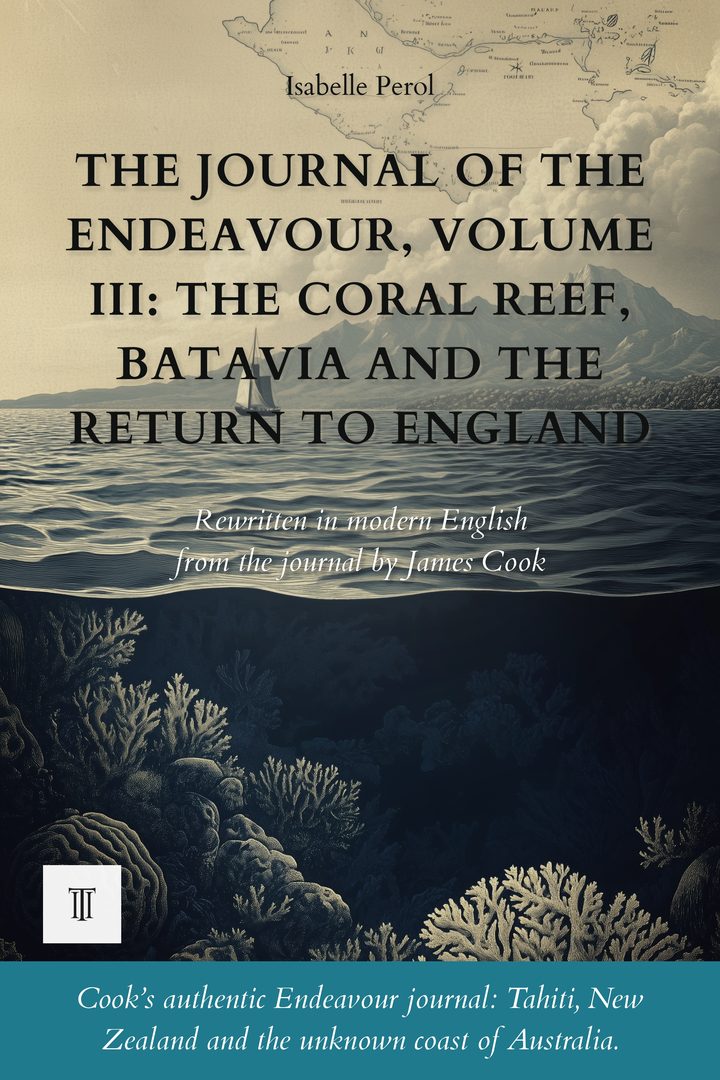
The Journal of the Endeavour, Volume III: The Coral Reef, Batavia and the Return to England
Modernized, illustrated English edition of Captain Cook's Journal by James Cook (1768-1771). 248 pages.
Cook narrowly escapes shipwreck on the Great Barrier Reef, takes possession of New South Wales, then faces the fevers of Batavia on the voyage home. Final volume of the authentic Endeavour journal, 1770-1771.
Read more ↓- 248 pages
- Paperback · Kindle
- English
- 18th century
About this book
11 June 1770. Off the coast of New Holland, in the dead of night, the Endeavour strikes a coral reef and grinds to a halt, her hull torn open, leagues from any shore. To survive, the crew casts her guns into the sea and fothers the ship with a sail to plug the breach.
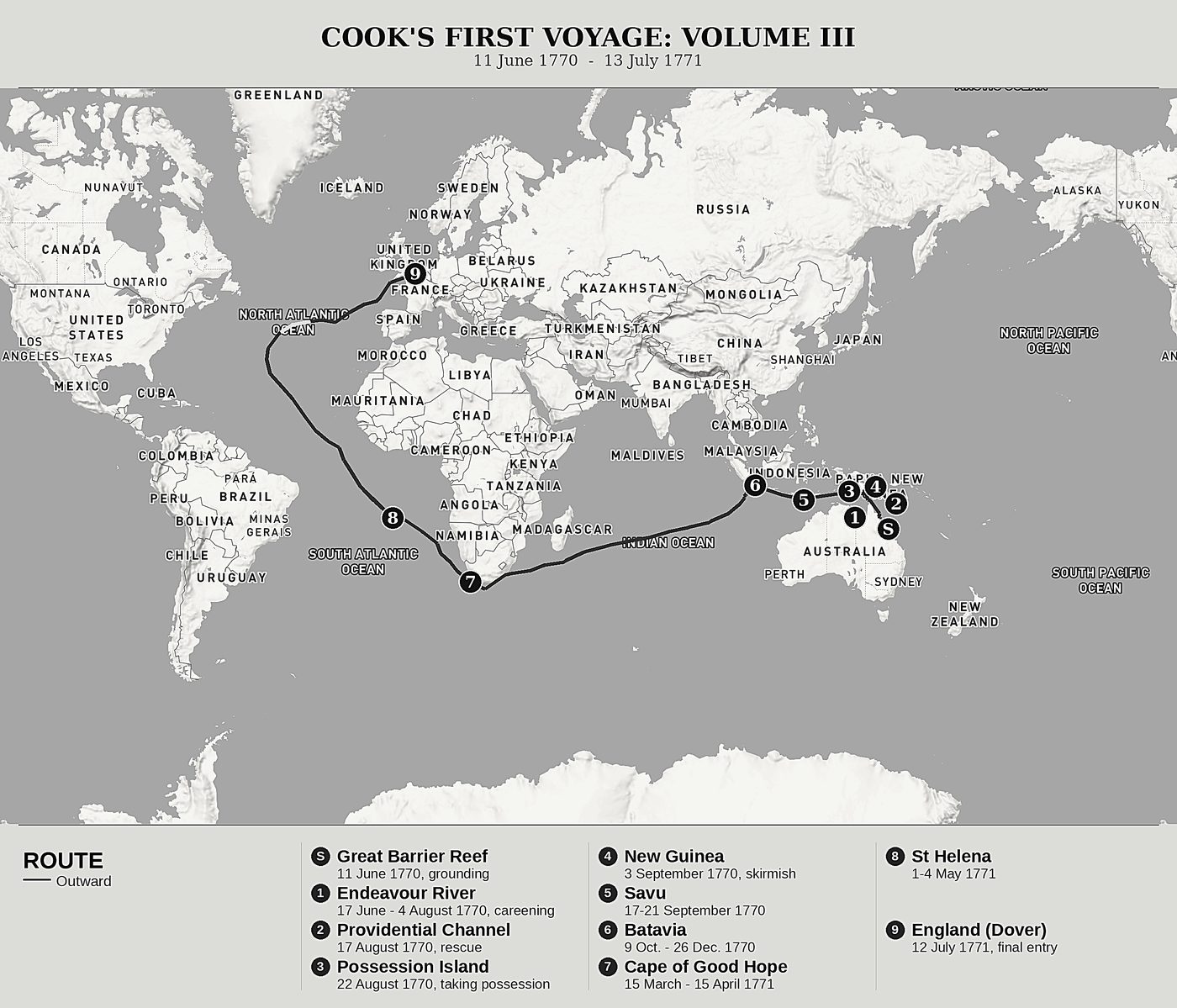
This third and final volume of Cook's authentic journal carries the reader from that night of dread to the return to England. The ship is careened for seven weeks on an unknown river, where Cook describes a leaping animal that Aboriginal people call the kangaroo. The Endeavour then threads back through the labyrinth of the Great Barrier Reef, comes within a hair of a second wreck, and escapes at last through the narrow Providential Channel. At Possession Island, Cook takes possession of the entire east coast in the name of New South Wales, then passes through the strait separating New Holland from New Guinea, proof that the two lands are indeed distinct.
Then comes the longest of the perils. After a stop at Savu, where Cook bargains for buffalo and provisions, the Endeavour reaches Batavia, a Dutch city of stagnant canals where fever and dysentery take hold aboard ship. The crossing to the Cape of Good Hope turns into a running register of deaths: the ship's surgeon, the astronomer Charles Green, the master Molineux and the faithful Tupaia fade away one after another. Cook makes it home, but he comes home in mourning, and his journal closes with the Postscript, in which he already turns his thoughts to Bougainville's ships and to the discoveries still to come.
This volume closes Cook's first great voyage on one of the major demonstrations of eighteenth-century geography: proof that New Holland and New Guinea are two lands separated by a navigable strait. The taking of possession of New South Wales at Possession Island, on 22 August 1770, also lays the foundation for the British claim to the entire east coast of Australia, the starting point of the colonisation that would follow two decades later.
The text followed here is Cook's personal journal, written day by day aboard the Endeavour, distinct from the reworked account that editor John Hawkesworth would publish in 1773 for the general public. Here the human cost of the voyage appears without embellishment: of the roughly ninety-four men who left England, more than a third would never see their country again, most of them carried off by the fevers of Batavia rather than by the sea itself, a contrast Cook notes with striking sobriety.
The first complete modern rewriting for today's reader, making this account accessible without betraying anything of the voyage. Twenty original illustrations and redrawn maps bring the route to life, while a set of reference materials (glossary, chronology, index, further reading, editor's note, afterword) and selected passages from the original text accompany the reading.
Product details
- Publisher
- Itinerarium Éditions
- Series
- Oceania & Pacific
- The author
- James Cook
- Date of the journey
- 1770-1771
- Modern edition by
- Isabelle Perol
- Language
- English
- Format
- Paperback, 6 × 9 in (15.2 × 22.9 cm)
- Pages
- 248
- ISBN
- 978-2-489330-49-6
- Published
- July 2026
The author
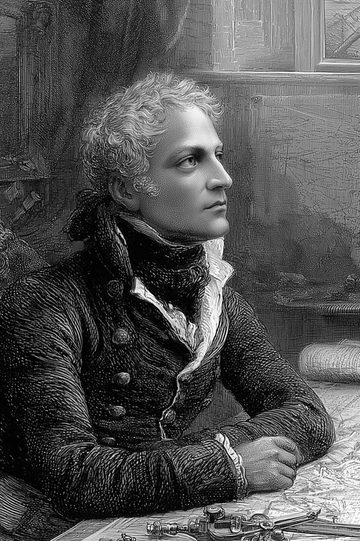
James Cook
A Royal Navy officer, James Cook (1728-1779) commanded the Endeavour on his first great voyage around the world, from 1768 to 1771. The son of a farmer who became an outstanding surveyor during the Seven Years' War, he was chosen by the Admiralty and the Royal Society to observe the transit of Venus at Tahiti and to search for the southern continent. This third and final volume of his journal sees him narrowly escape shipwreck on the Great Barrier Reef, take possession of the east coast of New Holland in the name of New South Wales, and bring his crew, decimated by the fevers of Batavia, back to England, before two further voyages that would make him the greatest navigator of his century.
All books by James Cook →Captain Cook’s Journal During His First Voyage Round the World: Our editorial work
There are several Cooks. There is the one the public discovered in 1773, when John Hawkesworth rewrote the journals of the great voyages into an elegant, rounded prose, lending the navigator reflections he had never set down on paper. There is the Cook presented by Admiral Wharton, who in 1893 produced the first scholarly edition of the logbook. And there is the true Cook, the one preserved in the manuscript kept aboard, in his own hand, day after day. It is this last Cook we have chosen. The present edition follows neither Hawkesworth nor Wharton: it rests on the literal transcription of the Endeavour's autograph manuscript, established by the South Seas project of the National Library of Australia, in Canberra, from the document known as MS 1. In it one hears the sailor's bare voice, before others polished it.
This journal could not fit into a single volume. We have divided it into three volumes, following the great stages of the voyage. The first carried the reader from departure to the transit of Mercury; the second, from the circuit of New Zealand to Cape Tribulation. This third and final volume picks up the narrative at that cape, on the night of 11 June 1770 when the Endeavour tore herself open on the Great Barrier Reef, and carries it through to the return to England: the careening at the Endeavour River, the escape through the Providential Channel, the taking of possession of New South Wales, the passage of the strait separating New Holland from New Guinea, and then the long way home by Savu, Batavia and the Cape of Good Hope. Since the manuscript is a logbook and not a composed narrative, each day opens its own entry, preceded by a date and the ship's position, and followed by navigation tables lining up the winds, the heading and the latitude. We have gathered these hundreds of daily entries into thirteen chapters. The log tables, the mechanical markers of date and position, and the running heads repeated from page to page belong to the ship's apparatus, not to the narrative: they have been removed. The coordinates they carried were not lost for all that, since they were used to draw the maps in this volume.
Before / after
before 10 oClock we had 20 and 21 fathom and continued in that depth untill a few Minutes before a 11 when we had 17 and before the Man at the lead could heave another cast the Ship Struck and stuck fast - Emmediatly upon this we took in all our sails hoisted out the boats and sounded round the Ship and found that we had got upon the SE edge of a reef of Coral rocks. we went to work to lighten her as fast as possible which seem'd to be the only means we had left to get her off, we not only started water but threw'd over board our guns Iron and stone ballast, Casks, Hoops staves oyle Jars, decay'd stores &Ca
Before ten o'clock the lead rose again to twenty, then to twenty-one fathoms, and this depth held until a few minutes before eleven, when we found seventeen fathoms. Before the man at the lead, the sailor whose task it was to cast the plummet and measure the bottom, could even heave his line again, the ship struck, her keel catching the coral, and stuck fast. In an instant every sail was taken in and clewed up to the yards. The boats were hoisted out, and we sounded all around the hull. We had struck on the south-east edge of the Great Barrier Reef.
The journey mapped
The modern editor

More in this series
See all →