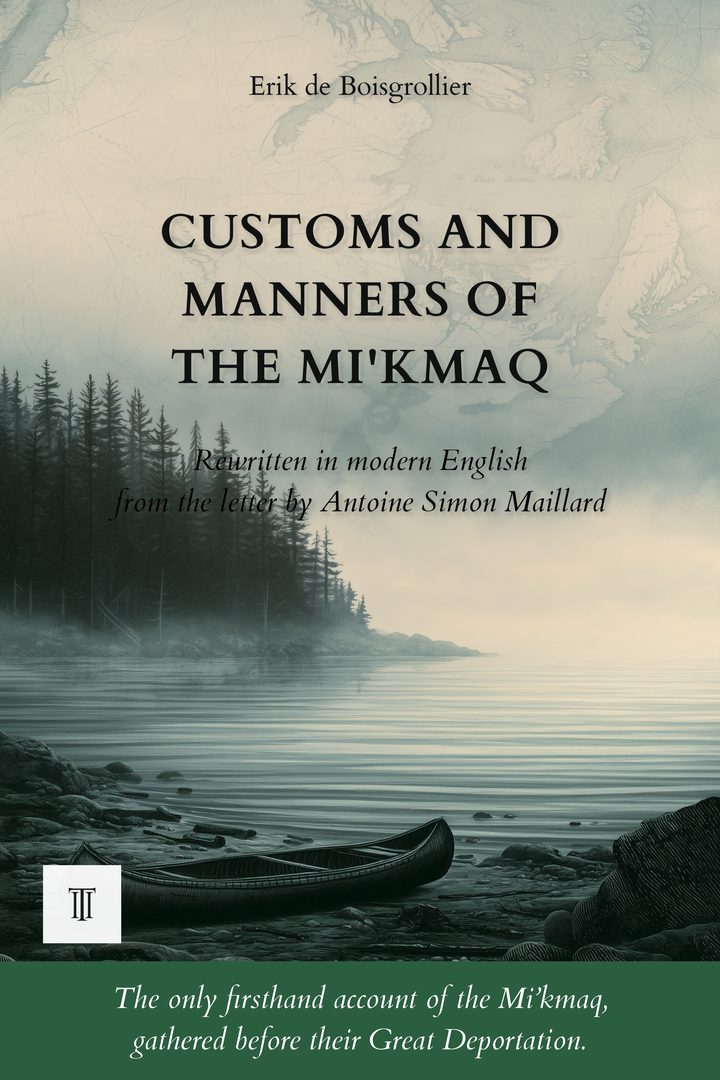
 Wild Americas · Modernised and illustrated edition
Customs and Manners of the Mi'kmaq
Modernized, illustrated English edition of Lettre sur les missions de l'Acadie by Antoine Simon Maillard (c. 1755). 200 pages.
Twenty years among the Mi'kmaq: a missionary learns their language, invents a writing system for them, before the fall of Louisbourg and the deportation of the Acadians. The period letter rewritten in modern English, including maps and illustrations.
Read more ↓- 200 pages
- Paperback · Ebook (EPUB)
- English
- 18th century
About this book
Île Royale, around 1755. For twenty years, a French priest has lived among the Mi'kmaq, speaking their language better than any European before him, and watching the end of a world approach. Before everything gives way, he writes.
What Antoine Simon Maillard recounts to his superior in Paris, no one else has seen. The old jongleur Arguimant describing the sacred fire, the skin canoes, and the monstrous fish of the time before ships. The eau-de-vie brought from France, and what it does to men. Warriors leaving to defend Louisbourg while the women mourn before the shuttered church. The wounded of Lorembec returning by night, and the chief René hidden beneath the moss while the English pass. An enemy officer attending Mass, discussing faith with the leader of the Prayer, unaware that he has been recognized.
Maillard admires this people and judges them, loves them and despairs of them, and loses his temper before the assembled mission. He invents for them a system of signs that the women copy onto birch bark. Then, one evening, he sets down his pen in the middle of a sentence and never picks it up again.
The text met an unusual fate. As early as 1758, English-speaking readers had access only to an abridged version published in London, reduced to a quarter of Maillard's original text, into which the London editor had inserted notes hostile to Catholicism in the very midst of the missionary's own sentences. The complete French text, meanwhile, was published only once, in Quebec in 1863, in Les Soirées canadiennes, from the autograph manuscript, and has never been reprinted since. The present edition offers its first complete translation into English.
Written as Louisbourg lived out its final years and the deportation of the Acadians began, this letter is a firsthand account gathered on the brink of upheaval, on the eve of the dispersal of the very people it describes. Maillard, the first Frenchman to master the Mi'kmaq language, also perfects in it a system of signs devised for this people, which the women of the mission copy and teach one another on birch bark.
Complete rewriting in modern English of the letter: "Lettre sur les missions de l'Acadie et particulièrement sur les missions micmaques" by Antoine Simon Maillard, 1755, including maps and illustrations.
Product details
- Publisher
- Itinerarium Éditions
- Series
- Wild Americas
- The author
- Antoine Simon Maillard
- Date of the journey
- 1735-1755
- Modern edition by
- Erik de Boisgrollier
- Language
- English
- Format
- Paperback, 6 × 9 in (15.2 × 22.9 cm)
- Pages
- 200
- ISBN
- 978-2-489330-80-9
- Published
- August 2026
The author
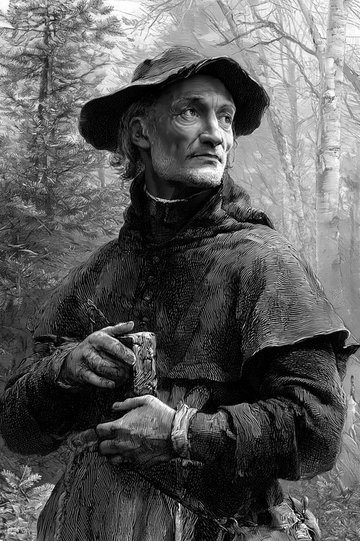
Antoine Simon Maillard
Antoine Simon Maillard (c. 1710-1762) was a French missionary priest of the Missions étrangères de Paris. Sent in 1735 to the Mi'kmaq of Île Royale and Acadia, he devoted the rest of his life to them and died there, in Halifax, in 1762. The first European to truly master the Mi'kmaq language, he drew from it a grammar and invented for his flock a system of hieroglyphic writing, still transmitted today. Around 1755, he sent his superior in Paris a long letter recounting the customs of this people, the ravages of eau-de-vie, and the war against the English. Left unfinished, breaking off in the middle of a sentence, this account was not published until 1863, in Quebec, in Les Soirées canadiennes, and has never been reprinted since.
All books by Antoine Simon Maillard →Lettre sur les missions de l'Acadie et particulièrement sur les missions micmaques: Our editorial work
This book could have been born from two texts. The first is a small volume published in London in 1758, in the midst of the Franco-British war, under the title An Account of the Customs and Manners of the Micmakis and Maricheets. It was through this text that the public first came to know this testimony, and it is a treacherous text: the letter is reduced to a quarter of its length, and the London editor sowed hostile notes in brackets throughout the missionary's own sentences, sometimes opening them in the very middle of a period to turn his faith into ridicule. The second text is the Quebec publication of 1863: the collection Les Soirées canadiennes (Quebec, Brousseau frères, volume III) gives the complete French letter, “for the first time, from the original written in the very hand of the illustrious missionary.” On one side, a period translation, abridged and hostile; on the other, Maillard's own language, whole, established from the autograph manuscript. The choice was not in question: it is the 1863 text that grounds this edition.
This text is written in eighteenth-century French: Maillard writes “sçauront,” “connoître,” “païs,” “avoit,” and his sentences unfold after the fashion of his time. We have modernized this language sentence by sentence: current spelling and conjugations, word order restored to the natural flow of contemporary English, long periods unwound into two or three sentences wherever breath required it. Nothing has been cut, nothing has been summarized: the sermons, the harangues, the doctrinal dialogues are there in their full extent, their very breadth documenting the eloquence that Maillard admired in his hosts.
Before / after
En l'écrivant je n'ay écrit que ce que j'ay entendu et vu. J'ay entendu de la plupart de nos vieillards tant mikmaques que marichites, ce que je rapporte ; et je suis sûr de le rapporter fidèlement et j'ay vu, et vois tous les jours, que nos mikmaques ont été tels que je les dépeins dans ma lettre. Mon style ne vous enchantera pas, Madame, il est des plus simples, pour ne pas dire rampant ; mais le vray l'accompagne dans le peu que je rapporte, je dis tout uniment ce qui a été ; voilà ce qui me plaît, et m'a toujours plû.
In writing it, I wrote only what I have heard and seen. I have heard most of our old men, Micmac as well as Maliseet, relate what I in turn relate, and I am certain that I do so faithfully. I have seen, and I see every day, that our Micmacs have been such as I depict them in my letter. My style will not delight you: it is of the plainest kind, not to say a crawling one. But truth accompanies it in the little I report; I say quite plainly what has been, and that is what pleases me, and has always pleased me.
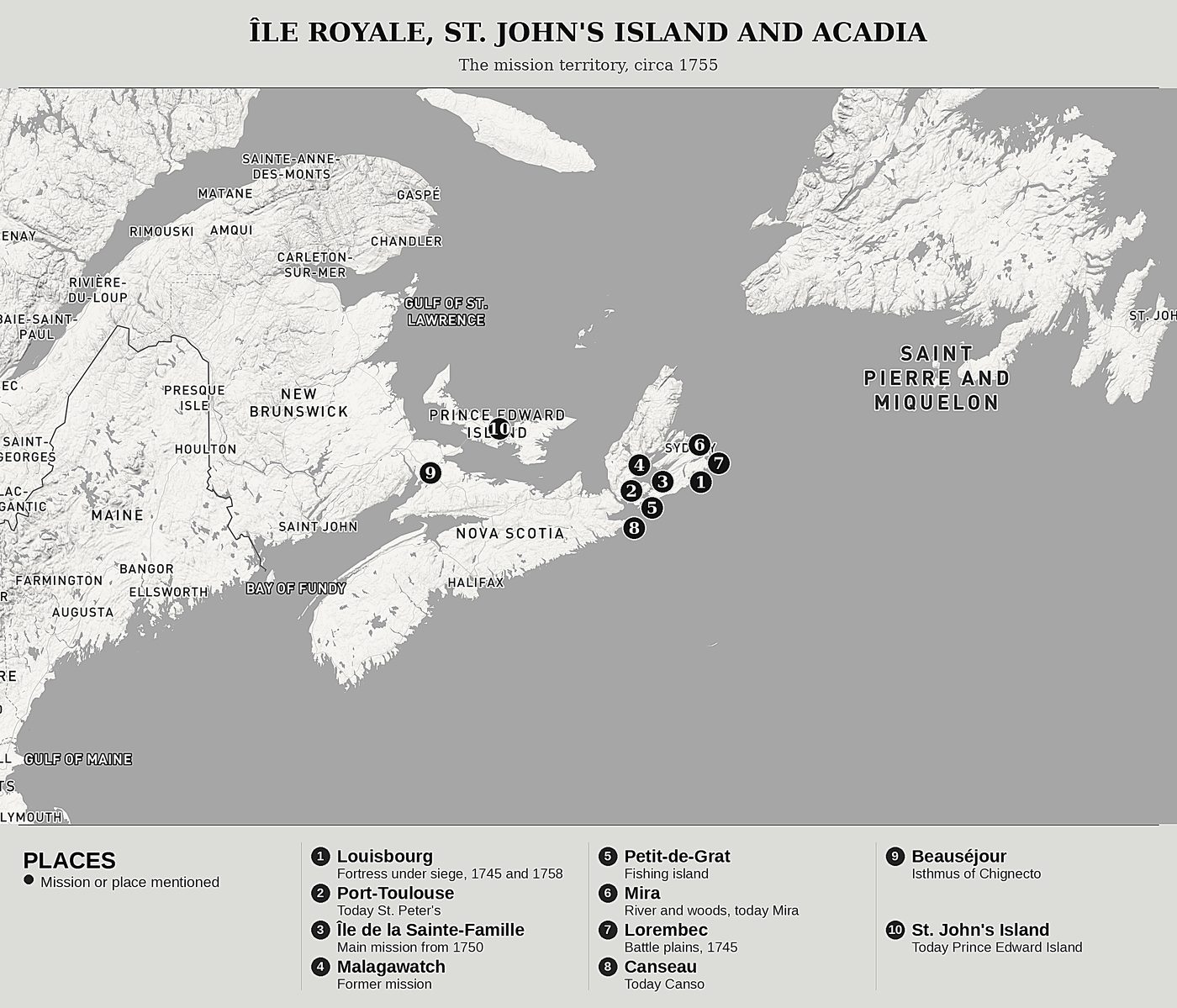
The journey mapped
The modern editor