 Wild Americas · Modernised and illustrated edition
Travel Journals in New France
Modernized, illustrated English edition of The Voyages of Jacques Cartier (Voyages au Canada) by Jacques Cartier (1534-1542). 178 pages.
The three journals of Jacques Cartier, the captain from Saint-Malo who opened France's path to the Saint Lawrence between 1534 and 1542. A modernized and illustrated edition of the first French account of Canada.
Read more ↓- 178 pages
- Paperback · Kindle
- English
- 16th century
About this book
In the spring of 1534, two ships of sixty tons leave Saint-Malo for a continent that has no name.
Aboard is Jacques Cartier, a forty-three-year-old captain from Saint-Malo, commissioned by Francis I to find gold and a passage to China. He will discover something else entirely: a vast gulf, a river that runs a thousand leagues into the land, peoples speaking unknown languages, and palisaded towns at the foot of mountains he will later name Royal. In three voyages, spread across eight years and ending in 1542, Cartier opens for France the way to a country his own century does not yet call Canada.
On his first crossing, he plants a cross thirty feet high at Gaspé, in full view of the people who watch it rise, and returns to Saint-Malo carrying two young men, Taignoagny and Domagaya, sons of the lord Donnacona. The following year he sails up the great river as far as Hochelaga, the fortified town that will become Montreal, and winters opposite Stadacona among the Iroquoians of the Saint Lawrence. Twenty-five of his men die of scurvy before Domagaya reveals the bark remedy, annedda, that saves the rest of the crew. Before sailing home, Cartier seizes Donnacona and several of his people; the lord will never see his country again, and dies in France.
Nearly five years pass before Cartier returns a last time, in 1541, sailing alone from Saint-Malo while Roberval, newly named viceroy by the king, prepares to follow with settlers. Cartier builds two forts at Cap-Rouge, meets Agona, who has succeeded Donnacona at Stadacona, and believes he has found gold and diamonds in the rock of the region; the ore proves worthless, and for a long time the phrase 'a diamond from Canada' becomes a byword for a false treasure. The account of this last voyage breaks off abruptly, its ending lost along with the original French manuscript.
Cartier's three accounts survive by different, and sometimes precarious, paths: the first from a manuscript held today at the Bibliothèque nationale de France, the second from a rare sixteenth-century printing rediscovered in London in 1843, the third only in the English translation that Richard Hakluyt published in 1600, the French original having disappeared. Together they form the earliest written record of French North America and the only surviving first-hand account of the Saint Lawrence Iroquoians, a people who vanished within a generation of Cartier's last voyage, well before the French returned to settle the river for good. This modernized and illustrated edition follows the original sixteenth-century manuscripts and prints, and is enriched with maps, an Iroquoian-Laurentian glossary, and the text of the royal privilege granted in 1544.
Product details
- Publisher
- Itinerarium Éditions
- Series
- Wild Americas
- The author
- Jacques Cartier
- Date of the journey
- 1534-1542
- Modern edition by
- Erik de Boisgrollier
- Language
- English
- Format
- Paperback, 6 × 9 in (15.2 × 22.9 cm)
- Pages
- 178
- ISBN
- 978-2-489330-12-0
- Published
- May 2026
The author
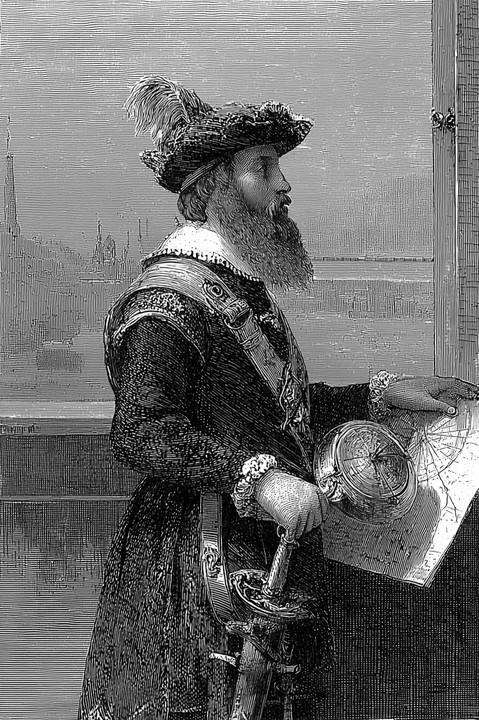
Jacques Cartier
Jacques Cartier (1491-1557), a captain from Saint-Malo trained in coastal navigation and Newfoundland fishing, was chosen by Francis I to lead three expeditions westward between 1534 and 1542. He charted the gulf and the great river he named the Saint Lawrence, planted a cross at Gaspé, sailed the waterway as far as Hochelaga, the future Montreal, and wintered twice across from Stadacona. His three Relations, written close to the ship's log, established European knowledge of Canada and preserve the only first-hand account of the Iroquoians of the Saint Lawrence, a people who had vanished by the following century.
All books by Jacques Cartier →Voyages au Canada: Our editorial work
This edition brings together for the first time in a single volume the three known accounts of Jacques Cartier, presented in the order of the voyages. The material was drawn from three distinct sources. The first voyage (1534) was modernized from the original French of the Moreau manuscript held at the Bibliothèque nationale de France, in the edition published in Paris by Michelant and Ramé at Tross in 1867. The second voyage (1535-1536), known under the title Bref récit et succincte narration, was modernized from the reprint of the 1545 printed edition produced by D'Avezac at Tross in 1863; this printed text, long known only by mention, had been rediscovered in 1843 at the British Museum by the American bookseller Henry Stevens. The third voyage (1541-1542), whose French manuscript has been lost, was entirely retranslated from the English version given by Richard Hakluyt in his Principal Navigations of 1600. All three texts, old in both languages, are today in the public domain.
Modernization concerned first the spelling. The old spellings "vng", "icelles", "soubz", "ouaiseaulx", "Sainct Malo", "nauires", "barcques" were brought back to contemporary English. Then the syntax: whenever an old sentence, stretching across eight or ten chained subordinate clauses, made the reader lose the thread, we unfolded it, and the word order was restored to the natural sense of present-day English, wherever the sixteenth-century turn of phrase weighed down the reading unnecessarily. Cartier's first-person plural narrative voice ("we") was preserved throughout; but the simple past tense, which dominated, often gave way to the compound past, more natural to a modern ear for a logbook kept from day to day. The simple past remains in the third-person passages and in the pages of editorial context-setting. This work was done sentence by sentence, with a constant concern for cutting what repeated itself and unfolding what was too elliptical, without ever weighing down or impoverishing the whole.
Before / after
J'estime mieulx que aultrement que c'est la terre que Dieu donna à Cayn. Il y a des gens à ladite terre qui sont assez de belle corpulance, mais ilz sont gens effarables et sauuaiges. Ilz ont leurs cheueulx liez sur leurs testes en faczon d'vne pougnye de fain teurcze et vng clou passé par my ou aultre chosse, Et y lient aulcunes plumes des ouaiseaulx.
In short, I judge it to be the land that God gave to Cain, the cursed and barren portion of the first murderer. There are people here nonetheless, of fairly good build but wild, and Savages. They knot their hair atop their heads in the fashion of a twisted handful of hay, binding it with a nail or something of the sort passed through it, and stick birds' feathers into it.
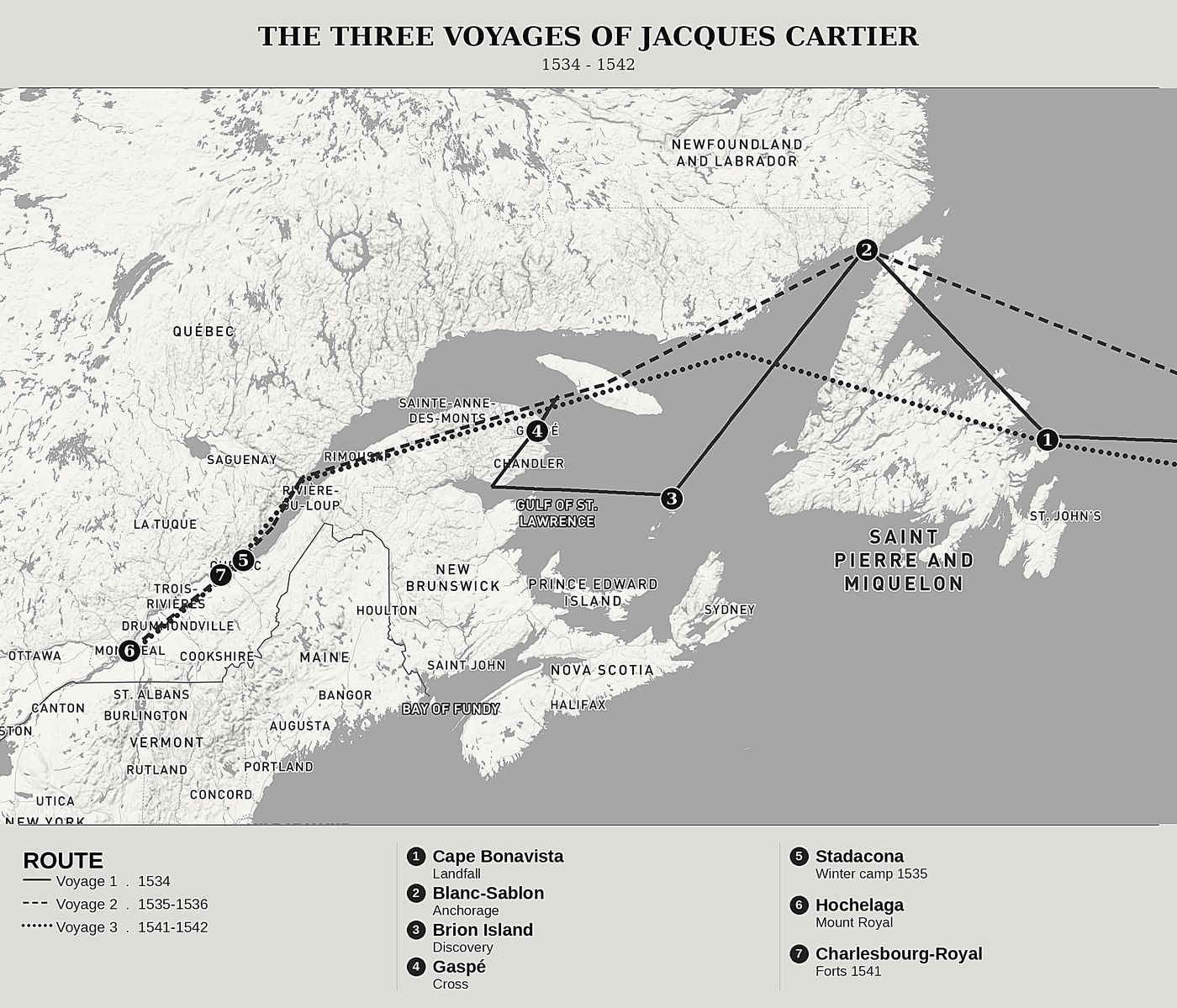
The journey mapped
The modern editor