Biography
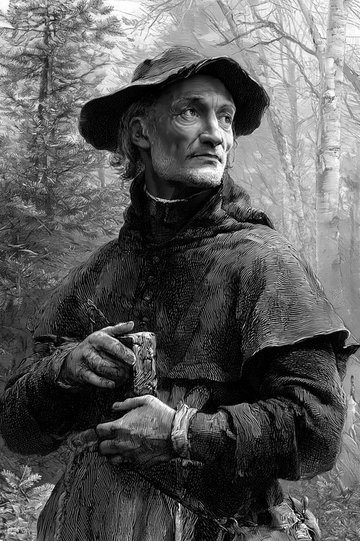
Antoine Simon Maillard (c. 1710-1762) was a French priest, a missionary among the Micmac, an Algonquian people of present-day Nova Scotia, Prince Edward Island and the shores of the Gulf of St Lawrence. He lived among them for the last twenty-seven years of the French presence in Acadia and learned their language better than any European before him. The long letter he devoted to these missions is one of the rare detailed descriptions of the Micmac world written by a man who had spent his whole life there.
Born around 1710 in the diocese of Chartres, he appears in the documents under several first names, so that the Dictionnaire biographique du Canada lists him under that of Pierre. He trained at the Séminaire du Saint-Esprit, in Paris, a house devoted to the training of priests for the colonies. In 1734 he was lent to the Séminaire des Missions Étrangères, then short of candidates, and appointed in the spring of 1735 to the Micmac missions of Île Royale, today Cape Breton Island. He landed at Louisbourg on 13 August 1735.
Gifted for languages, he mastered Micmac in a few months and devised a system of signs, known as hieroglyphs, that made it possible to transcribe prayers and catechism in notebooks which the faithful learned by heart. The process was not entirely new, the Recollect Chrestien Le Clercq having described as early as 1691 a similar method in the Gaspé, itself inspired by a Micmac practice of drawn messages; Maillard, who was perhaps unaware of it, systematised and enriched it. Appointed vicar general of the Bishop of Quebec for Île Royale in 1740, he travelled each year through the settlements of the region before establishing his mission, after 1754, on Île de la Sainte-Famille, today Chapel Island.
His life then merges with the colonial wars. Present at the siege of Annapolis Royal in 1744, taken prisoner at the end of 1745 and sent back to France by way of Boston, he returned to Acadia in 1746 with the fleet of the Duc d'Anville. After the founding of Halifax in 1749 and the Micmac declaration of war on the English, he served as intermediary between Louisbourg and the chiefs of the bands. The fall of Louisbourg in 1758 cast him onto the roads with the Acadians who had taken refuge at Miramichi, then at Malagomich. In 1759 he accepted British peace terms, which Governor Vaudreuil described as treason, and settled around the autumn of 1760 in Halifax as the government's agent to the Indians, with an oratory where he celebrated Catholic worship. He died there on 12 August 1762, honoured with an official funeral.
It was probably in the 1750s, from his mission, that he wrote the letter addressed to a director of the Séminaire des Missions Étrangères. It describes the customs, the ceremonies and the eloquence of the Micmac, gives examples of sermons, dwells on the ravages of brandy and on the treatment of prisoners, and offers an interpretation of the murder of the English officer Edward How. The text breaks off without a conclusion.
It appeared only in 1863, in Quebec, in the third volume of the Soirées canadiennes, under the title Lettre de M. l'abbé Maillard sur les missions de l'Acadie et particulièrement sur les missions micmaques. His Micmac grammar was published in New York in 1864 by Joseph-Marie Bellenger. Historians of Acadia and linguists still rely on these works, and the sign writing he fixed remained in use among the Mi'kmaq long after his death.