 East Indies · Modernised and illustrated edition
Thirty Years on the Seas of the Indies
Modernized, illustrated English edition of A New Account of the East Indies by Alexander Hamilton (1688-1723). 262 pages.
After India, the Scottish captain Alexander Hamilton crosses the Malay Archipelago, sails up the coasts of China, and brushes against the closed empire of Japan: Sumatra, Java, Siam, Canton, Amoy, Formosa, amid the tumult of Asian trade.
Read more ↓- 262 pages
- Paperback · Ebook (EPUB)
- English
- 17th century
About this book
After the coasts of India, the Scottish captain Alexander Hamilton pushes further east. This third and final volume takes him across the Malay Archipelago, up the coasts of China, and ends at the gates of Japan, the most closed empire of his time. Thirty-five years at sea have blunted neither his curiosity nor his causticity.
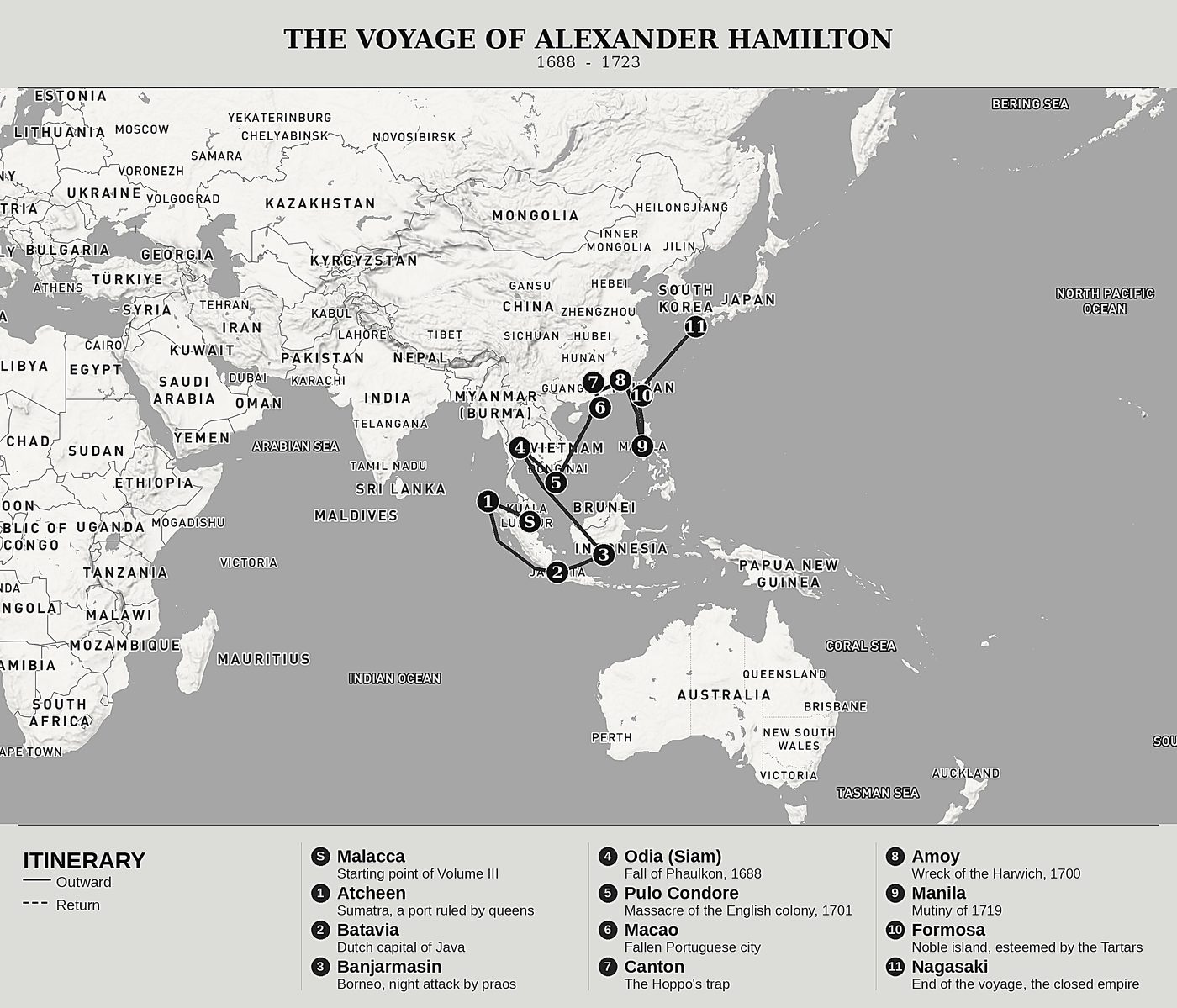
The narrative begins at Johore and at Atcheen, governed by queens, then follows the coasts of Sumatra, rich in gold and tin, before crossing Java, its volcanoes and its orangutan, on to the spice-laden Moluccas and Borneo. Hamilton then sails up to Trangano, whose afflicted king begs his protection against an enemy fleet, and on to Siam, where French Jesuits had placed a Greek minister, Constantine Phaulkon, at the head of the kingdom: his bloody fall in 1688 opens one of the book's most dramatic episodes, followed by Hamilton's own trial, accused of treason by the Siamese court in 1719.
The voyage continues through war-torn Cambodia and the forgotten massacre of the English colony at Pulo Condore, before reaching the China of the hongs: the hurricane that dismasts his ship near Macao, the trap set by three Canton merchants who have bought the monopoly on his cargo, the massacre of the Dutch at Amoy told as a lesson in cunning, then the wreck of the Harwich, whose abandoned crew Hamilton alone rescues after his peers turn away. He also describes the gods, laws, and punishments of the empire, the trade in ginseng and tea, before the Manila mutiny in which a priest brandishing a crucifix rouses the city against its viceroy.
The narrative ends at Formosa and Japan, the closed empire that forbids its own subjects from leaving: the rise and then the crushing of Christianity, the affair of the Firando trading post, and the wreck of Dutch explorers stranded in Korea. This third volume thus covers the easternmost stretch of Hamilton's journey, the one where European trade collides most directly with Asian powers: rival companies, local courts, and merchant monopolies sketch a world in the midst of reshaping itself, on the eve of the great expansions of the eighteenth century. A merchant free of any company, Hamilton reports here what he saw with his own eyes rather than what he was told, which makes his testimony a firsthand source on the maritime Asia of his time.
The first complete modern rewriting for today's reader, making this testimony accessible without betraying anything of the voyage. Original illustrations and redrawn maps bring the route to life, while a set of reference materials (glossary, chronology, index, further reading, editor's note, afterword) and selected passages from the original text illuminate the reading.
Product details
- Publisher
- Itinerarium Éditions
- Series
- East Indies
- The author
- Alexander Hamilton
- Date of the journey
- 1688-1723
- Modern edition by
- Isabelle Perol
- Language
- English
- Format
- Paperback, 6 × 9 in (15.2 × 22.9 cm)
- Pages
- 262
- ISBN
- 978-2-489330-98-4
- Published
- July 2026
The author
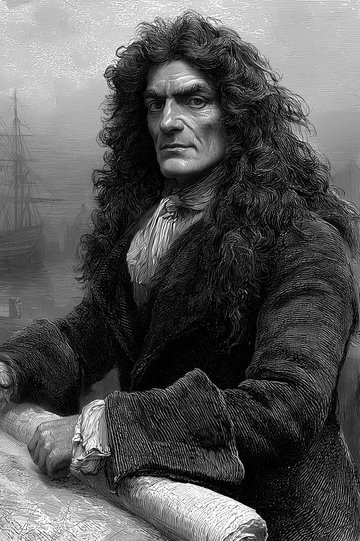
Alexander Hamilton
A Scottish merchant and captain, Alexander Hamilton sailed for more than thirty years, from around 1688 to 1723, across the seas linking southern Africa to the coasts of India. Independent of the great companies, he traded on his own account from Zanzibar to Japan, closely observing the courts, ports, and wars of his time. His account, published in 1727 under the title A New Account of the East Indies, remains one of the few direct testimonies of a European merchant who lived, rather than imagined, the Indian Ocean of his era.
All books by Alexander Hamilton →A New Account of the East Indies: Our editorial work
This third and final volume takes up Alexander Hamilton's voyage where the second left it, near Malacca, and carries it to the far edge of the world known to the merchants of his time. He leaves the strait for the Malay Archipelago, skirting Johore and its tyrants, Sumatra and its queens, Dutch Java and its orangutan, the Spice Islands and Borneo; then he reaches the monsoon kingdoms, Siam and its revolution, Cambodia and Cochinchina, before sailing up the China seas to Canton, Amoy and Peking, and touching at last on the Philippines, Formosa and closed Japan, where the whole narrative comes to an end. Where the original strung together long numbered chapters and interminable tables of contents, we have redivided the material into twelve chapters with new titles, which follow the route itself without the reader getting lost in the lists of capes, rivers and trading posts that the merchant enumerated out of professional scruple.
The whole work gathers more than thirty years of seafaring into a mass too vast to fit in a single volume. We have therefore published it in three volumes, divided not by whim but along the natural seams of the voyage: the first ran from the Cape of Good Hope and Arabia to the gateways of India; the second followed the coasts of the peninsula, Ceylon and the threshold of Southeast Asia, from Goa to Malacca; this third volume closes the whole on the Malay Archipelago, China and Japan. Each volume reads as a complete stage of the journey in its own right, and this last volume has the privilege of carrying the reader to the very end of the account, where the captain at last lays down his pen.
Before / after
My Lord Falcon, for that was generally his Designation, had, by his civil Deportment towards People of all Ranks and Degrees, so ingratiated himself, that he had a stronger Party by far, both in the City and Country, than the General; and besides, had all the Fleet at his Devotion. But being infatuate, he was deaf to all good Advice…
Phaulkon, for his part, had by his civility toward people of every condition made himself so generally beloved that he commanded, in city and countryside alike, a party far stronger than the Usurper's own. He had, besides, the entire fleet at his devotion. Many of his friends urged him not to obey the summons: let him rather raise, they told him, the forces of the city to avenge the king's death. Numbers of officers, who held the regicide in horror, would have rallied to his orders, and his party grew by the hour. But, as though blinded, he remained deaf to all good counsel.
The journey mapped
The modern editor