 East Indies · Modernised and illustrated edition
Thirty Years on the Seas of the Indies
Modernized, illustrated English edition of A New Account of the East Indies by Alexander Hamilton (1688-1723). 288 pages.
A Scottish merchant spends thirty-five years crossing the Indian Ocean, from the Cape to Basra and Bombay. Shipwrecks, trading posts, the court of the Great Mughal: up to the reckless war Aurangzeb wages against the English Company.
Read more ↓- 288 pages
- Paperback · Ebook (EPUB)
- English
- 17th century
About this book
Around 1688, a young Scottish merchant sets sail for the East Indies. He will remain there for more than thirty years, from the Cape of Good Hope to the gateways of the Great Mughal.
Alexander Hamilton is neither a scholar nor a conqueror: he is a captain, a trading man who saw everything with his own eyes. The salt currency of the Christian kingdom of Abyssinia, the largest coffee market in the world, the towers where the Parsis deliver their dead to the birds, the pearls of Bahrain, the carnelians of Cambay. But also shipwrecks on cannibal coasts, Gujarat pirates who drink before boarding, the fall of Isfahan under the blows of Mirwais, and the reckless war that the English Company dares to declare on the emperor Aurangzeb.
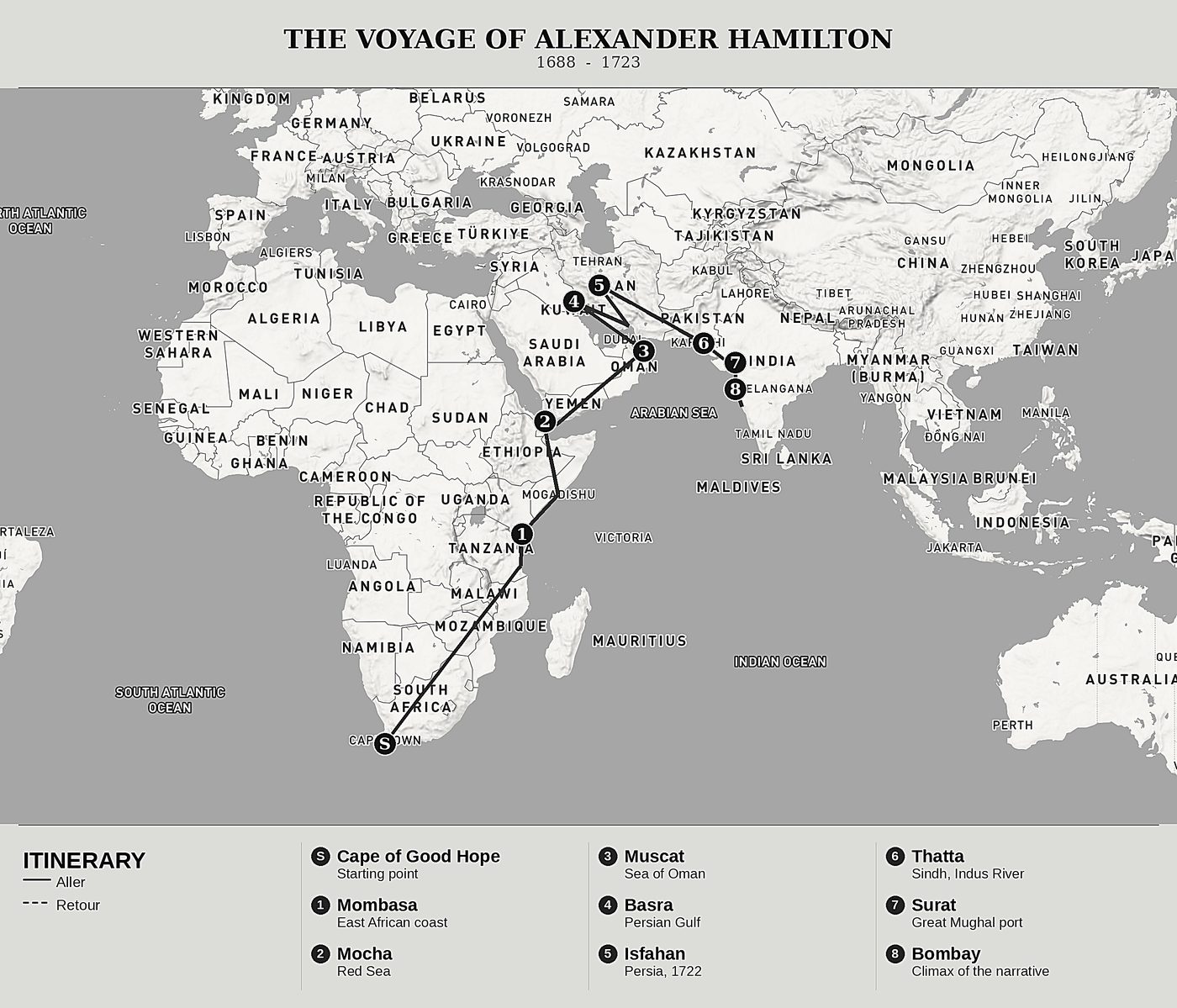
From his quarterdeck, this frank and curious witness paints the portrait of an Indian Ocean still half guessed at, where declining Portuguese, conquering Arabs, and European companies fight over ports, routes, and cargoes. This first volume follows the great outward diagonal: from the Cape to the East African coast, from Christian Abyssinia to the coffee ports of the Red Sea, from Muscat and the Persian Gulf to the gateways of the Great Mughal, Sindh, Gujarat, Surat, and Bombay.
He does not yet know it: what he describes here are the first steps of an empire. The narrative culminates in the war of Bombay between the English East India Company and the emperor Aurangzeb, an episode in which the young Europe measures for the first time the true size of the Mughal giant.
The volume opens on a world in the midst of upheaval: the Portuguese lose Muscat and their trading posts to the Arabs of Oman, Safavid Persia collapses under the blows of Mirwais, whose siege of Gombroon and capture of Isfahan Hamilton follows closely, while the empire of the Great Mughal shines with its last brilliance under Aurangzeb. A merchant free of any company, Hamilton assesses ports, currencies, and customs with the same frankness, reporting the schemes of governors as readily as the ways of peoples: it is this freedom of tone, rare for the period, that makes his account a firsthand source on the Indian Ocean at the turn of the eighteenth century.
The first complete modern rewriting for today's reader, making this account accessible without betraying anything of the original. Twenty-one original illustrations and redrawn maps bring the route to life, while a set of reference materials (glossary, chronology, index, further reading, editor's note, afterword) and selected passages from the original text accompany the reading.
Product details
- Publisher
- Itinerarium Éditions
- Series
- East Indies
- The author
- Alexander Hamilton
- Date of the journey
- 1688-1723
- Modern edition by
- Isabelle Perol
- Language
- English
- Format
- Paperback, 6 × 9 in (15.2 × 22.9 cm)
- Pages
- 288
- ISBN
- 978-2-489330-72-4
- Published
- July 2026
The author
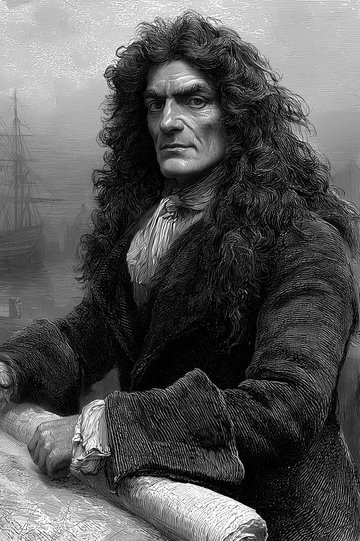
Alexander Hamilton
A Scottish merchant and captain, Alexander Hamilton sailed for more than thirty years, from around 1688 to 1723, across the seas linking southern Africa to the coasts of India. Independent of the great companies, he traded on his own account from Zanzibar to Japan, closely observing the courts, ports, and wars of his time. His account, published in 1727 under the title A New Account of the East Indies, remains one of the few direct testimonies of a European merchant who lived, rather than imagined, the Indian Ocean of his era.
All books by Alexander Hamilton →A New Account of the East Indies: Our editorial work
Alexander Hamilton's account has come down to us as a large, loosely built work, in which the captain follows the coastline rather than the thread of a story. It begins at the Cape of Good Hope, runs up the East African coast, crosses the Red Sea, skirts Arabia and Persia, and finally enters the India of the Great Mughal: a long geographical diagonal, punctuated by anecdotes, historical digressions and scenes of war. For this first volume, we have kept that progression, which is the progression of the voyage itself, while dividing the material into fifteen chapters with new titles, where the original ran together long, numbered chapters with interminable headings. The reader can thus follow the great stages of the journey, from the Cape to Bombay, without getting lost in the lists of rivers and villages the merchant enumerated out of professional scruple.
The original work gathers more than thirty years of seafaring into a mass too vast to fit in a single volume without wearing out the reader. We have therefore chosen to publish it in three volumes, divided not by whim but along the natural seams of the voyage: this first volume runs from the Cape of Good Hope to the gateways of the Great Mughal, from East Africa and Arabia to Sindh, Gujarat and Bombay; the second will follow the coasts of India, Ceylon and Southeast Asia; the third will reach China, Japan and the road home. Each volume reads as a complete stage of the journey in its own right.
Before / after
for about the Year 1683, an English Ship, called the Johanna, was lost somewhere near Delagoa, and the Natives shew'd the shipwrack'd Men much more Civility and Humanity than some Nations that I know, who pretend much Religion and Politeness, for they accommodated their Guests with whatever they wanted of the Product of their Country, at very easy Rates…
About the year 1683, an English ship named the Johanna was lost somewhere near Delagoa Bay. I can easily picture the scene: the hull stove in, the men cast up on an unknown shore, without a word of the country's tongue, and already reckoning the black people who came running toward them among the barbarians one distrusts. They were wrong. These same natives, whom one so readily takes for savages, showed the shipwrecked men more civility and humanity than do certain nations of my acquaintance, who pride themselves greatly, for all that, on religion and good manners.
The journey mapped
The modern editor