 East Indies · Modernised and illustrated edition
Thirty Years on the Seas of the Indies
Modernized, illustrated English edition of A New Account of the East Indies by Alexander Hamilton (1688-1723). 248 pages.
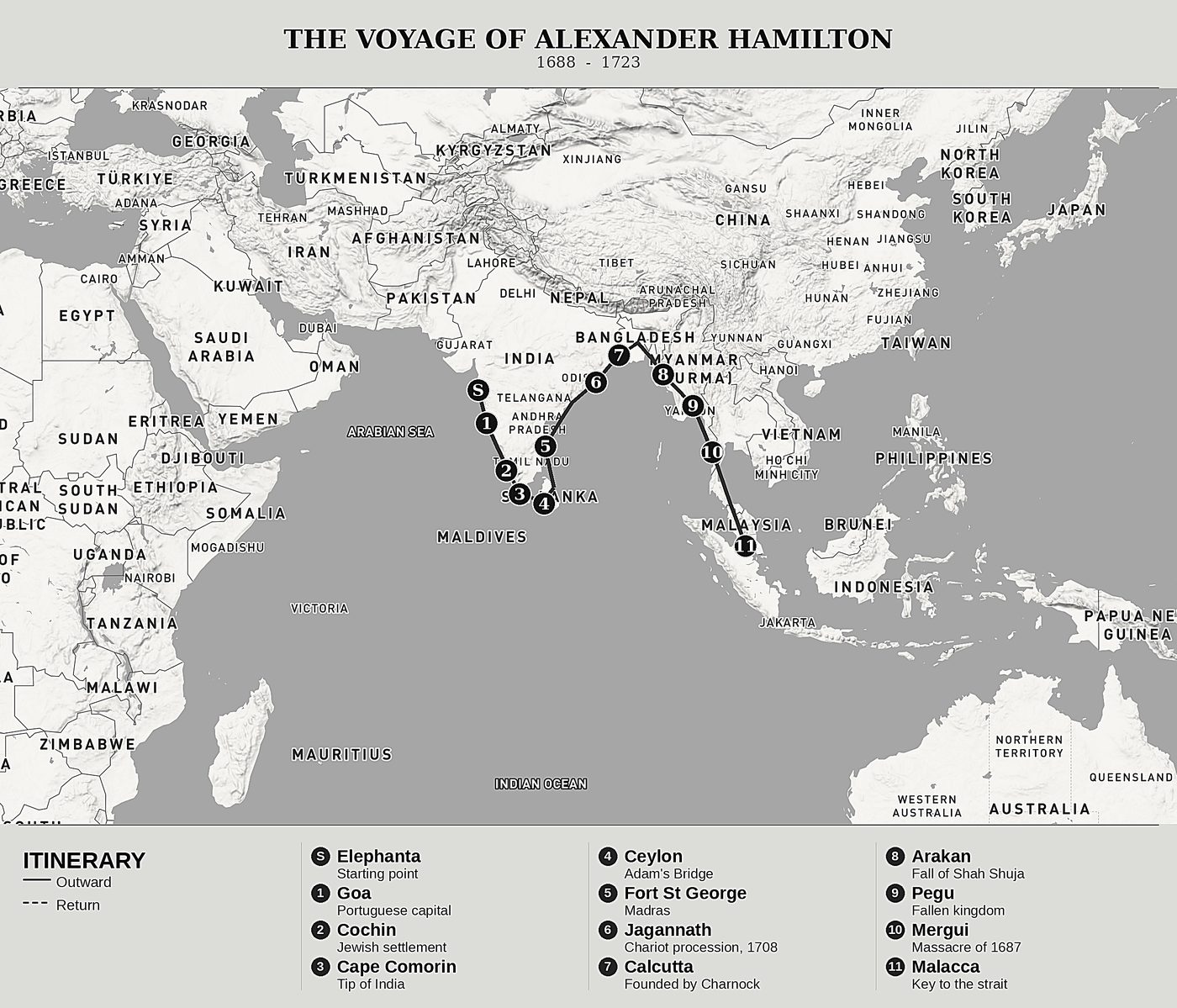
After Africa and Arabia, the Scottish captain Alexander Hamilton follows the coasts of India to the Strait of Malacca: Goa, Malabar, Ceylon, Coromandel, Bengal, Pegu, as far as the contested trading posts of Southeast Asia.
Read more ↓- 248 pages
- Paperback · Ebook (EPUB)
- English
- 17th century
About this book
After Africa and Arabia, the Scottish captain Alexander Hamilton continues on his way and follows the coasts of India, from Goa to the Strait of Malacca. Thirty years at sea have sharpened his eye: nothing surprises him any longer, and yet everything remains to be told.
Here is Portuguese Goa and its fallen pride, the tiger forests of Canara where widows are burned upon pyres, the principalities of Malabar and the mighty Samorin of Calicut. Here is Cochin and its Jewish community, Ceylon and its Adam's Bridge, the Coromandel coast where the diamonds of Golconda lie close by the gallows of Fort St George. The narrative then pushes eastward: the Ganges delta and feverish Calcutta, the great temple of Jagannath whose procession chariot crushes its devotees, the fall of Shah Shuja, brother of Aurangzeb, hunted down as far as the kingdom of Arakan.
Then comes the fallen kingdom of Pegu and its King of the White Elephant, the mendicant monks and the giant rockets offered to the gods, the massacre of the English at Mergui, the shipwrecks of the Nicobar Islands, and finally Malacca, the lock upon the strait, where a case of witchcraft occupies the closing pages of the volume.
A merchant free of any company, Hamilton saw everything with his own eyes: the castes and the creeds, the trading-post wars, the shipwrecks and the betrayals. From his quarterdeck, he paints the portrait of an Indian Ocean where declining Portuguese, conquering Dutch, and rival companies fight over ports, routes, and cargoes, without guessing at the empire already taking shape.
This second volume covers the years in which the political map of maritime Asia is redrawn: the Dutch complete their ousting of the Portuguese from Ceylon and Cochin, the emperor Aurangzeb dies in 1707 after having reigned over the height of the Great Mughal, and the still-fragile English trading posts of the Coromandel coast and Bengal hold their ground against local nabobs. A firsthand witness rather than an armchair scholar, Hamilton reports the customs of courts, the prices of markets, and the schemes of governors with a frankness that makes his account a primary source on Asia at the turn of the eighteenth century.
The first complete modern rewriting for today's reader, making this account readable without betraying anything of the original. Original illustrations and redrawn maps bring the route to life, while a set of reference materials (glossary, chronology, index, further reading, editor's note, afterword) and selected passages from the original text accompany the reading.
Product details
- Publisher
- Itinerarium Éditions
- Series
- East Indies
- The author
- Alexander Hamilton
- Date of the journey
- 1688-1723
- Modern edition by
- Isabelle Perol
- Language
- English
- Format
- Paperback, 6 × 9 in (15.2 × 22.9 cm)
- Pages
- 248
- ISBN
- 978-2-489330-76-2
- Published
- July 2026
The author
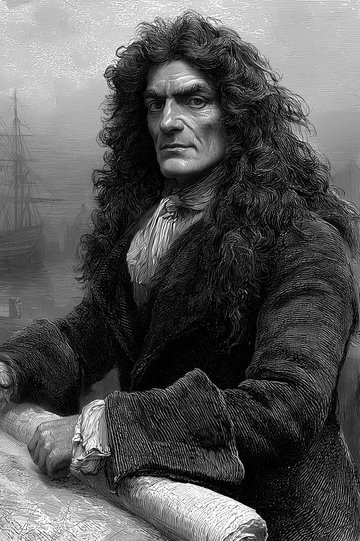
Alexander Hamilton
A Scottish merchant and captain, Alexander Hamilton sailed for more than thirty years, from around 1688 to 1723, across the seas linking southern Africa to the coasts of India. Independent of the great companies, he traded on his own account from Zanzibar to Japan, closely observing the courts, ports, and wars of his time. His account, published in 1727 under the title A New Account of the East Indies, remains one of the few direct testimonies of a European merchant who lived, rather than imagined, the Indian Ocean of his era.
All books by Alexander Hamilton →A New Account of the East Indies: Our editorial work
Alexander Hamilton's account has come down to us as a large, loosely built work, in which the captain follows the coastline rather than the thread of a story. This second volume takes up the voyage where the first left it, at the gateways of India, and now runs along the great maritime facade of the peninsula: Portuguese Goa, Canara with its tigers, the principalities of Malabar and the Samorin of Calicut, Cochin, Ceylon and its Adam's Bridge, then the Coromandel coast, the Bengal of the Ganges, the kingdom of Pegu, and finally Malacca, key to the strait. We have kept that progression, which is the progression of the voyage itself, while dividing the material into seventeen chapters with new titles, where the original ran together long, numbered chapters with interminable headings. The reader can thus follow the great stages of the journey without getting lost in the lists of rivers, capes and villages the merchant enumerated out of professional scruple.
The original work gathers more than thirty years of seafaring into a mass too vast to fit in a single volume without wearing out the reader. We have therefore chosen to publish it in three volumes, divided not by whim but along the natural seams of the voyage: the first ran from the Cape of Good Hope to the gateways of the Great Mughal; this second volume follows the coasts of India, Ceylon and the threshold of Southeast Asia, from Goa to Malacca; the third will reach China, Japan and the road home. Each volume reads as a complete stage of the journey in its own right.
Before / after
He is never removed out of the Temple, but at one solemn Procession, mounted on a Coach four Stories high. It runs on eight or ten Wheels, and is capable to contain near 200 Persons. It is drawn thro' a large Street about 50 Yards wide, and half a League long, by a Cable of 14 Inches Circumference, and, at convenient Distances, they fasten small Ropes to the Cable, so that upwards of 2000 People have Room enough to draw the Coach, and some old Zealots, as it passes thro' the Street, fall flat on the Ground, to have the Honour to be crusht to Pieces by the Coach Wheels…
The idol never leaves its sanctuary except in procession. It is then hoisted onto a chariot four stories high, which rolls on eight or ten wheels and can carry nearly two hundred people. It is drawn through a street fifty yards wide and half a league long, by means of a cable fourteen inches around, to which ropes two or three fathoms long are tied at intervals; in this way more than two thousand men find a grip to pull it. As the chariot passes, certain old zealots throw themselves flat on their faces on the pavement, for the honor of being crushed beneath the wheels.
The journey mapped
The modern editor