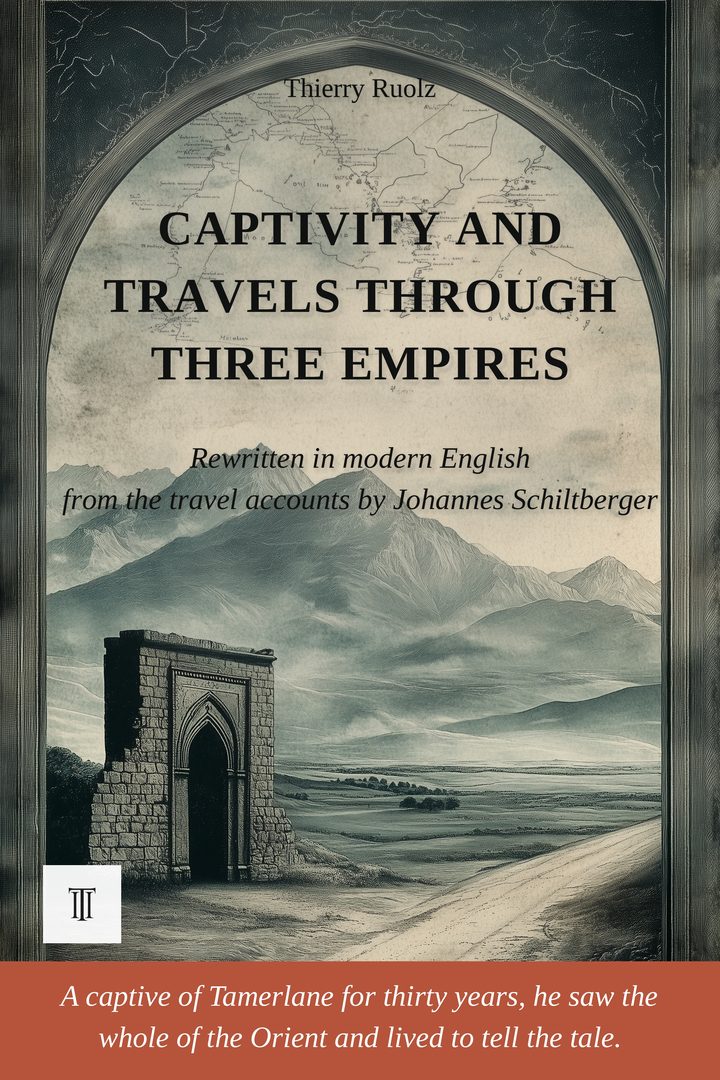
 The Old Orient · Modernised and illustrated edition
Captivity and Travels Through Three Empires
Modernized, illustrated English edition of The Bondage and Travels of Johann Schiltberger (Reisebuch) by Johannes Schiltberger (1394-1427). 210 pages.
Held captive by Tamerlane for thirty years, the Bavarian squire Johannes Schiltberger crossed the Ottoman, Timurid and Tatar empires. His account, dictated around 1430, is the first Western view from within.
Read more ↓- 210 pages
- Paperback · Ebook (EPUB)
- English
- 14th century
About this book
September 25, 1396, on the plains of Bulgaria. The chivalry of the West has just been annihilated before Nicopolis. A sixteen-year-old Bavarian boy, esquire to a lord of Munich, is dragged away among the prisoners. His name is Johannes Schiltberger. He will not see Europe again for thirty-three years.
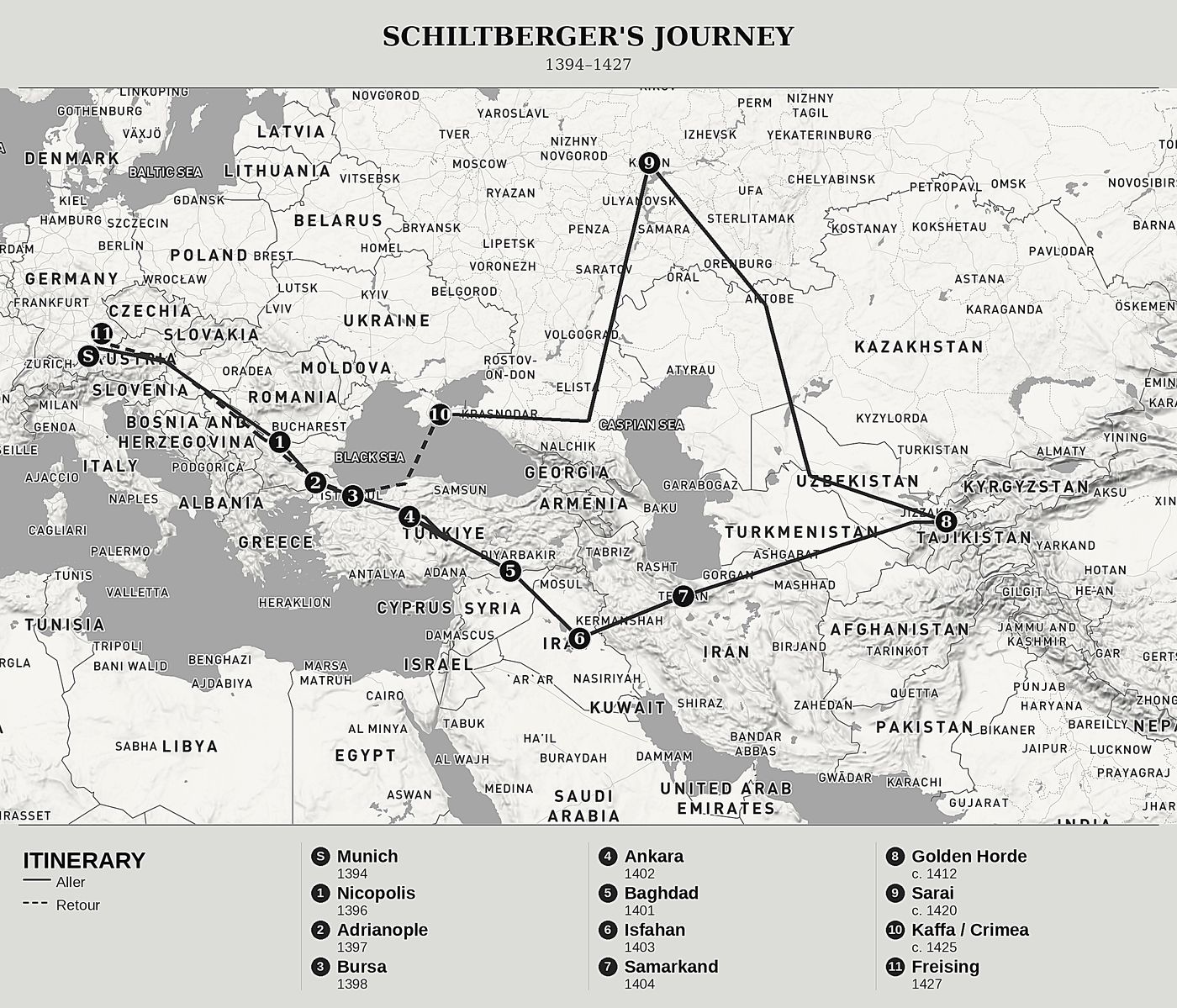
For six years he runs on foot before the horse of Sultan Bayezid I, through the campaigns that carry the Ottomans across Karaman, the lands of Burhan al-Din, and the conquest of Anatolia. Then Tamerlane defeats Bayezid at Ankara in 1402, ransoms the young captive, and takes him east to Samarkand. He watches Baghdad razed to the ground, the seven thousand children of Isfahan put to the sword, and the conqueror's army set out for India. When Tamerlane dies, Schiltberger passes to the service of his sons, Shah Rukh and Miran Shah, in Persia and the Caucasus, then spends four years under Miran Shah's son Abu Bakr. A fugitive Mongol prince, Çekre, drags him next across the steppe and through Siberia, among hairy tribesmen and sled dogs, into the Golden Horde. There he meets Sadur Malik, a Tatar queen leading four thousand horsewomen, and learns the Our Father in Armenian and Tatar. He crosses the Crimea, reaches Constantinople twice held sacred, makes two pilgrimages to Jerusalem under Muslim escort, and sees the wonders and sultans of Cairo. In 1427, serving his last master, Manyaš, he finally escapes on horseback and walks the rest of the way home to Munich.
Captured at sixteen, Schiltberger spent more than three decades as a captive, page, and soldier at the courts of Bayezid I, Tamerlane, and the princes of the Golden Horde before dictating his memoirs around 1430 to a scribe in Bavaria. First printed in Augsburg around 1473, his account is the earliest German eyewitness testimony on the post-Mongol Orient, and remains six centuries later one of the only Western views of that world from within. This edition modernizes the Frankfurt am Main print of 1570, a rare survival of the sixteenth-century tradition, and restores the narrative to the form in which it nourished European curiosity about the East for three hundred years.
Text modernized, illustrated, and annotated by Thierry Ruolz, this edition follows Schiltberger's own itinerary chapter by chapter, from the disaster of Nicopolis to the long road home, with maps, a glossary of the peoples and places he names, and the two Pater Noster prayers, in Tatar and in Armenian, that close his account.
Product details
- Publisher
- Itinerarium Éditions
- Series
- The Old Orient
- The author
- Johannes Schiltberger
- Date of the journey
- 1394-1427
- Modern edition by
- Thierry Ruolz
- Language
- English
- Format
- Paperback, 6 × 9 in (15.2 × 22.9 cm)
- Pages
- 210
- ISBN
- 978-2-489330-16-8
- Published
- June 2026
The author
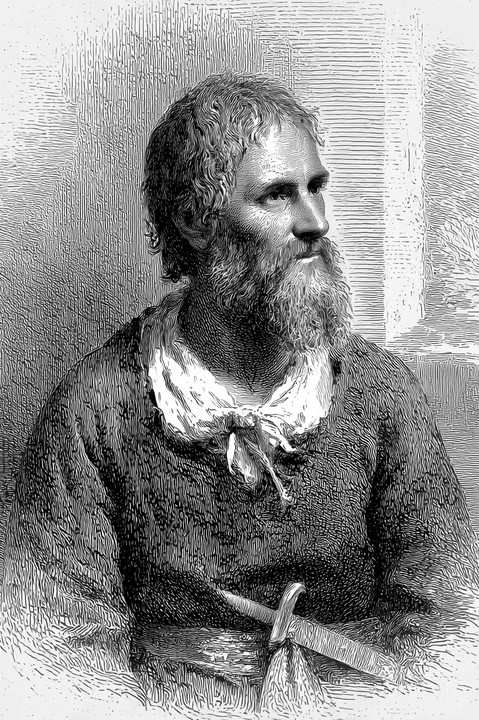
Johannes Schiltberger
Johannes Schiltberger (c. 1380-after 1427) was a Bavarian squire from Munich. Taken prisoner at the crusading defeat of Nicopolis in 1396 at the age of sixteen, he was successively a captive and page of the Ottoman sultan Bayezid I, of Tamerlane and his sons Shah Rukh and Miran Shah, then of the Mongol prince Çekre in the Golden Horde. He escaped in 1427 and walked from Crimea back to Bavaria, dictating his memoirs around 1430 to a scribe. This account, first published in Augsburg around 1473, is the earliest German first-hand testimony on the post-Mongol Orient.
All books by Johannes Schiltberger →Reisebuch: Our editorial work
This edition is not drawn from the manuscript. The original manuscript of the Reisebuch, dictated by Schiltberger around 1430, no longer exists; what is known of it comes down through later copies and printed editions, the most widely circulated of which, until the nineteenth century, was the one issued by the heirs of Weygand Han, printed in Frankfurt am Main around 1570. It is this text, not the version reconstructed at the end of the nineteenth century from the surviving manuscripts, that the present edition modernizes. The lineage is claimed deliberately: the aim was to give the English-speaking public the Schiltberger who circulated for three centuries in Germany, from the sixteenth to the eighteenth century, in the form through which he fed European culture's image of the Turkish and Tatar Orient, rather than a scholarly reconstruction of the lost manuscript. The present volume opens a road that passes through the 1570 print and through its contemporary charge, in the century of Suleiman the Magnificent.
The book's structure has been reworked. The Frankfurt print runs on without a break through hundreds of dense paragraphs, mixing personal narrative, Ottoman chronicles, Tatar ethnography, Muslim theology, and Eastern Christian controversies. To make continuous reading possible, the text has been redivided into chapters that follow the traveler's biographical chronology, from his departure from Munich in 1394 to his return on foot in 1427, grouping coherent geographical and thematic passages together. No episode has been moved out of its narrative context; the divisions follow the story's natural joints.
Before / after
Anfang der Histori. Ich Schildtberger / zohe auss von meiner heimat / auss der Statt Muenchen gelegen in Beyern / zu der zeyt / als Koenig Sigissmundus zu Hungern / in die heydenschafft zohe / das war / als man zaelt nach Christi vnsers lieben Herrn / vnd Seligmachers geburt. 1394. mit einem Herrn / genant Lienhart Reichertinger / Vnd kam widder auss der heydenschafft zu Landt / als man zaelt nach der geburt Christi / 1427. Was ich nu diese zeit / in den Landen der Heydenschafft fuer krieg / streit / vnd wunders erfahren / Auch was fuer Laender / Stett / Schloesser vnd wasser ich darinn gesehen / vnd gemerckt mag haben / von solchem allem / werd jr hernach hoeren.
I, Johannes Schiltberger, left my native city of Munich, in Bavaria, at the time when King Sigismund of Hungary was marching into infidel lands. It was the year 1394 after the birth of Our Lord and Savior Jesus Christ, and I set out in the service of a lord named Leonhard Reichartinger. I was young then, and I did not know what I was going into. The road to Hungary opened before us, and at the end of that road were the Turks, and beyond the Turks lands whose very names I did not know. I did not return until much later, by way of land, in the year 1427 after the birth of Christ.
The journey mapped
The modern editor