 Wild Americas · Modernised and illustrated edition
Journal of Jasper Danckaerts
Modernized, illustrated English edition of Journal of Jasper Danckaerts by Jasper Danckaerts (1679-1680). 434 pages.
New York, 1679. A Dutch missionary crosses colonial America and records everything: streets, farms, Indians, planters. A journal from the other side of the Atlantic, rewritten in modern English.
Read more ↓- 434 pages
- Paperback · Ebook (EPUB)
- English
- 17th century
About this book
June 1679. Two Labadist brothers leave a village in Friesland on a mission kept secret: to find, on the far side of the ocean, a land where their community can live out its faith. One of them, Jasper Danckaerts, keeps his journal day after day.
What he records there is priceless. Here is the New York of 1679, only just turned English, still thoroughly Dutch: its fort, its orchards, its muddy streets, its taverns full of sailors. Here are the farms of Long Island, the Lenapes of Najack sharing their cornmeal cake, the tobacco planters of Maryland, the Passaic Falls locked in ice. Here is the Hudson followed upstream to Albany, the fur trade, the mixed-blood interpreter Illetie, and the stories of a converted Mohawk. Here is Puritan Boston, and the long voyage home across the North Atlantic.
Danckaerts almost never judges. He watches. And his sober, attentive gaze crosses the centuries intact: this is colonial America captured at the moment when its world still stood, seen by a witness from elsewhere who did not know he was writing History.
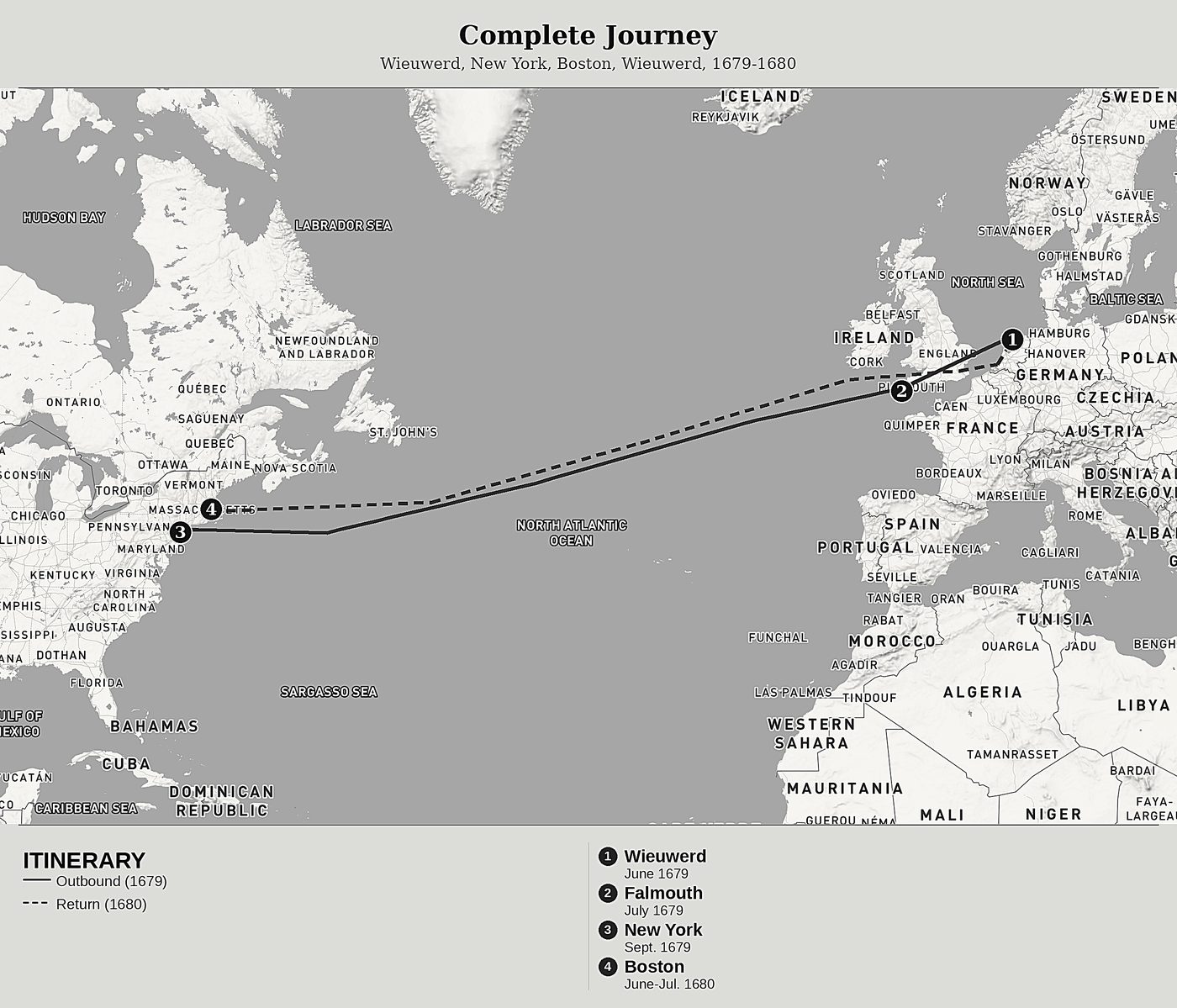
Danckaerts and Sluyter travel under false names, as ordinary men. That may be what gives their account its rare quality: doors open, tongues loosen. Over sixteen months on the road, they cross Manhattan, New Jersey, Delaware, the tobacco plantations of Maryland, follow the Hudson up to Albany and Schenectady, reach Boston and its fledgling colleges, then sail home to Holland by way of the North Atlantic and the Orkneys. Danckaerts describes an America soon to vanish beneath the English tide: he observes the Lenapes while they are still on their own land, listens to a converted Mohawk recount his visions, and crosses paths with Illetie, the mixed-blood woman who interprets at the fur trading post. This notebook lay dormant for nearly two centuries before it was found by chance in an Amsterdam bookshop. It had never before been made accessible to the English-speaking reader.
This is the first complete modern rewriting for today's reader, one that makes this testimony accessible without betraying anything of the original. Nineteen original illustrations and eight maps of the journey bring the route to life, while a full critical apparatus (timeline, index, afterword, selected passages from the original text, editor's note, further reading) illuminates the reading.
Product details
- Publisher
- Itinerarium Éditions
- Series
- Wild Americas
- The author
- Jasper Danckaerts
- Date of the journey
- 1679-1680
- Modern edition by
- Isabelle Perol
- Language
- English
- Format
- Paperback, 6 × 9 in (15.2 × 22.9 cm)
- Pages
- 434
- ISBN
- 978-2-489331-02-8
- Published
- July 2026
The author
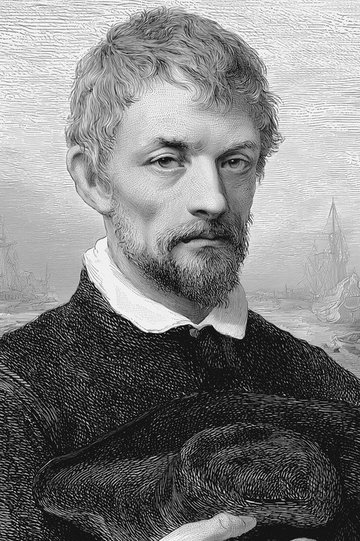
Jasper Danckaerts
Jasper Danckaerts (c. 1639-1704) was born in Flushing (Vlissingen), in Zeeland, under the name Schilders. Converted to the Labadist movement, he became one of the brothers of the community at Wieuwerd, in Friesland. In 1679, he was sent, together with Peter Sluyter, to seek out a land of refuge in America. His journal, kept day by day in Dutch, is one of the most precise and vivid testimonies on seventeenth-century colonial America: New York only just turned English, the Lenape and Mohawk peoples, the Dutch settlers, and the English planters of Maryland.
All books by Jasper Danckaerts →Journal of Jasper Danckaerts: Our editorial work
The journal of Jasper Danckaerts was never meant for continuous reading. It is a logbook, kept day by day, in which dates mark the text like so many milestones: "the 9th, Friday," "the 14th, Wednesday." Left in its raw form, this entry-by-entry structure chops up the narrative and tires the modern reader, who quickly loses the thread of a journey that was, in fact, continuous. We have therefore gathered the material into sixteen chapters, following the natural stages of the journey: the crossing, the arrival in New York, the descent to Maryland, the winter return, the ascent of the Hudson, the stay in Boston, the long return to Friesland. The dates remain, discreetly, but the narrative regains its flow.
The language required its own care. The source text we followed is an English translation of the Dutch original, faithful but dense, with long sentences that seventeenth-century usage allowed to pile up. We have unraveled them, one by one, restoring the words to the natural order of today's English, cutting what repeats and unfolding what remained too elliptical, without ever weighing down or impoverishing the observation. Where Danckaerts lingers, we condense; where he moves too fast, his elliptical thought has sometimes been given the word it lacked to be clear. The goal: that we may still hear the diarist's sober and attentive voice, freed from the heaviness of old turns of phrase.
Before / after
On the eighth of June, 1679, we left home at four o'clock in the morning, taking leave of those with whom God had joined us fast in spirit, they committing us, and we them, with tenderness of heart, unto the gracious protection of the Highest. Although for a time separated in body, we remained most closely united in soul, which is, always and everywhere, but one and the same. We went on foot to Oosterend, expecting there to take the canal boat, which we did, after waiting an hour.
On the 8th of June, 1679, at four o'clock in the morning, we left the house. It was still dark over Friesland, and the silence of the fields held something of prayer. We took leave of those whom God had so closely united with us in spirit, the brothers and sisters of our community whom we were leaving behind. They commended us to the gracious keeping of the Most High, and we did the same for them, our hearts tight with a tenderness that no distance could undo. Parted for a time in body, we remained joined in soul, which is, in every place and at every time, one and the same thing.
The journey mapped
The modern editor