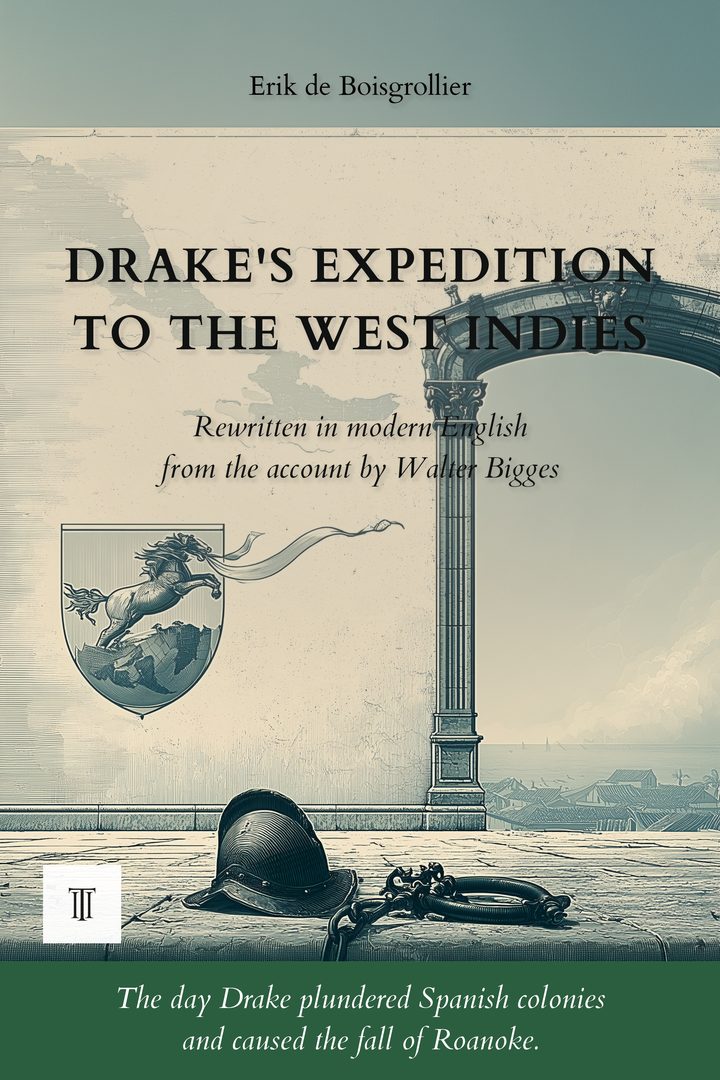
 Wild Americas · Modernised and illustrated edition
Drake's Expedition to the West Indies
Modernized, illustrated English edition of A Summarie and True Discourse by Walter Bigges (1585-1586). 124 pages.
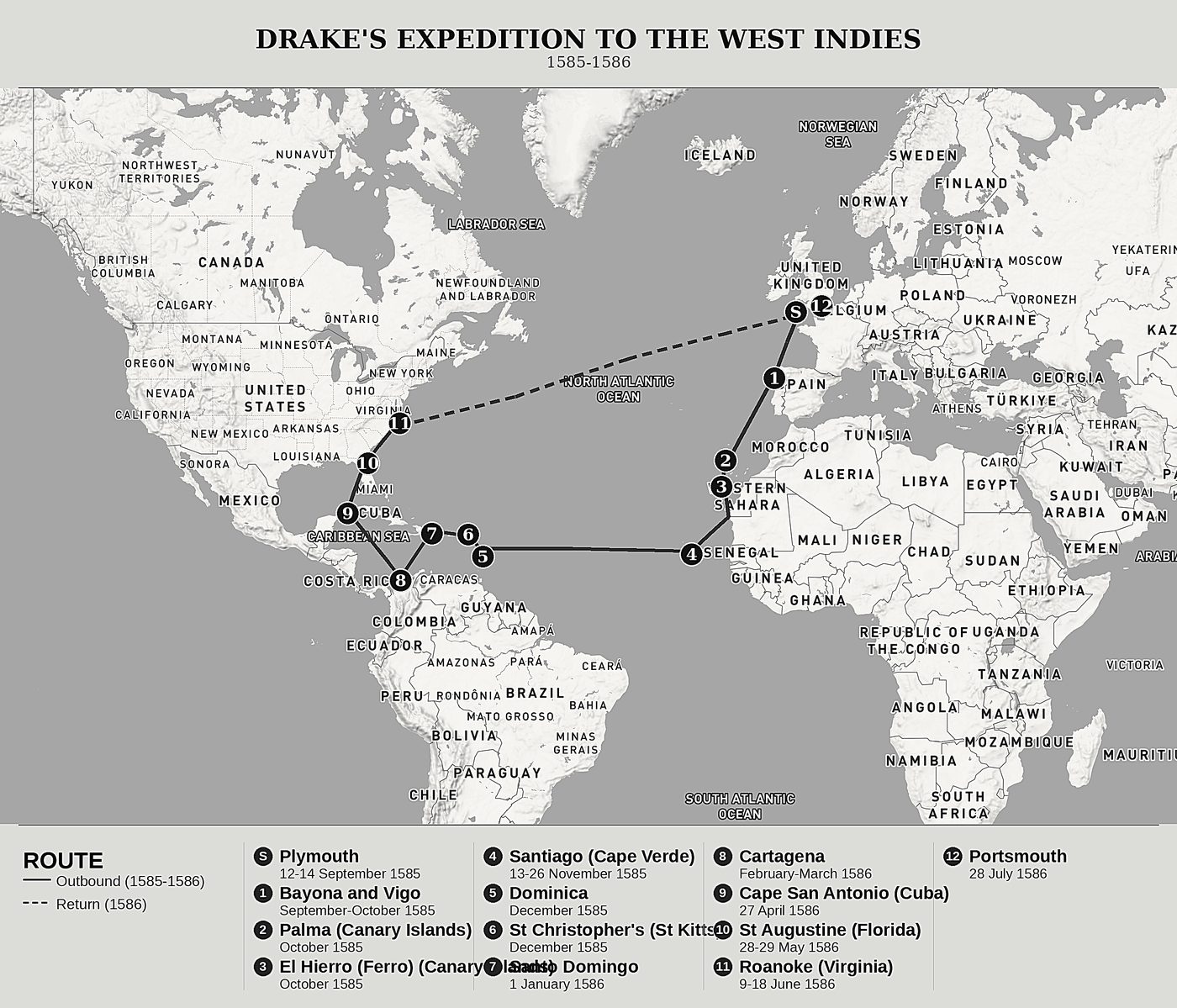
September 1585: Francis Drake sails from Plymouth with twenty-five sail to strike the Spanish empire in the West Indies. Captain Walter Bigges recounts this ten-month raid, from Santiago to Roanoke.
Read more ↓- 124 pages
- Paperback · Ebook (EPUB)
- English
- 16th century
About this book
September 1585. Twenty-five sail leave Plymouth with two thousand three hundred men aboard, soldiers and seamen crowded onto ships and pinnaces alike. England and Spain are not yet officially at war, but Sir Francis Drake sets out to strike Philip II's empire directly in his own colonies, carrying the fight across the Atlantic to Spanish soil.
Captain Walter Bigges, one of the ten land officers who go ashore first, keeps the journal of ten months of raids. Santiago in Cape Verde is taken at dawn and burned on departure. Santo Domingo, the oldest Spanish city in the Indies, is seized on New Year's Day through its two sea gates, held for a month, and ransomed for twenty-five thousand ducats. Cartagena is carried by night across a fifty-pace strip of sand, under the crossfire of two galleys, occupied for six weeks and ransomed for one hundred ten thousand ducats. Then comes the coast of Florida, where a fort of logs is burned and a timber town reduced to ashes.
Between one town and the next, the fever. It strikes the fleet eight days after Cape Verde and never lets go: two to three hundred dead within days, seven hundred fifty in all, and Panama that must be given up as a target. Bigges himself will not see England again: he dies at sea after Cartagena, and a companion takes up the pen to finish his account.
On the way home, a great fire burns on the coast of Virginia. One hundred three English colonists, settled for a year under the authority of Ralph Lane at Roanoke, wait for relief that does not come. Drake offers them a choice on which the future of the first English colony in America hangs: they re-embark with the fleet, ending the settlement attempt before it could take root. The account, published in London in 1589 on the eve of the Armada, remains one of the most precise firsthand narratives of the Anglo-Spanish rivalry in the West Indies and of the hesitant, violent beginnings of the English presence in North America.
This edition restores Bigges's text in full, complemented by a historical apparatus of glossary, chronology, index, and further reading, and by selected passages from the original English text, so as to set the account back in its context and let the curious reader compare this modernization with the language of 1589 by returning directly to the source.
Product details
- Publisher
- Itinerarium Éditions
- Series
- Wild Americas
- The author
- Walter Bigges
- Date of the journey
- 1585-1586
- Modern edition by
- Erik de Boisgrollier
- Language
- English
- Format
- Paperback, 6 × 9 in (15.2 × 22.9 cm)
- Pages
- 124
- ISBN
- 978-2-489331-19-6
The author
Walter Bigges
Walter Bigges was one of the ten land captains named at the head of Francis Drake's fleet in 1585, given command of a company of foot soldiers. Almost nothing is known of his life before the expedition: his name, printed without particular title, suggests he did not belong to the great English families. He keeps the journal of the raid on the West Indies in the first person plural, from Cape Verde to Cartagena de Indias, before dying at sea of the fever that decimates the fleet. A companion in arms finishes his account up to the return to Portsmouth on the twenty-eighth of July 1586. His name appears among the officers who died, in the list that closes the book published in London in 1589.
All books by Walter Bigges →A Summarie and True Discourse: Our editorial work
The book printed in London in 1589 under the title A Summarie and True Discourse of Sir Frances Drakes West Indian Voyage has no chapters. It is a single sweep of prose, from the embarkation at Plymouth to the table of guns taken, running unbroken across some thirty leaves. The only pauses in the original volume were the four engraved plates by Baptista Boazio, inserted at the points where the narrative refers to "this plate." We have divided this continuous flow into eight chapters that follow the ports of call, one per port or episode, and given them titles. The reader gains resting points; the overall order of the narrative has been kept, with a few rearrangements.
We have, however, removed the 1589 paratext: Thomas Gates's dedication to the Earl of Essex, the notice explaining that printing had been delayed by the approach of the Armada, and the table of pages indicating where to place the maps. These pieces speak to the English reader of 1589; the introduction restates what is needed to know. The references to Boazio's plates have been kept in the text: they are part of the way Bigges describes terrain, a map before his eyes. The copy we worked from did not include these plates, and the cartography of the present volume has been drawn up from scratch.
The English of 1589 writes a doubled v for a w, confuses u and v, i and j, and follows no fixed spelling for names or verbs alike. The real work fell on the sentence. Bigges writes as officers speak: one clause draws in the next by "and," "which," "as has been said," and the period stretches over fifteen lines before it comes to rest. We have opened up these periods, restored the order of subject, verb and object where the English of the time inverted it, and replaced the connecting tags with contemporary punctuation. Every distance, every sum, every ship's name has stayed in its place. Where the narrative turned elliptical, the Hawkins affair, "which you already know," for instance, we have left the ellipsis: it says something about the person this text was written for.
Before / after
This vvorthie Knight for the seruice of his Prince and Countrie, hauing prepared his vvhole fleete, and gotten them downe to Plimmouth in Deuonshire, to the number of fiue and twentie saile of ships and pinnaces, and hauing assembled of Souldiours and Marriners to the number of two thousand and three hundred in the vvhole, embarqued them and himselfe at Plimmouth aforesaid, the twelfth day of September 1585. being accompanied vvith these men of name and charge, vvhich hereafter followe.
This valiant knight served his prince and his country, and it was at Plymouth, in Devon, that he gathered the means to serve them. He had prepared his whole fleet and brought it together there, under the same fine rain and the same west wind: twenty-five sail, ships and pinnaces, those light, swift vessels that carry men where the greater ships cannot go. He had gathered soldiers and seamen, two thousand three hundred men in all. He embarked them, himself among them, at Plymouth, on the twelfth of September 1585, and with them went the men of rank and charge whose names follow.
The journey mapped
The modern editor