 Far North · Modernised and illustrated edition
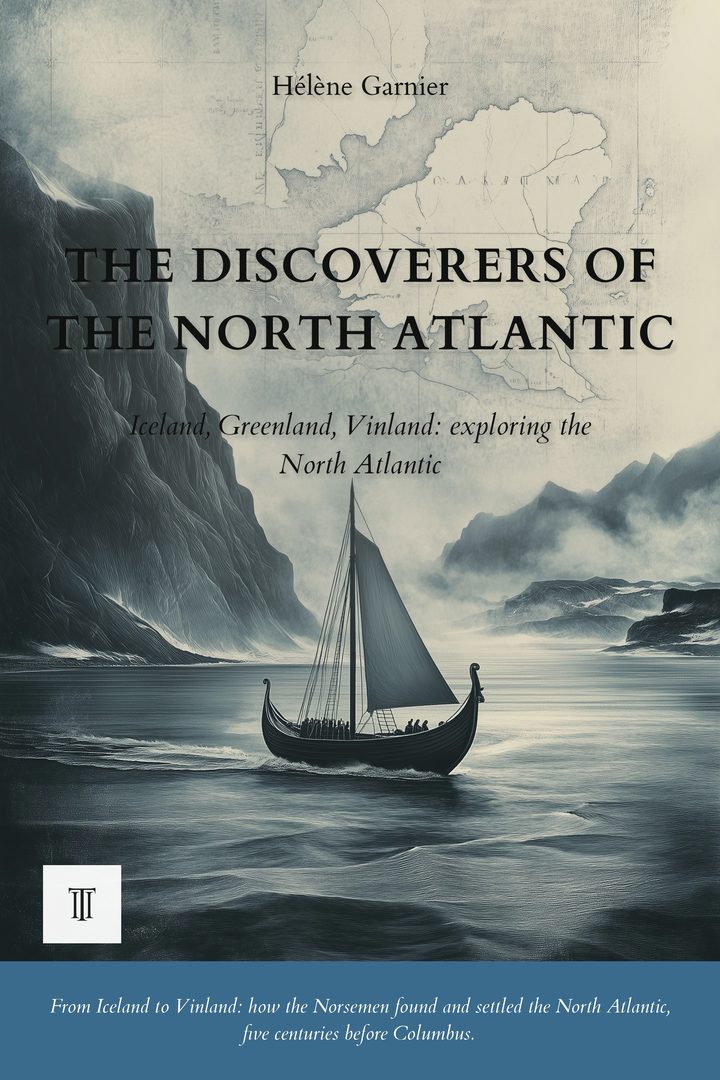
The Discoverers of the North Atlantic
Modernized, illustrated English edition of The Vinland Sagas (Landnámabók, Íslendingabók, Eiríks saga rauða) and other Icelandic sagas (c. 860-1000). 138 pages.
Around 860, storm-driven Norse sailors discover Iceland. Erik the Red invents Greenland; his sons reach America five centuries before Columbus. A Viking odyssey carried by the figure of Gudrid.
Read more ↓- 138 pages
- Paperback · Kindle
- English
- 9th century
About this book
Around 860, a ship bound from Norway for the Faroe Islands is driven west, far out to sea. At the end of its drift a strange land rises from the water, grey and high: it will be named Iceland. So begins the longest chain of discoveries of the Middle Ages, made almost always reluctantly, almost always by sailors who were looking for something else.
From the Iceland glimpsed by three storm-driven Vikings to the land of the vine that Leif the Lucky will reach, this account follows a century and a half of drift voyages, of named lands, and of first contacts. There is Ingolf, who settles Iceland; Erik the Red, banished, who invents Greenland and gives it the most beautiful misleading name in history; his sons, who reach America five centuries before Columbus; and Freydis, who plots a massacre in the snow.
At the heart of this epic of men searching for land walks a woman, Gudrid, to whom a seeress once promised an illustrious fate. She will bury husbands, give birth in America to the first European child born on the continent, then set out as a pilgrim all the way to Rome. Where the sailors cross the sea, she crosses time.
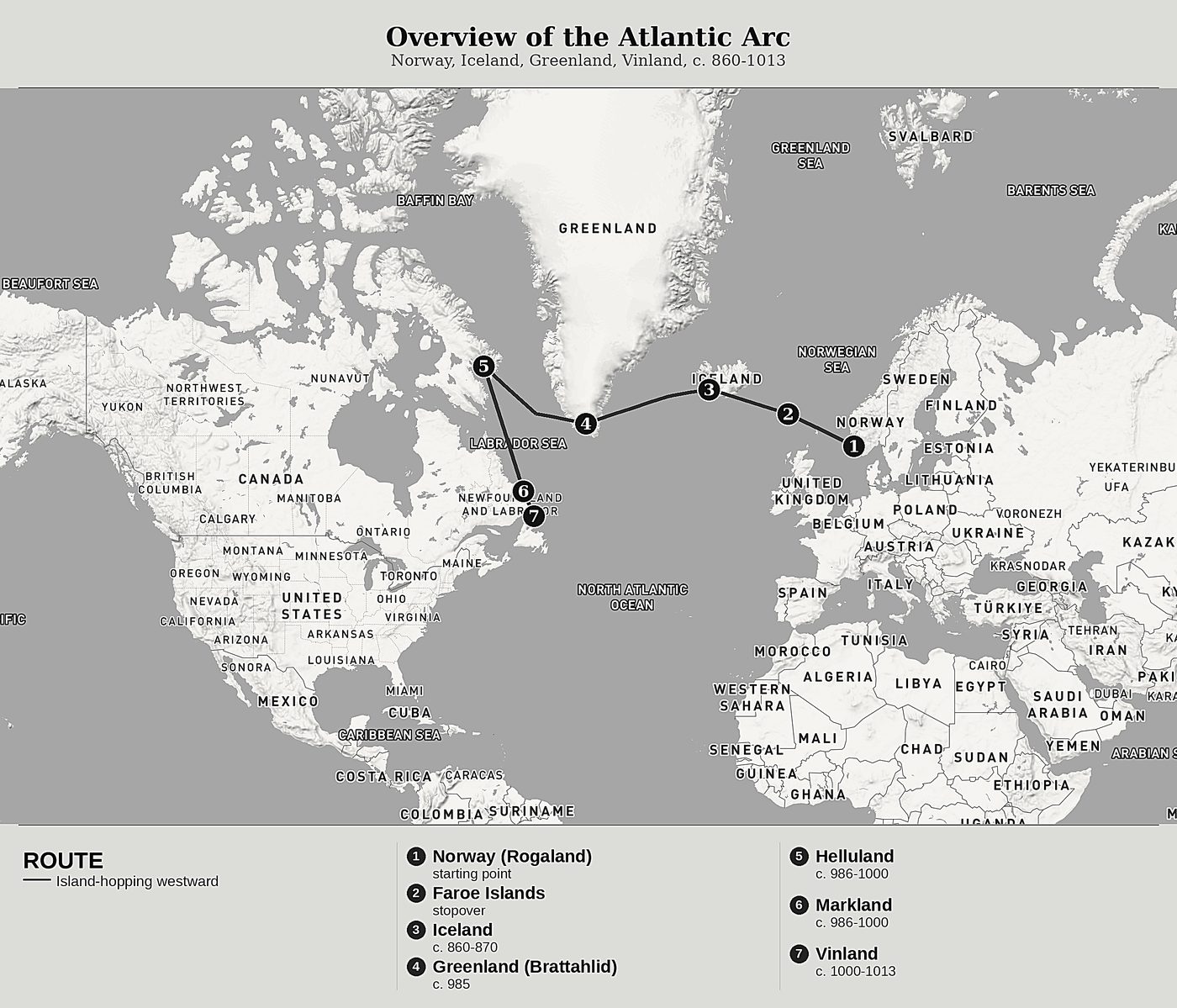
The journey follows fourteen stages, from the Iceland glimpsed by Naddodd around 860 to Karlsefni's attempt to settle Vinland around 1010-1013. Between the two, Ingolf founds Reykjavik, the chronicler Ari sets the memory of the settlement down in writing, Erik the Red discovers Greenland after a double banishment, and his sons, Bjarni, Leif, and Thorvald, reach in turn Helluland, Markland, and Vinland, lands the sagas name for what they offer: flat stones, forest, wild vine. The Skraelings, the native peoples encountered on these shores, mark the narrative first with peaceful exchanges, then with arrows.
Woven together from the Landnamabok, from the chronicler Ari's Islendingabok, and from the two Vinland Sagas, this book restores a world in which the chance of the winds decides discoveries as much as the courage of men. The divergences between the sources, embraced rather than smoothed away, speak the truth of a memory still uncertain about the death of Thorstein or of Thorvald, and give this account the flavour of a living testimony rather than a polished legend.
The first complete modern rewriting for today's reader, one that makes this account readable without betraying the original in any way. Twenty original illustrations and nine redrawn maps bring the itinerary to life, while a set of reference materials (glossary, timeline, index of places and people, further reading, editor's note, afterword) and selected passages from the original text accompany the reading.
Product details
- Publisher
- Itinerarium Éditions
- Series
- Far North
- The author
- Sagas norroises (Landnámabók, Íslendingabók, Sagas du Vinland)
- Date of the journey
- v. 860-1000
- Modern edition by
- Hélène Garnier
- Language
- English
- Format
- Paperback, 6 × 9 in (15.2 × 22.9 cm)
- Pages
- 138
- ISBN
- 978-2-489330-84-7
- Published
- July 2026
The author
Sagas norroises (Landnámabók, Íslendingabók, Sagas du Vinland)
The sources of this account are the great works of medieval Icelandic literature. The Landnamabok, the Book of Settlements, records the first settlers of Iceland and their lands. The Islendingabok, written around 1130 by the priest Ari Thorgilsson, known as Ari the Learned, was the first to set the memory of the settlement down in writing. The two Vinland Sagas, the Saga of Erik the Red and the Grœnlendinga saga, each tell, in their own way and not always in agreement, the crossing to America. Composed to pass on the memory of families rather than to persuade foreign readers, these accounts keep the grain of an oral word faithfully reported: nicknames, prophecies, wonders, and first contacts with unknown peoples.
All books by Sagas norroises (Landnámabók, Íslendingabók, Sagas du Vinland) →Landnámabók: Our editorial work
This book does not come from a single text, but from several Icelandic works which all, in their own way, tell of the conquest of the North Atlantic. The Landnámabók lists the settlers of Iceland; the Íslendingabók of the chronicler Ari fixes its framework; the two Vinland Sagas, the Grœnlendinga saga and the Saga of Erik the Red, carry the story as far as the shores of America. Our first task was to weave these scattered threads into a single chain, from the first Norseman driven off course to Iceland down to the last voyage west.
The difficulty lay in the overlap between the two sagas, which tell of the same voyages without ever quite agreeing. We have given the founding of Greenland to the Saga of Erik the Red, and kept from its version of Karlsefni's great voyage only a tightened account, through which pass the camp at Straumfjord, the bay of Hóp, the hunter Þorhallr faithful to Thor and the strange one footed man. The Grœnlendinga saga carries the backbone of the Vinland cycle in sequence: Bjarni who sights the coasts, Leif who lands, Thorvald who dies there, Karlsefni who tries to found a colony, Freydis who plots the massacre. Where the two texts diverge, we have not tried to force them into agreement. Thorstein dies in both, Thorvald in two different ways, by a Skræling arrow in the Grœnlendinga, by the arrow of a one footed man in the Saga of Erik: these contradictions are left as they stand, for they tell the truth of a memory that hesitates.
Before / after
It is thus told, that there were certain men who needed to journey out of Norway to the Faereys, some name Naddodh the wicking as being one of them. But they were driven west into the sea, and there they found a great land. They walked up a high mountain in the East-friths, and looked far and wide to see if they could see smoke or any token that the land was settled, but they saw none. They went back at harvest-tide to the Faereys, and as they sailed from the land there fell great snow upon the hills, wherefore they called the land Snow-land. They praised the land much.
They put in on the side of the eastern fjords and climbed a high mountain to survey it. From up there they scanned the horizon for a long while, looking for smoke, a fire, the smallest sign that a man might live somewhere on those slopes. They saw nothing. The land was empty. In the autumn they took to the sea again for the Faroes, and as they drew away from the coast, a heavy snow began to cover the mountains behind them. So they called this country Snaeland, the land of snow. On their return, they praised it highly.
The journey mapped
The modern editor