 The Old Orient · Modernised and illustrated edition
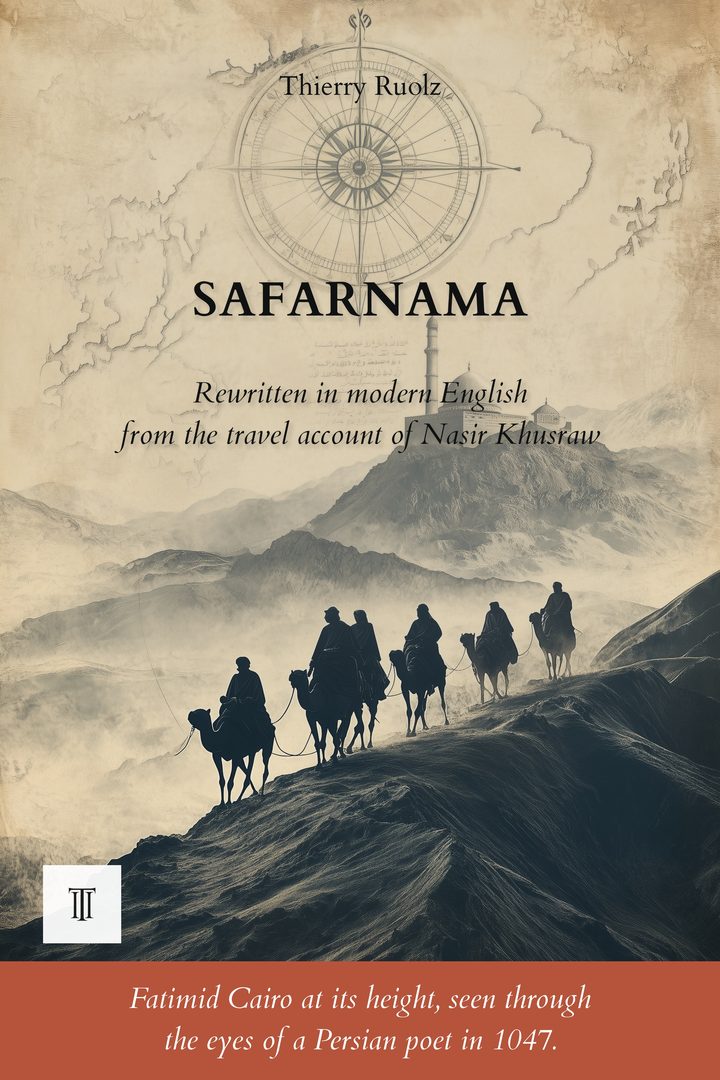
Safarnama
Modernized, illustrated English edition of Book of Travels (Safarnama) by Nasir Khusraw (1045-1052). 258 pages.
In 1045, a Persian official leaves everything behind to seek what elevates the mind. Over seven years, Nasir Khusraw crosses Fatimid Cairo, Jerusalem, and Mecca: the first great travel journal of the medieval Muslim world.
Read more ↓- 258 pages
- Paperback · Ebook (EPUB)
- English
- 11th century
About this book
December 1045, in Khorasan. Nasir Khusraw, a senior Seljuk finance official from Merv, secretary to the treasury and, by his own account, no stranger to wine, dreams one night of a stranger who orders him to seek what elevates the mind rather than what dulls it. Three months later, at forty-one, he leaves his post, his house, and his belongings, and sets out on the road with his younger brother and a young Indian servant.
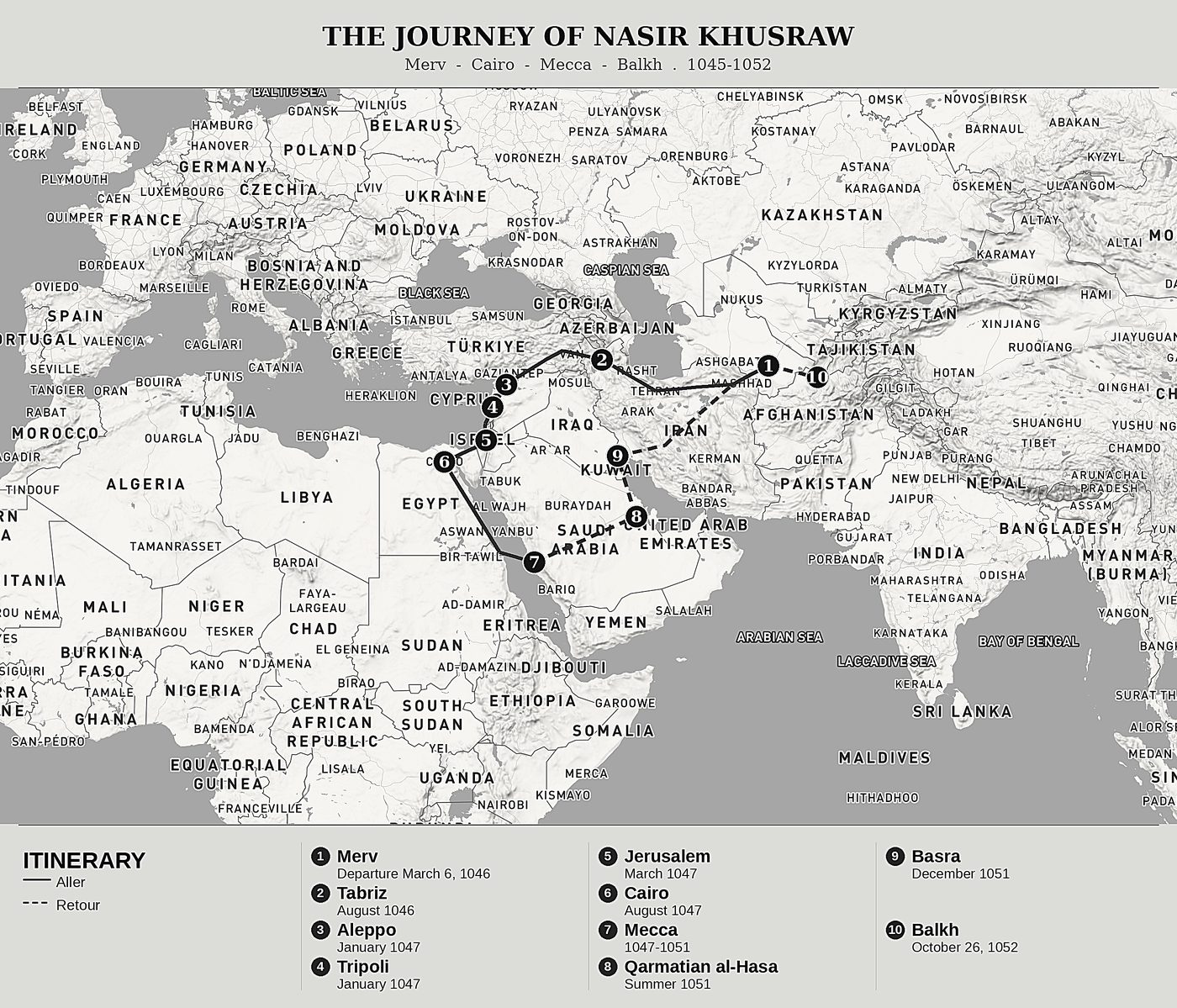
For seven years, and two thousand two hundred and twenty farsakhs, close to thirteen thousand kilometers, he crosses Persia, the Caucasus, Syria, and Palestine before reaching Fatimid Egypt, where he settles for three years. He visits Tabriz, still scarred by earthquakes, follows the Syrian coast half a century before the Crusades, and measures the Haram al-Sharif of Jerusalem cubit by cubit. In Fatimid Cairo he witnesses the public processions of Caliph al-Mustansir, then travels on to the Hejaz and Yemen, completing the pilgrimage to Mecca four times. He discovers the Qarmatian utopia of al-Hasa, comes back down through Basra and Fars, is saved along the way, ragged and penniless, by a Persian merchant who recognizes him, and finally reaches Balkh again in October 1052.
Fifty years before the fall of Jerusalem to the Crusaders, a hundred and twenty before the collapse of the Fatimid caliphate, Nasir Khusraw's journal offers a unique photograph of a vanished world. Kept as a diary along the road, it remains, nine centuries later, an unmatched eyewitness account of the Muslim Near East on the eve of the Crusades. The first great travel account of the Persian-speaking world, the Safarnama is also the record of a conversion: the man who comes home is no longer the one who left. He would become an Ismaili missionary, be persecuted for his faith, and end his days in exile in the mountains of the Pamir.
This modernized edition is based on Charles Schefer's 1881 French translation of the Persian text and includes 15 original illustrations, 5 maps of the journey, an 80-term glossary, a detailed timeline, two indexes of persons and places, an afterword on Nasir Khusraw's fate after the journey, selected passages from the original text, and an editor's note on the sources and the method of modernization.
Product details
- Publisher
- Itinerarium Éditions
- Series
- The Old Orient
- The author
- Nasir Khusraw
- Date of the journey
- 1045-1052
- Modern edition by
- Thierry Ruolz
- Language
- English
- Format
- Paperback, 6 × 9 in (15.2 × 22.9 cm)
- Pages
- 258
- ISBN
- 978-2-489330-44-1
- Published
- June 2026
The author
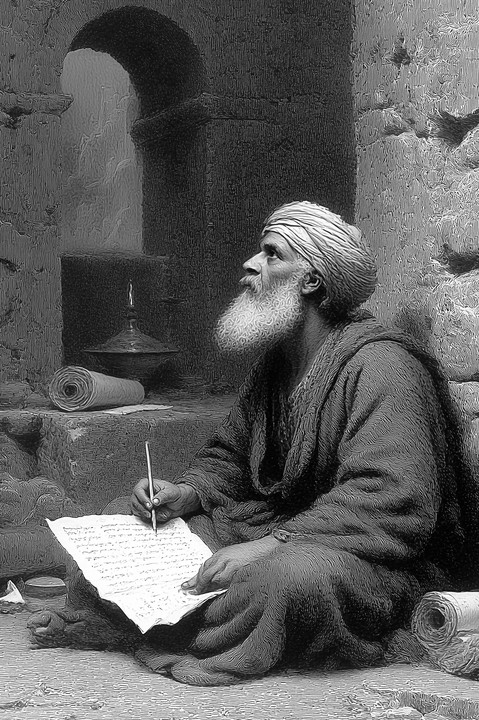
Nasir Khusraw
Nasir Khusraw (c. 1004-c. 1088) was a Persian poet, philosopher, and traveler born in Qubadiyan in Khorasan. Secretary to the treasury of the Seljuk sultan, he abandoned his post in December 1045 after a founding dream and undertook a seven-year journey across the Muslim Near East. His Safarnama, the first great travel journal of Persian literature, is the account of that journey. On his return, converted to Ismailism, he became a missionary and preacher, was persecuted by the Sunnis, and ended his days in exile at Yumgan in Badakhshan (present-day Afghanistan), where he composed philosophical treatises and poems still celebrated today throughout the Persian-speaking world.
All books by Nasir Khusraw →Safarnama: Our editorial work
This edition draws on a single modern witness: the complete French translation of the Safarnama published in Paris in 1881 by Charles Schefer, in the second series of publications of the École des langues orientales vivantes. Schefer worked directly from the Persian text, which he had established by collating the manuscripts he had been able to gather. More than a century later, his translation remains the reference French version of the journal. It suffers, however, from two traits that distance it from today's reader: a learned nineteenth-century French that has aged, and an abundance of scholarly notes where, on some pages, the commentary takes up more space than the narrative.
The structure of the source text has been kept. Nasir Khusraw does not divide his journal into chapters: he keeps it stage by stage, city after city. To make continuous reading possible, the narrative has been divided into sixteen chapters corresponding to the great geographical sequences of the journey, from the dream at Juzjanan to the return to Balkh. No passage has been moved; the breaks follow the natural hinges of the journal.
Modernization concerned spelling and syntax first. Schefer's nineteenth-century spellings (khalife, Kaire, Mostansser, fathimite) have been normalized to standard modern usage: caliph, Cairo, al-Mustansir, Fatimid. The long, multiply subordinated sentences frequent in Schefer's learned French have been brought back to their frame, word order restored to the natural sense of the target language, so as to spare today's reader the heaviness of period phrasing. For tense, the simple past has been used throughout, for both the first-person narrative and the third-person historical passages, so that Nasir's account keeps the immediacy of a journal kept day by day. Nasir's voice, in the I and the we, alongside his brother Abu Sa'id and their young Indian servant, has been preserved throughout.
Before / after
Une nuit, je vis en songe un personnage qui m'adressa la parole en ces termes : « Jusques à quand boiras-tu ce vin qui prive l'homme de la raison ? Il vaudrait mieux que tu fisses un retour sur toi-même. » « Les sages, lui répondis-je, n'ont rien pu trouver de meilleur que le vin pour dissiper les soucis de ce monde. » « La perte de la raison et de la possession de soi-même, répliqua-t-il, ne donne pas le calme à l'esprit ; le sage ne peut donc recommander à personne de se laisser guider par la démence. Il faut, au contraire, rechercher ce qui augmente l'esprit et l'intelligence. »
"How long will you drink this wine that robs a man of his reason? It would be better for you to turn back upon yourself." I believed I had a good answer, the kind one is proud of at the table. "The wise," I said to him, "have found nothing better than wine to dispel the cares of this world." "The loss of reason," he replied, "and the forgetting of oneself, do not restore calm to the mind. No wise man can counsel a man to let himself be led by madness. Seek instead what increases the mind and the intelligence."
The journey mapped
The modern editor