 Hidden Asia · Modernised and illustrated edition
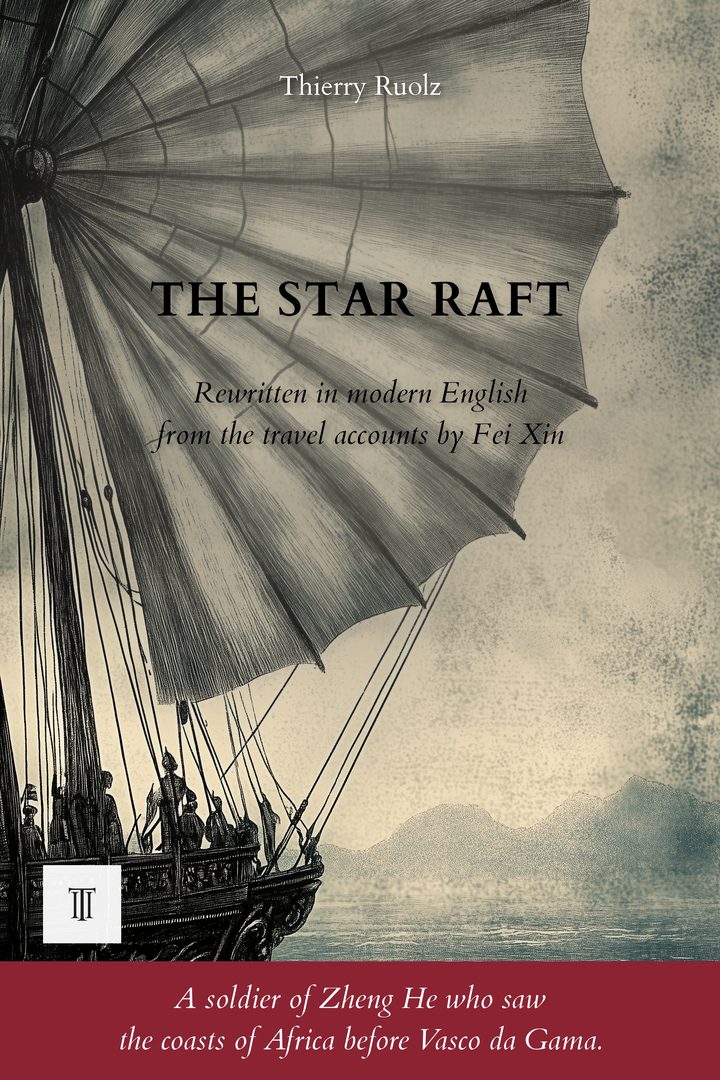
The Star Raft
Modernized, illustrated English edition of Xingcha shenglan by Fei Xin (1409-1433). 134 pages.
Half a century before Vasco da Gama, a soldier of Zheng He's fleet describes forty-four countries across Asia, the Indian Ocean, Arabia, and East Africa. A Chinese view of the fifteenth-century world.
Read more ↓- 134 pages
- Paperback · Ebook (EPUB)
- English
- 15th century
About this book
In 1409, Fei Xin, a young rank-and-file soldier embarked on the giant junks of Admiral Zheng He, left the shores of China for one of the most extensive voyages ever undertaken. For more than twenty years, across successive expeditions of the treasure fleet, he sailed the China Sea, the Indian Ocean, the Persian Gulf, and the shores of the Horn of Africa.
Born around 1385 into a modest family, Fei Xin inherited a hereditary military post that placed him, while still young, aboard Zheng He's treasure ships in 1409. A soldier of modest fortune but a literate man, with a keen eye and a taste for words, he took part in at least four of the great Ming maritime expeditions, under the reigns of the Yongle and Xuande emperors. Around 1436, from these crossings that carried him from the South China Sea to the coast of East Africa, he drew together The Star Raft, a collection of forty-four regional notices, each one closed by a poem.
From country to country, he records everything: the splendor of kings, the startling customs, the goods and the trade, the legends of flying heads and of widows cast onto funeral pyres. Champa and its lunar calendar, populous Java, Palembang and its captured pirate, Ceylon and the footprint of the Buddha, Hormuz and its mountains of salt, Mecca and its black stone, Bengal and its gold-covered court: forty-four lands pass in review, each one closed by a poem.
What this forgotten witness wrote six centuries ago, before Europe opened the same routes, sketches a globalization that came from elsewhere, and one that resonates strangely with our own. His testimony, that of a simple crew member rather than an official envoy, offers a rare Chinese view of societies that Europe would not encounter for generations to come.
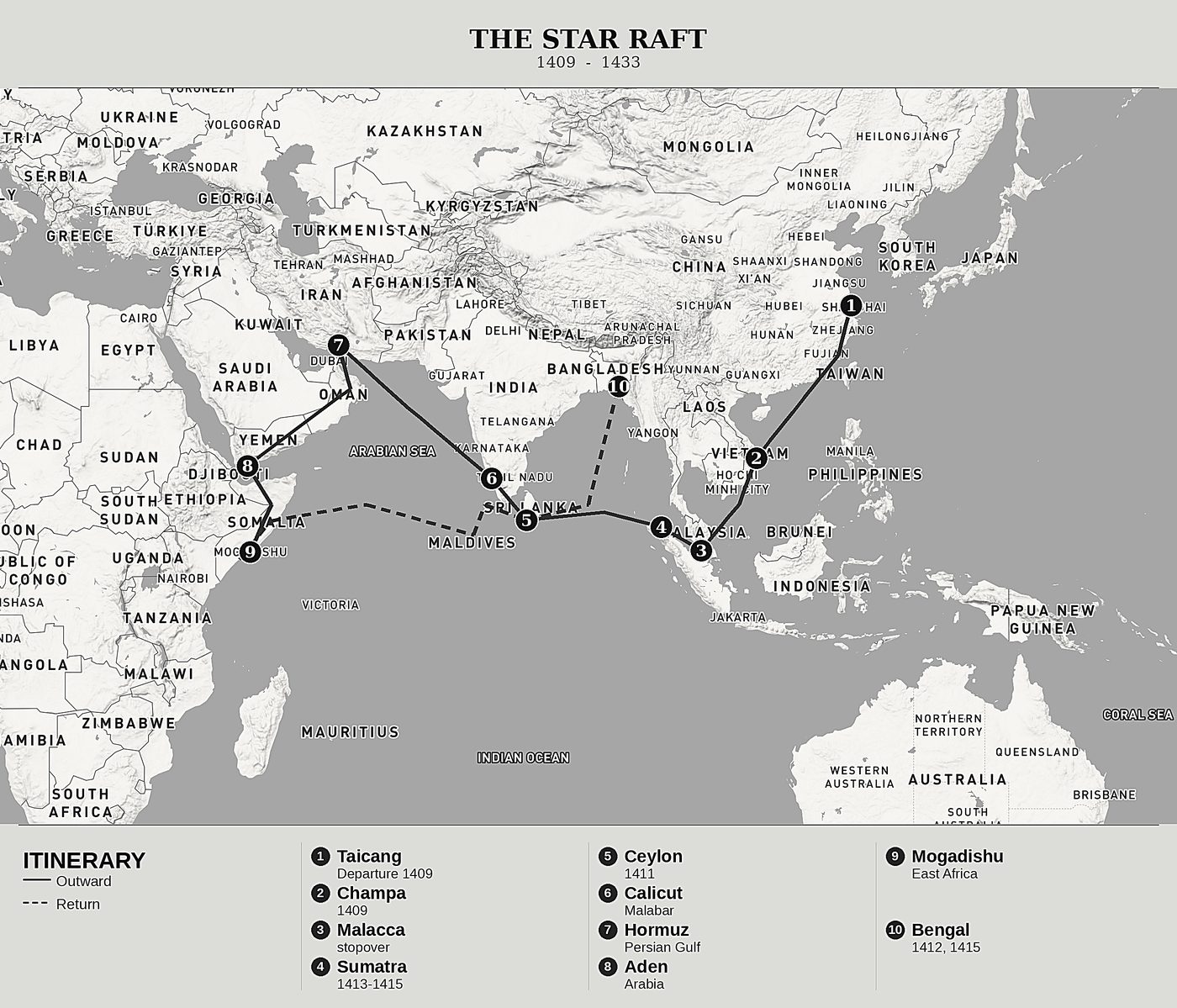
The first complete modern translation for today's reader, this edition renders the testimony legible without betraying anything of the original. Twenty original illustrations and nine redrawn maps bring the itinerary to life, while a full critical apparatus, glossary, chronology, index, editor's note, afterword, original text, and further-reading suggestions, together with selected passages from the original text, accompany the reading. The Star Raft joins the Forgotten Travel Journals collection, within the Hidden Asia series.
Product details
- Publisher
- Itinerarium Éditions
- Series
- Hidden Asia
- The author
- Fei Xin
- Date of the journey
- 1409-1433
- Modern edition by
- Thierry Ruolz
- Language
- English
- Format
- Paperback, 6 × 9 in (15.2 × 22.9 cm)
- Pages
- 134
- ISBN
- 978-2-489330-68-7
- Published
- July 2026
The author
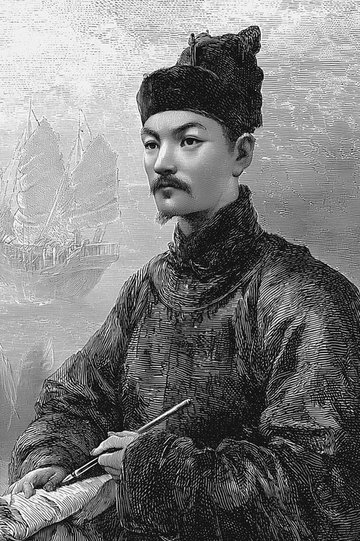
Fei Xin
Fei Xin (费信) was born around 1385 into a modest family. An inherited military post placed him, while still young, aboard Admiral Zheng He's treasure ships around 1409. A soldier of modest fortune but a literate man, with a keen eye and a taste for words, he took part in at least four of the great Ming maritime expeditions, under the reigns of the Yongle and then Xuande emperors. From these crossings, which carried him from the South China Sea to the coast of East Africa, he drew, around 1436, The Star Raft, a collection of forty-four regional accounts, each one closed by a poem. His testimony, that of a simple crew member, offers a rare Chinese view of societies that Europe would not encounter for generations to come.
All books by Fei Xin →Xingcha shenglan: Our editorial work
Fei Xin's collection did not originally present itself as a book to be read from beginning to end. It was a sequence of forty-four entries placed side by side, each devoted to a country and built on the same invariable mold: location, terrain, climate, customs, economy, produce, trade goods, occasionally an imperial anecdote, then a formal poem to close. A preliminary table, redundant with what followed, opened the whole. We have chosen to remove it, the only cut in the entire edition, and to regroup the entries into ten chapters that faithfully follow the order of the voyage, from the Malay world to the Indian Ocean, Arabia, East Africa, and Bengal. No entry, no poem has been left out: all forty-four poems are here, in their place.
The most delicate matter concerned the language itself. Fei Xin writes in the classical Chinese of the scholars, a language of extreme concision, without articles or auxiliaries, where the subject is left to be guessed and four characters suffice to set a scene. Rendering this in readable English required unfolding what was too elliptical without ever weighing the sentence down, cutting what repeated identically from one entry to the next, and restoring word order to the natural sense of today's English. This work was done sentence by sentence, almost word for word: restoring a subject pronoun here, supplying an implied verb there, turning a dry enumeration of goods into a sentence that breathes, without ever adding anything the text did not contain. The recurring formulas, those surveyor's refrains that return from country to country, "the climate there is constantly hot," "sea water is boiled to draw out the salt," have been kept as a signature of Fei Xin's gaze, but varied just enough not to grow wearisome.
Before / after
永樂七年己丑,上命正使太監鄭和等統領官兵,駕使海船四十八號,往諸番國開讀賞賜。是歲秋九月,自太倉劉家港開船,十月到福建長樂太平港泊。十二月,福建五虎門開洋,張十二帆,順風十晝夜,至占城國。
In the seventh year of the Yongle era, the year ji-chou, the emperor ordered his principal envoy, the eunuch admiral Zheng He, to take command of the officers and troops and lead forty-eight seagoing ships to the foreign kingdoms, there to proclaim the imperial edicts and distribute the gifts of the throne. This double dating, by the reign era and by the sexagenary cycle, marks the year in which the fleet put to sea. In the ninth month of autumn, it set sail from the port of Liujia, at Taicang. In the tenth month, it reached the port of Taiping, at Changle, in Fujian, where it anchored.
The journey mapped
The modern editor