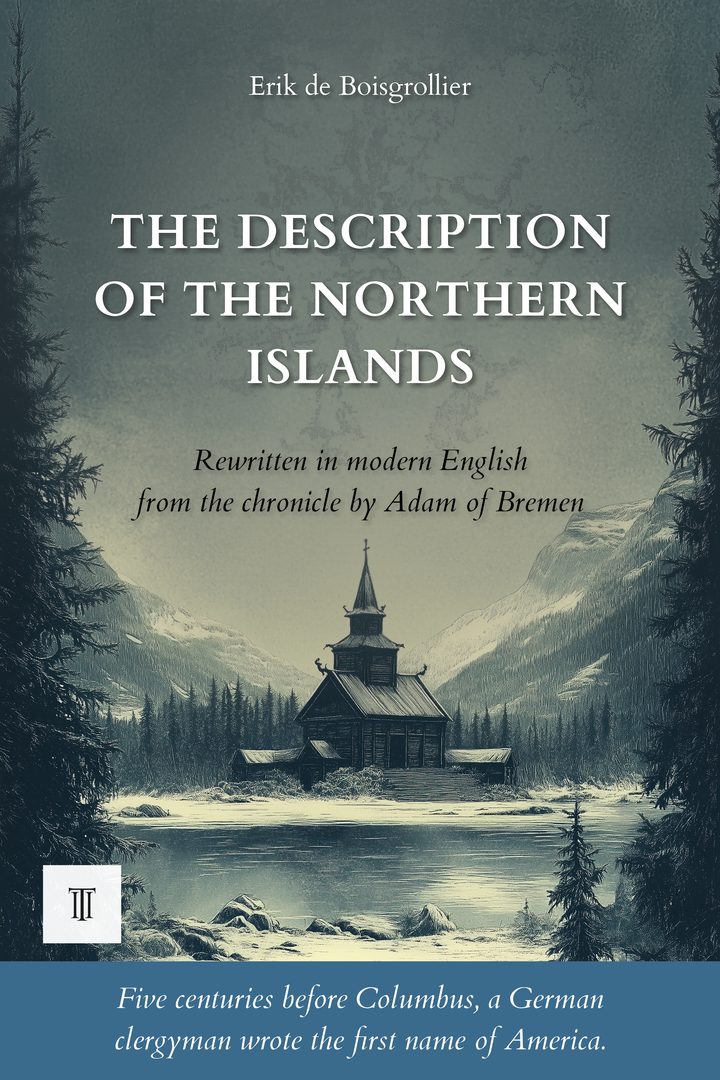
 Far North · Modernised and illustrated edition
The Description of the Northern Islands
Modernized, illustrated English edition of Description of the Islands of the North (Gesta Hammaburgensis ecclesiae pontificum) by Adam de Brême (c. 1075). 160 pages.
Around 1075, a canon of Bremen drafts the first written portrait of Scandinavia, Iceland, Greenland, and the mysterious Vinland, without ever leaving his cell.
Read more ↓- 160 pages
- Paperback · Kindle
- English
- 11th century
About this book
Around 1075, in his scriptorium at Bremen, a canon of the archdiocese of Hamburg-Bremen who has never seen the open sea sets out to map the ends of the earth. He has scarcely traveled beyond the mouth of the Elbe, yet he means to fix on parchment everything that lies farther north, where no cleric of his rank has ever set foot.
Adam of Bremen never traveled to the lands he describes. But he questioned the kings, sailors, and missionaries who returned from the North, and from their words he drew the oldest written description of the Nordic world. Across his pages pass the Danish kings who slaughter one another for the throne, the Ascoman pirates who ransom the Baltic Sea, the golden temple of Uppsala where the bodies of the sacrificed hang from its sacred trees, and the missionaries who smash idols at the risk of their lives. His instrument is not the sail but the ear: above all he gains the ear of a king, Sweyn Estridsson, the living memory of the North, who entrusts him with kingdoms, battles, and shipwrecks as an inheritance to be set down for posterity.
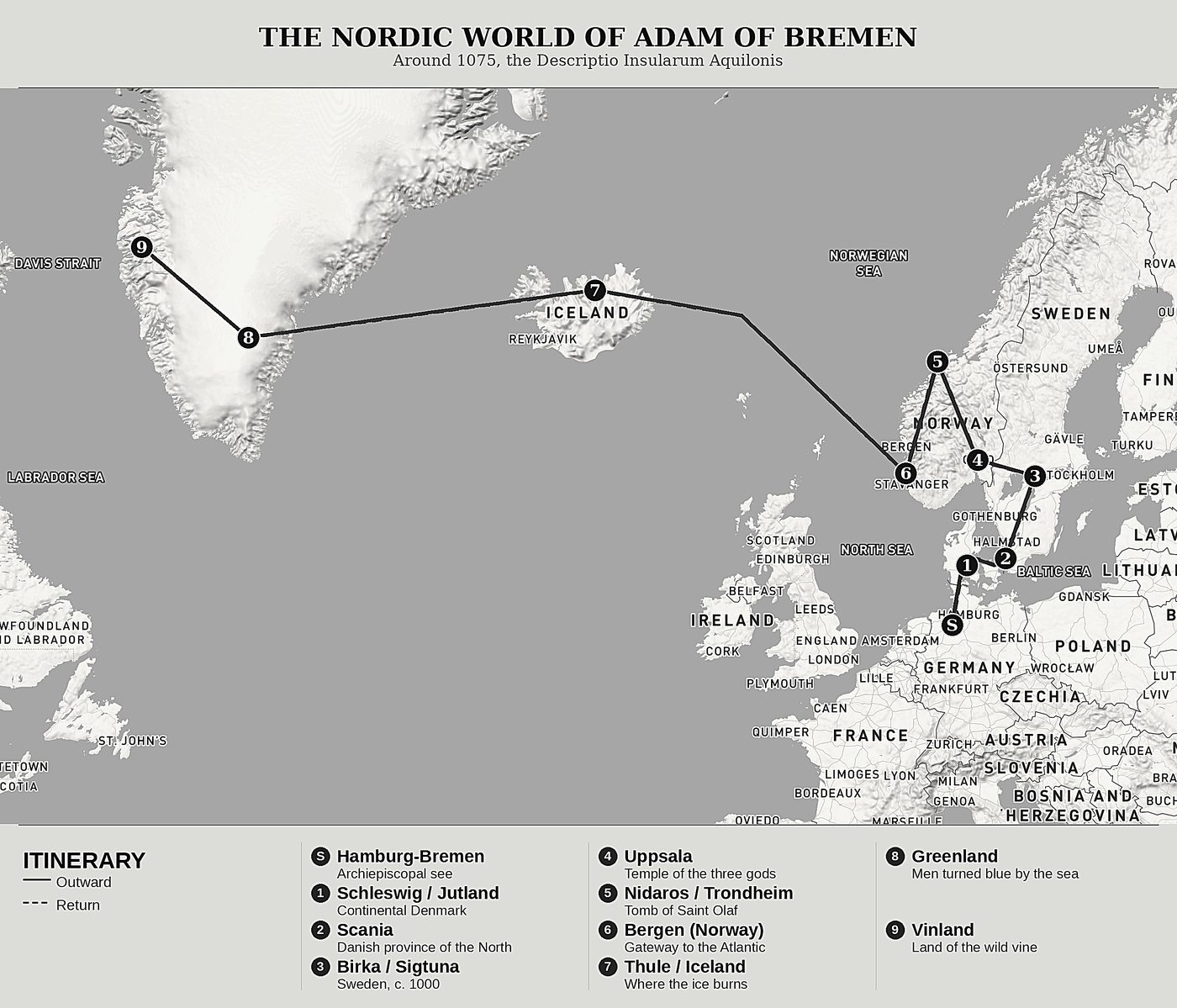
Then the narrative races toward the edges of the world: Iceland, where the ice itself seems to catch fire; Greenland, land of men turned blue by the salt spray of the northern seas; and that distant country where the vine grows wild of its own accord, Vinland, whose name Adam is the first writer in history to set down on parchment, nine centuries before archaeological excavations would prove him right. Beyond even Vinland opens the gulf of darkness, the place where, in the geography of Adam's century, the known world comes to its end.
The first written portrait of Scandinavia, Iceland, and the threshold of America, this unique eleventh-century testimony blends the most surprising factual accuracy with pure marvel, often within the same page. No complete English translation of this text had previously been made available to the general reading public.
The present edition modernizes the text based on the Latin critical edition by Lappenberg and Waitz (Hanover, 1876), collated against the later Schmeidler edition, and brings together the Descriptio Insularum Aquilonis, the fourth and final book of the Gesta Hammaburgensis Ecclesiae Pontificum, with selected passages from the chronicles of the kings and the missions of the North drawn from Books II and III. The whole is reorganized into twenty continuous chapters, and Adam's own marginal scholia are preserved throughout. This edition is illustrated with eighteen engravings, accompanied by ten original maps, a glossary of Nordic terms, a detailed chronology of the events described, and a double index of characters and places.
Product details
- Publisher
- Itinerarium Éditions
- Series
- Far North
- The author
- Adam de Brême
- Date of the journey
- v. 1075-1080
- Modern edition by
- Erik de Boisgrollier
- Language
- English
- Format
- Paperback, 6 × 9 in (15.2 × 22.9 cm)
- Pages
- 160
- ISBN
- 978-2-489330-89-2
- Published
- May 2026
The author

Adam de Brême
Adam of Bremen was an eleventh-century German canon attached to the archdiocese of Hamburg-Bremen, the principal missionary see of the Nordic world. Around 1075-1080, he wrote the Gesta Hammaburgensis Ecclesiae Pontificum, a history of the Church of Hamburg and its missions among the peoples of the North. Book IV, the Descriptio Insularum Aquilonis, is the first systematic description of Scandinavia, Iceland, Greenland, and Vinland. Never a traveler himself, Adam built his work from the accounts of Sweyn Estridsson, king of Denmark, and other witnesses. His text remained, for two centuries, the most complete source on the northern edges of the known world.
All books by Adam de Brême →Gesta Hammaburgensis Ecclesiae Pontificum: Our editorial work
Adam of Bremen's work, the Gesta Hammaburgensis Ecclesiae Pontificum, is first of all a history of the archbishops of Hamburg, divided into four books. This edition does not keep all of it. Book I, devoted to the distant origins of the see, has been set aside. We have kept the whole of Book IV, the famous Descriptio insularum Aquilonis, which forms the geographical heart of the work, and joined to it a selection of those passages from Books II and III that tell of the northern missions and the kings of the North. This choice gives the reader a continuous narrative, from the first conversions in Denmark to the gulf of darkness where the world comes to an end, without the purely institutional developments that shed little light on the voyage. The plan has been reorganised into twenty thematic chapters, where the Latin text followed the order of the episcopates and the numbering of the medieval chapters.
No recent and complete English rendering of the Descriptio was available to the general reader. The few partial translations in existence, most of them from the nineteenth century, carry an aged language and a philological apparatus that puts them beyond the reach of the non specialist. It is that gap this edition sets out to fill.
Before / after
Aurum ibi plurimum, quod raptu congeritur pyratico. Ipsi enim pyratae, quos illi Wiclingos appellant, nostri Ascomannos, regi Danico tributum solvunt, ut liceat eis praedam exercere a barbaris, qui circa hoc mare plurimi abundant. Unde etiam contingit, ut licentia, quam in hostes acceperunt, saepe abutantur in suos; adeo fide nulla utrique ad invicem sunt, et sine misericordia quisque alterum, mox ut ceperit, in ius famulicii vel socio vendit vel barbaro…
But what strikes the stranger, in this rich island, is the source of its wealth. Gold abounds there; only this gold did not grow in its fields. It is the plunder of brigandage. The pirates who scour these waters, whom the inhabitants call Wiclings and whom our people call Ascomans, the men of the boats, have struck a bargain with the Danish king: they pay him tribute, and the king, in exchange, grants them the right to go plunder the barbarian peoples who swarm all around this sea. Thus the crown takes its share of the sack and the burning.
The journey mapped
The modern editor