 Far North · Modernised and illustrated edition
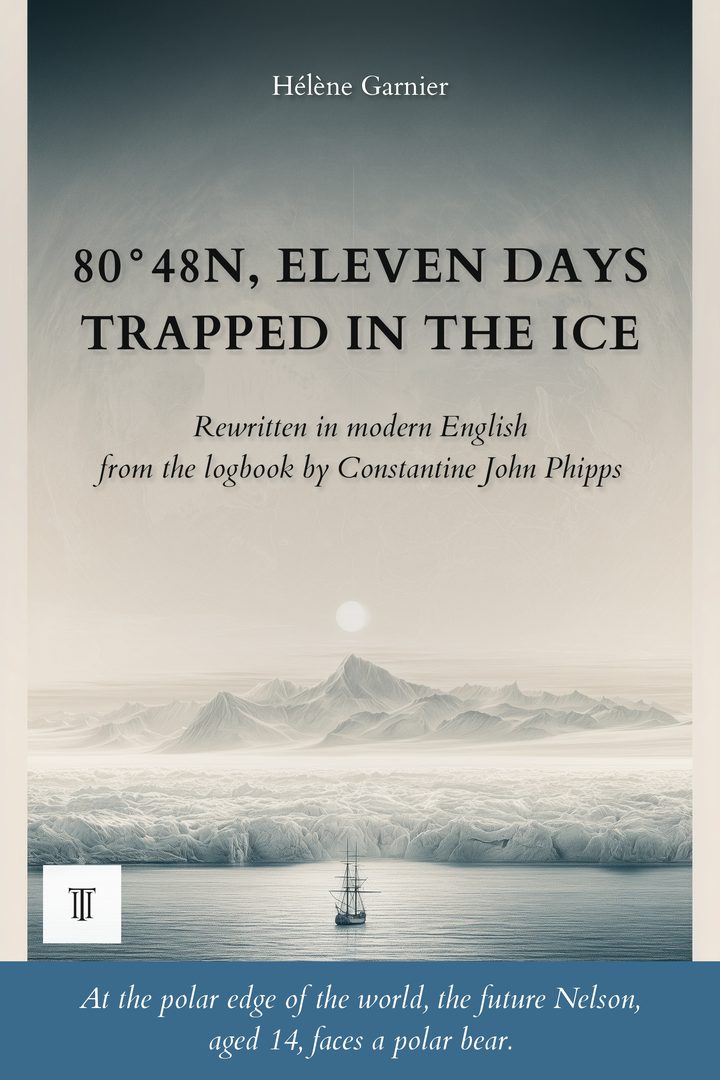
80°48N, Eleven Days Trapped in the Ice
Modernized, illustrated English edition of A Voyage towards the North Pole by Constantine John Phipps (1773). 192 pages.
1773: two Royal Navy ships attempt to force a passage through the ice to the North Pole. Captain Phipps's logbook, between pack ice, soundings with no bottom, and eleven days trapped in the ice at the Seven Islands.
Read more ↓- 192 pages
- Paperback · Ebook (EPUB)
- English
- 18th century
About this book
Spring 1773, the Thames. Two reinforced bomb vessels, the Racehorse and the Carcass, set sail for a destination no one had ever reached. On the orders of King George III and at the request of the Royal Society, Captain Constantine John Phipps was tasked with forcing a passage through the ice to the North Pole.
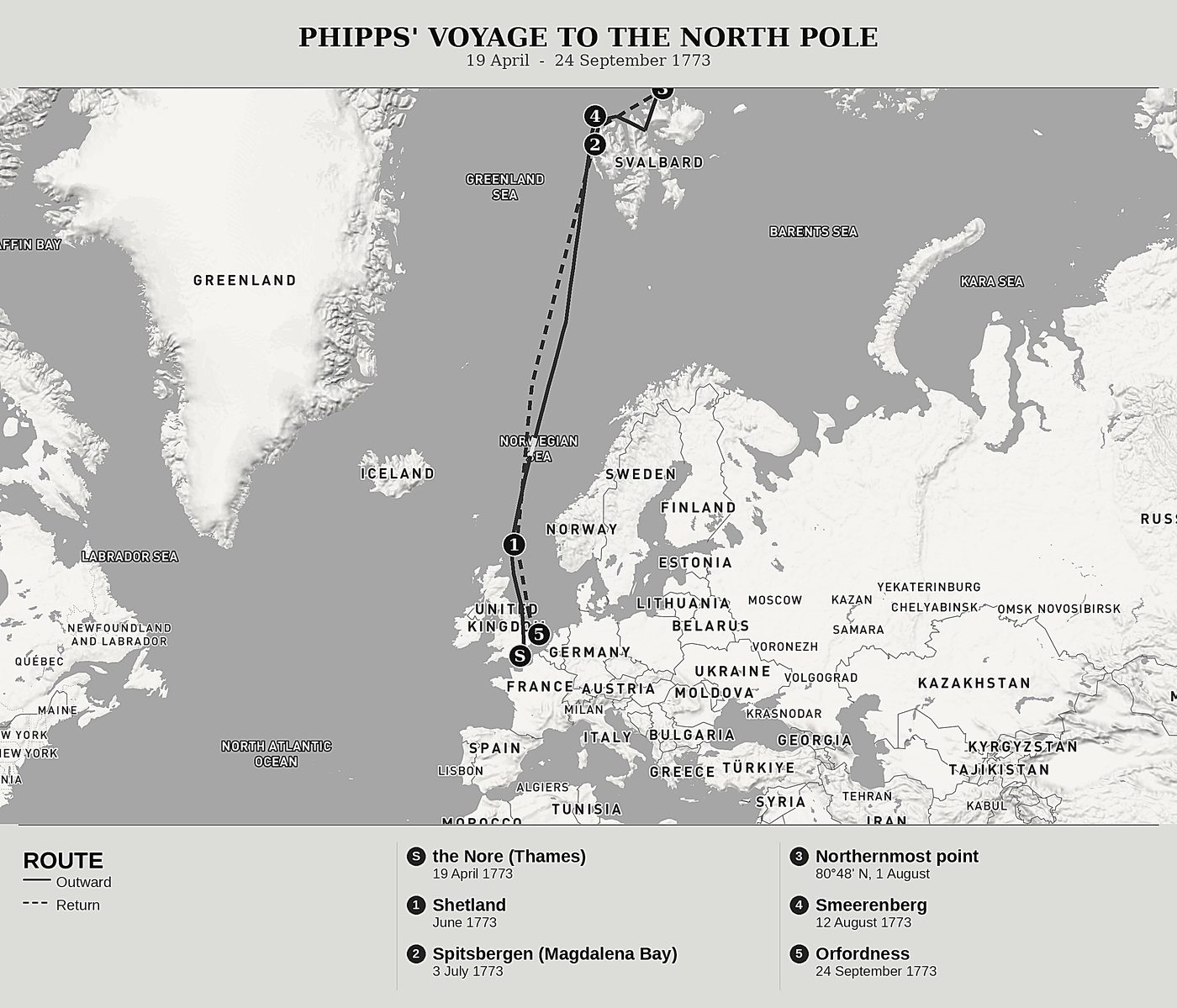
Phipps kept the log of this summer race: the Shetlands in sight, the sea sounded with no bottom at seven hundred and eighty fathoms, the sun that no longer set, the black coast of Spitsbergen, then, on the 5th of July, the ice pack dead ahead. For six weeks, the Racehorse and the Carcass skirted, forced, fled and returned against a white wall that gave way only to close again.
At the Seven Islands, the ice closed in for good. For eleven days, the ships were trapped. The crews sawed through the ice, hauled the boats across it, and prepared to abandon ship. Serving aboard the Carcass was a fourteen-year-old midshipman who would become Admiral Nelson. Deliverance came from a north-northeast wind, not from the oars.
This clear and precise logbook takes its place in a long history: since 1527, when the merchant Robert Thorne wrote to King Henry VIII to propose a route to the Indies over the pole, the English had tried their luck with Hudson, Poole, Baffin and Fotherby, never once passing beyond the wall of ice north of Spitsbergen. Phipps's expedition, mounted on a proposal from the Royal Society, was the first official attempt by the British crown toward the pole in a century and a half of silence.
The book is not confined to the log: it also carries a scientific appendix that runs through the methods for measuring a ship's course, the magnetic variation compared with Baffin's, Nairne's dipping needle, Ramsden's barometer that foretold gales, and Doctor Irving's process for drawing fresh water from seawater. Here too appear the walrus, the reindeer and the polar bear of Spitsbergen, in a natural history kept with the same precision as the latitude readings.
The first complete modern rewriting for today's reader, one that makes this account readable without betraying anything of the voyage. Twenty original illustrations and eight redrawn maps bring the route to life, while a set of reference materials (glossary, timeline, index) and selected passages from the original text illuminate the reading.
Product details
- Publisher
- Itinerarium Éditions
- Series
- Far North
- The author
- Constantine John Phipps
- Date of the journey
- 1773
- Modern edition by
- Hélène Garnier
- Language
- English
- Format
- Paperback, 6 × 9 in (15.2 × 22.9 cm)
- Pages
- 192
- ISBN
- 978-2-489331-15-8
- Published
- September 2026
The author
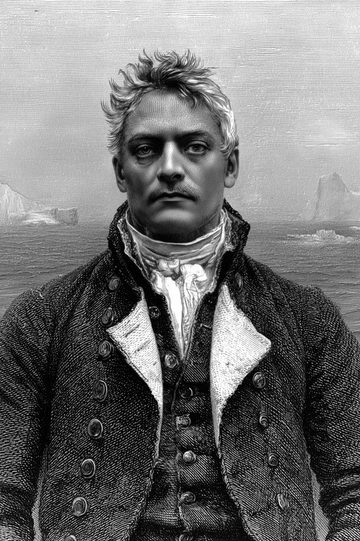
Constantine John Phipps
Constantine John Phipps (1744-1792), later second Baron Mulgrave, was a Royal Navy officer and British member of parliament. In 1773, on a proposal from the Royal Society, he took command of the Racehorse to attempt, together with Skeffington Lutwidge's Carcass, the first official expedition of the British crown toward the North Pole in a century and a half. Blocked by the ice pack at the Seven Islands, north of Spitsbergen, he brought back charts, soundings and unprecedented scientific observations, along with a fourteen-year-old midshipman, Horatio Nelson, the future victor of Trafalgar. His logbook, published in London in 1774, remains a first-hand source on eighteenth-century polar exploration.
All books by Constantine John Phipps →A Voyage towards the North Pole: Our editorial work
The volume that Constantine John Phipps published in London in 1774, A Voyage towards the North Pole undertaken by His Majesty's command, 1773, printed by W. Bowyer and J. Nichols for the bookseller J. Nourse, in the Strand, is made up of three very unequal parts. An introduction of some thirty pages traces English polar attempts back to Robert Thorne. A logbook, dated day by day, recounts the summer campaign. Then comes an appendix that alone takes up nearly two thirds of the book: the ship's muster roll, tables of positions and routes, a meteorological journal, magnetic readings, interspersed with prose accounts of the instruments, the experiments and the natural history of Spitsbergen. It is this volume, in its first edition, that has served as the source text for the present publication.
We have divided this material into eleven chapters. The first two draw on the introduction and the opening of the logbook, from Thorne's letter to Henry VIII to the ship's passage down the Thames. The next six break the logbook down according to the stages of the voyage, from the great soundings of the Norwegian Sea to the captivity at the Seven Islands and the return by way of Smeerenberg. The last three gather what prose the appendix contains: the logs and instruments, the experiments and the natural history of Spitsbergen, and Doctor Irving's memoir on the distillation of sea water. The numerical tables have been set aside. They are not meant to be read but consulted, and their most telling results are given in the narrative wherever Phipps himself comments on them.
Before / after
The idea of a passage to the East Indies by the North Pole was suggested as early as the year 1527, by Robert Thorne, merchant, of Bristol, as appears from two papers preserved by Hackluit; the one addressed to king Henry VIII; the other to Dr. Ley, the king's ambassador to Charles V. In that addressed to the king he says, "I know it to be my bounden duty to manifest this secret to your Grace, which hitherto, I suppose, has been hid." This secret appears to be the honour and advantage which would be derived from the discovery of a passage by the North Pole.
Two hundred and forty-six years ago, a Bristol merchant named Robert Thorne sat down to write to his king and lay before him what he called a secret. The year is 1527. Two memoranda in his hand have survived, gathered later by Hakluyt: one addressed to King Henry VIII, the other to Doctor Ley, then the king's ambassador to Charles V. The first opens with the gravity of a man who had long carried an idea alone. "I know it is my bounden duty to disclose to Your Grace this secret, which until now, I suppose, has remained hidden."
The journey mapped
The modern editor