Biography
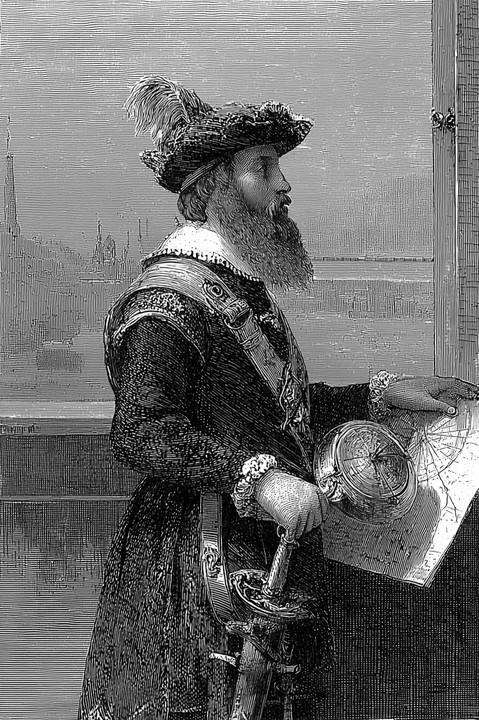
Jacques Cartier (1491-1557) was a captain of Saint-Malo who led three expeditions to North America for Francis I between 1534 and 1542. He explored the gulf and then the river he named the St Lawrence, and sailed up the latter as far as the site of the future Montreal. His travel accounts form the first body of European descriptions of Laurentian Canada and the only direct testimony on the St Lawrence Iroquoians.
Little is known of his beginnings. The Dictionary of Canadian Biography places his birth at Saint-Malo, probably in the second half of 1491, in a family of seamen. In 1520 he married Catherine des Granches, daughter of a constable of the town, an alliance that set him among the good bourgeoisie of Saint-Malo. He had in all likelihood sailed to Newfoundland, where Bretons and Normans had been fishing for cod for decades, and perhaps to Brazil, but no document attests it. It was Jean Le Veneur, abbot of Mont-Saint-Michel, who recommended him to the king.
Having left Saint-Malo on 20 April 1534 with two ships and some sixty men, Cartier passed through the Strait of Belle Isle, followed the coast of Labrador, which he judged barren, and explored the shores of the gulf. On 24 July he planted at Gaspé a cross bearing the arms of France and took to France the two sons of the chief Donnacona, Domagaya and Taignoagny, who would afterwards serve him as interpreters. The second voyage, in 1535, took him with three ships as far as the village of Stadacona, on the site of Quebec, then to Hochelaga on 2 October. The wintering that followed was deadly: scurvy carried off twenty-five men before the Iroquoians pointed out a decoction of bark and needles, the annedda, which stopped the disease within a few days. On his departure, in May 1536, Cartier took away Donnacona and nine other people, almost all of whom died in France.
The third voyage, in 1541, was conceived as a colonising enterprise, Cartier serving in it as captain and pilot under the authority of Roberval, who had been appointed lieutenant general. At Cap-Rouge he established the post of Charlesbourg-Royal, spent there a difficult winter, marked by the hostility of the Iroquoians, and left again in 1542 without waiting for Roberval, whom he met off Newfoundland. He brought back ores taken for gold and stones taken for diamonds: they were iron pyrite and quartz, whence the proverbial expression about the diamonds of Canada. He never sailed again and died at Saint-Malo on 1 September 1557.
The three accounts met with unequal fates. That of the first voyage was not printed in the author's lifetime and long circulated only through the Italian translation of Giovanni Battista Ramusio (1556) and the English one of Richard Hakluyt (1600); the French text was published only in 1867, by Henri Michelant and Alfred Ramé. That of the second voyage appeared in Paris in 1545 under the title Bref récit et succincte narration de la navigation faite en MDXXXV et MDXXXVI, and may have been put into shape by the secretary Jehan Poullet. Of the third voyage only a fragment survives, preserved by Hakluyt.
Historians draw from them the first French toponymy of the region, two short lexicons of the language of the St Lawrence Iroquoians, and notes on their agriculture, their dwellings and their organisation. That people had vanished from the valley when Champlain returned there in 1603, without the causes being established, which gives Cartier's pages a documentary value that nothing replaces. Botanists still debate the exact identification of the annedda, most often referred to the eastern white cedar.