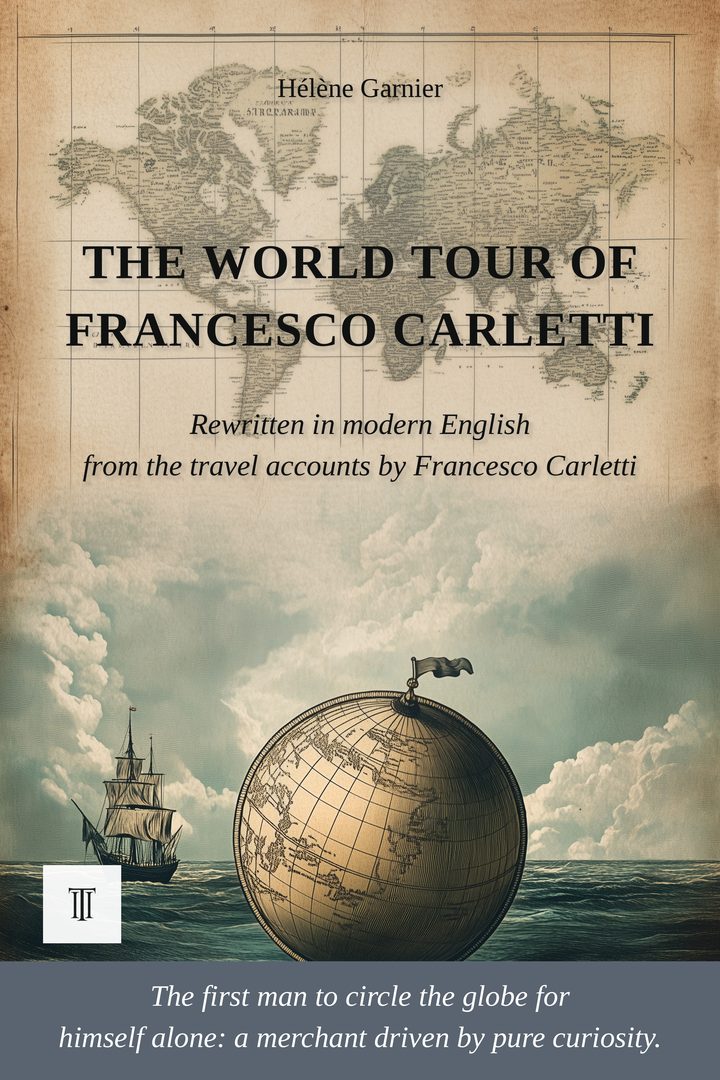
 Lost Europe · Modernised and illustrated edition
The World Tour of Francesco Carletti
Modernized, illustrated English edition of My Voyage Around the World (Ragionamenti del mio viaggio intorno al mondo) by Francesco Carletti (1594-1606). 340 pages.
A Florentine merchant circles the globe out of curiosity, from Cape Verde to Japan and China, before losing everything at Saint Helena. A firsthand account, 1591-1606.
Read more ↓- 340 pages
- Paperback · Kindle
- English
- 16th century
About this book
Florence, 1591. An eighteen-year-old boy sets sail for Seville and will not return until 1606, having become the first man in history to circle the globe on his own account. Francesco Carletti is no captain, no ambassador, no conquistador: he is a literate merchant, driven as much by curiosity as by trade.
We follow him from Cape Verde, where he buys slaves with his father, to Cartagena de Indias and Peru, from the silver of Lima to the cacao of Mexico City, then across the immensity of the Pacific to the Philippines. He reaches Japan at the moment of the crosses of Nagasaki, crosses the China of the mandarin officials as far as Macao, where his father dies, spends twenty months in Portuguese Goa, and already crosses paths with the Dutch fleets upending Asia.
And then, off Saint Helena, disaster: the carrack attacked by Zeeland ships, the plunder, a lifetime's fortune swallowed in a single day. Ruined, he makes his way home through Paris, where Henry IV receives him at the Tuileries, and Carletti recounts from memory to the Grand Duke of Tuscany a world no European had yet crossed in a single unbroken journey: the first testimony of a planet suddenly linked by trade, between the silver of Peru and the silk of China.
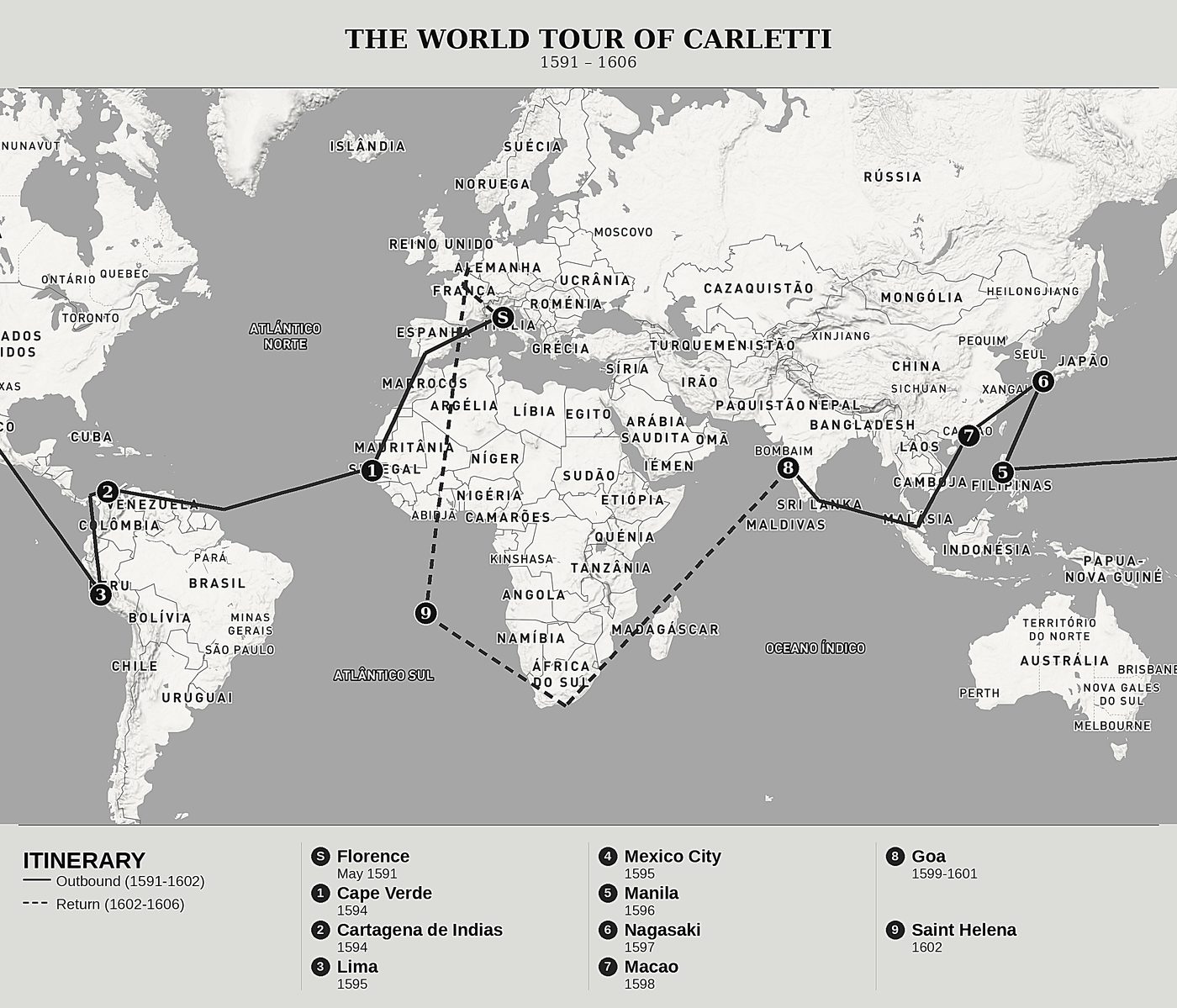
The journey unfolds as a single crossing of the globe: from Seville to the Antilles, then Cartagena de Indias, the Isthmus of Panama and Peru, before the long Pacific route taken by the Manila galleon to the Philippines, then Macao, Japan, Goa, and finally the Atlantic crossing home. All along this itinerary, Carletti looks on as a merchant: he weighs currencies, compares prices, appraises goods, and maps the trading networks that already link four continents. He ranks among the very first Westerners to describe Japan and the trade of Ming China at first hand, with the eye of an accountant as much as that of a curious observer. Yet the disaster at Saint Helena changes everything: in the hold of the carrack seized by the Dutch privateers was also the cargo of slaves he was transporting for his own trade, a fact the account itself documents without evasion as an ordinary practice of the age. This loss, human in its consequences and financial in its scale, ruins the merchant and entirely upends the meaning of his voyage. This is what makes the text singular: neither a missionary's report nor an official relation, it is the account of a merchant who keeps his world like a ledger, blending business sense with an almost ethnographic curiosity, in counterpoint to the better-known accounts of the great navigators of his time.
The first complete modern rewriting for today's reader, making this account readable without betraying anything of the voyage. Twenty original illustrations and nine redrawn maps bring the itinerary to life, while a full apparatus of reference material (glossary, chronology, index, editor's note, afterword, original text, further reading) and selected passages from the original text illuminate the reading.
Product details
- Publisher
- Itinerarium Éditions
- Series
- Lost Europe
- The author
- Francesco Carletti
- Date of the journey
- 1594-1606
- Modern edition by
- Hélène Garnier
- Language
- English
- Format
- Paperback, 6 × 9 in (15.2 × 22.9 cm)
- Pages
- 340
- ISBN
- 978-2-489330-23-6
- Published
- July 2026
The author
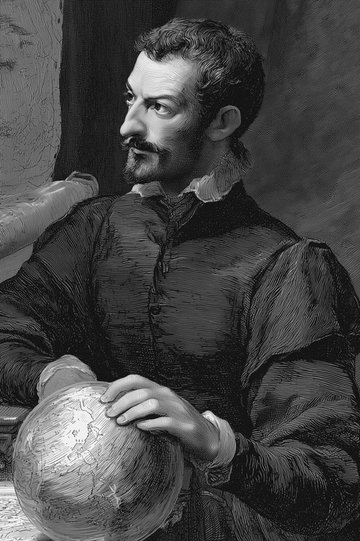
Francesco Carletti
Francesco Carletti was born in Florence around 1573 into a family of merchants. In 1591, at the age of eighteen, he sailed on behalf of his father Antonio and reached the West Indies, then Peru, Mexico, the Philippines, Japan, China, and Portuguese India, before returning by way of Northern Europe. Ruined by a naval attack off Saint Helena, he came back to Florence in 1606, fifteen years after his departure, the first man known to have circled the globe on his own account rather than for a crown. On his return, he dictated to the Grand Duke of Tuscany the account of this journey, a precious testimony from a literate merchant on a world already linked in a single sweep by trade.
All books by Francesco Carletti →Ragionamenti di Francesco Carletti Fiorentino sopra le cose da lui vedute ne' suoi viaggi: Our editorial work
The book you are holding was born from an Italian text of the very beginning of the seventeenth century, the Ragionamenti that Francesco Carletti addressed to the Grand Duke of Tuscany, and which we wanted to render readable without betraying it. Carletti wrote, or rather dictated, in a Florentine merchant's language: sentences that unwind over half a page, digressions that bounce off one another, a syntax in which the verb keeps the reader waiting and complements pile up. As it stood, this flow would elude today's reader. Our task was to make it breathe, sentence by sentence, without ever impoverishing it.
Carletti had organized his account into ragionamenti, these long conversations divided between the West Indies and then the East Indies, with no titles or landmarks for the reader. We have broken up this continuous material into fifteen chapters following the very thread of the voyage, from Florence to Cape Verde, from Peru to Mexico, from Japan to China, from Goa to Saint Helena and back. Every chapter now carries a title, and the reader can follow the merchant from one stop to the next without losing the way. No material has been cut from the journey: only the order has been clarified.
Modernizing the language was the heart of the work. The long Tuscan periods had to be undone, the words restored to the natural order of contemporary English, the cascading subordinate clauses untangled, all without smoothing away the merchant's voice, his avid curiosity, his concrete sense of things, his melancholy as a man who lost everything. Cutting what repeats itself, unfolding what was too elliptical, clarifying an allusion grown obscure: this care was applied line by line. Where Carletti dropped in an Italian word without translating it, we rendered its meaning or kept the term with a light gloss.
Before / after
AVERE io Serenissimo Principe insieme con i miei beni di fortuna, perduto ancora tutte le mie Scritture, e memorie de' Viaggi fatti da me nel giro di tutto il Mondo, sarà cagione, che io non potrò così minutamente raccontare a V. A. S. ogni particolarità di quanto ho veduto, e aveva osservato, e notato ne' suddetti miei scritti, de' quali non mi rimane altro che una debol memoria, e quella sconcertata, e confusa dalle disgrazie accadutemi.
I have lost everything, Most Serene Prince, and together with my worldly goods there has vanished the whole of my writings and my memoirs of the voyages I made around the entire world. It is therefore impossible for me to report to Your Most Serene Highness every detail of what I once saw, observed, and noted in my journals. Of it there remains to me only a weakened memory, blurred and confused by the misfortunes that have struck me.
The journey mapped
The modern editor