The Antiquities of Constantinople
Constantinople, 1544. Ninety-one years after its fall to the Ottomans in 1453, the city is being transformed: churches become mosques, the Hippodrome empties, ancient columns are toppled or buried under new construction, and the memory of Byzantium fades a little more with each passing year.
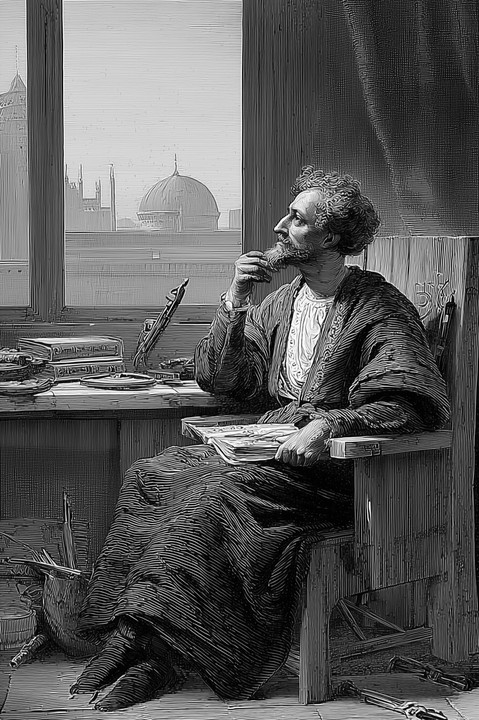
Into this changing city comes Pierre Gilles, a scholar and naturalist from Albi, sent east by Francis I to collect Greek manuscripts for the royal library. When the royal funds stop arriving, he enlists for a time in the army of Suleiman the Magnificent simply to survive, all the while devoting himself to a mission of his own choosing: saving Constantinople from oblivion before the last visible traces of the Byzantine capital disappear beneath the growing Ottoman city.
He climbs the city walls, measures its towers and columns pace by pace, digs through ruins overgrown with weeds, and questions Ottoman gardeners about the marble fragments and bronze relics they have turned up while digging their beds. Hill by hill, he reconstructs the topography of the Seven Hills: Hagia Sophia and its dome, the Sacred Palace and the Chalke gate, the Hippodrome where the factions once cheered, the forums of Constantine and Theodosius, the Augusteon, the Column of Porphyry, and the Byzantine districts stretching from the Golden Horn to the land walls, holding, page after page, a silent dialogue with the emperors who built them and are now gone.
The result is unique: the last scientific description of Byzantine Constantinople, compiled just before the disappearance of what little of Byzantium remained standing. Without Gilles's patient survey, entire sections of the city's ancient topography, the location of the Church of the Holy Apostles and the tomb of Constantine among them, would have been lost forever, swallowed by later building and by the passage of time.
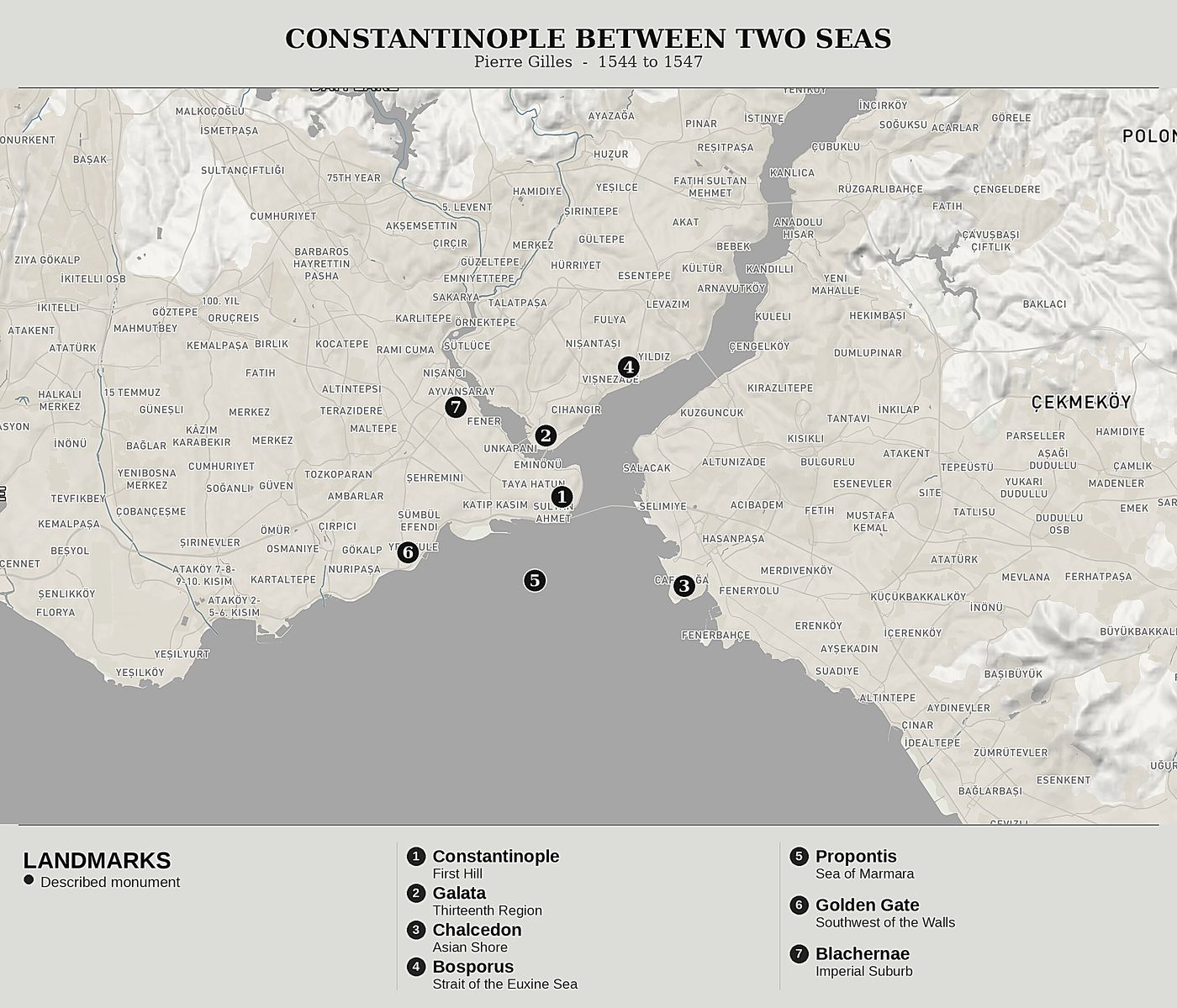
Published in Lyon in 1561, six years after Gilles's death, by his nephew Antoine, this Latin text, "De topographia Constantinopoleos et de illius antiquitatibus libri quatuor", had never before been rendered into modern English directly from the original. The only earlier English version was the free and heavily periphrastic translation published by John Ball in London in 1729, itself an intermediary reading of Gilles's Latin. The present edition returns to the 1561 princeps, newly transcribed from the copy held by the Getty Research Institute, and offers the first complete modern-English rewriting of the four books devoted to Constantinople proper. The text is modernized and reorganized into eighteen readable chapters, the voice of the humanist surveyor left intact throughout. It is illustrated with fifteen engravings, accompanied by six original maps tracing the Seven Hills, the central quarters, the Golden Horn, and the forums along the Mese, and rounded out with a glossary of ancient, Byzantine, and Ottoman terms, a detailed chronology, and a double index of characters and places.