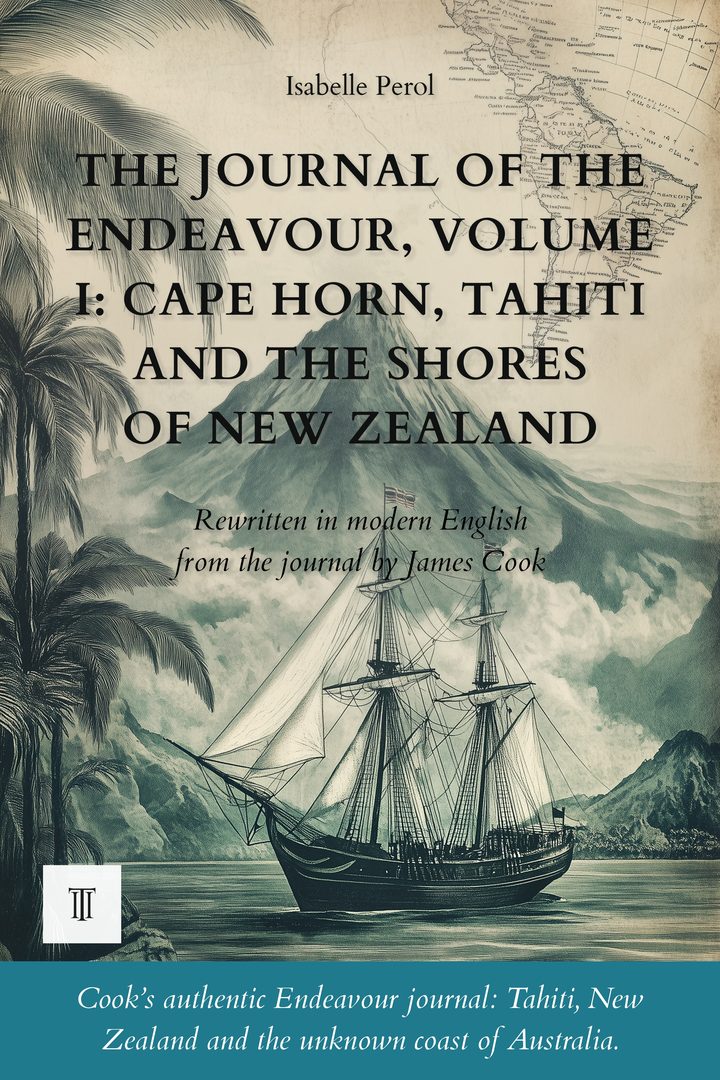
Couverture de The Journal of the Endeavour, Volume I: Cape Horn, Tahiti and the Shores of New Zealand de James Cook Buy

The Journal of the Endeavour, Volume I: Cape Horn, Tahiti and the Shores of New Zealand

Summer 1768. At Deptford, on the Thames, a still obscure lieutenant takes command of an old collier renamed the Endeavour. His mission holds two secrets: to observe, on the far side of the world, the passage of Venus across the sun, and to search for the southern continent believed to lie hidden in the seas of the South.

From the English Channel to Cape Horn, the Endeavour faces the suspicion of a viceroy in Rio, the deadly cold of Tierra del Fuego and the storms of the far South. Then Tahiti appears, with its lagoons, its chiefs and the thefts of objects that exasperate the English crew. On June 3, 1769, under a cloudless sky, Venus finally glides across the face of the sun.

But the true adventure begins afterward. Guided by Tupaia, a Tahitian priest and navigator, Cook sets a course south, toward the unknown, until a new coastline rises on the horizon: New Zealand. There, the first steps turn to bloodshed, and every bay holds its own ordeal.

This first volume of Cook's authentic journal leads the reader, day by day, to the shore of Mercury Bay, where astronomy and conquest meet. The rest of the voyage awaits, beyond the horizon.

This voyage is not a simple expedition of discovery: it is a scientific mission commissioned by the Royal Society and the British Admiralty, one of the earliest ventures in international scientific cooperation, since observing the transit of Venus was expected to allow the exact distance between the Earth and the Sun to be calculated. On board, the naturalist Joseph Banks and the Swedish botanist Daniel Solander record an unprecedented scientific harvest, while the astronomer Charles Green trains his instruments on the southern sky.

The text followed here is Cook's own personal journal, written day by day aboard the Endeavour, long before the reworked and embellished accounts that the editor John Hawkesworth would publish in 1773 for the general public. Here we find the direct voice of a meticulous sailor, more attentive to headings, winds and men than to literary effect, which makes it a firsthand source on the very first contacts between Europeans and the peoples of the Pacific, in Tahiti as in New Zealand.

This is the first complete modern rewriting for today's reader, one that makes this testimony readable without betraying anything of the voyage. Twenty original illustrations and redrawn maps bring the itinerary to life, while a set of reference materials (glossary, timeline, index, further reading, editor's note, afterword) and selected passages from the original text illuminate the reading.

Oceania & Pacific
Original text : James Cook
Modern edition by : Isabelle Perol
1768-1771

The author

James Cook

Captain Cook’s Journal During His First Voyage Round the World (1768-1771)

An officer in the British Royal Navy, James Cook (1728-1779) commanded the Endeavour during his first great voyage around the world, from 1768 to 1771. A farmer's son who became an outstanding cartographer during the Seven Years' War, he was chosen by the Admiralty and the Royal Society to observe the transit of Venus at Tahiti and to search for the southern continent. His logbook, kept day after day, records with rare precision the shores of the Pacific and the first contacts with the Tahitians and then the Maori of New Zealand, before two further voyages that would make him the greatest navigator of his century.

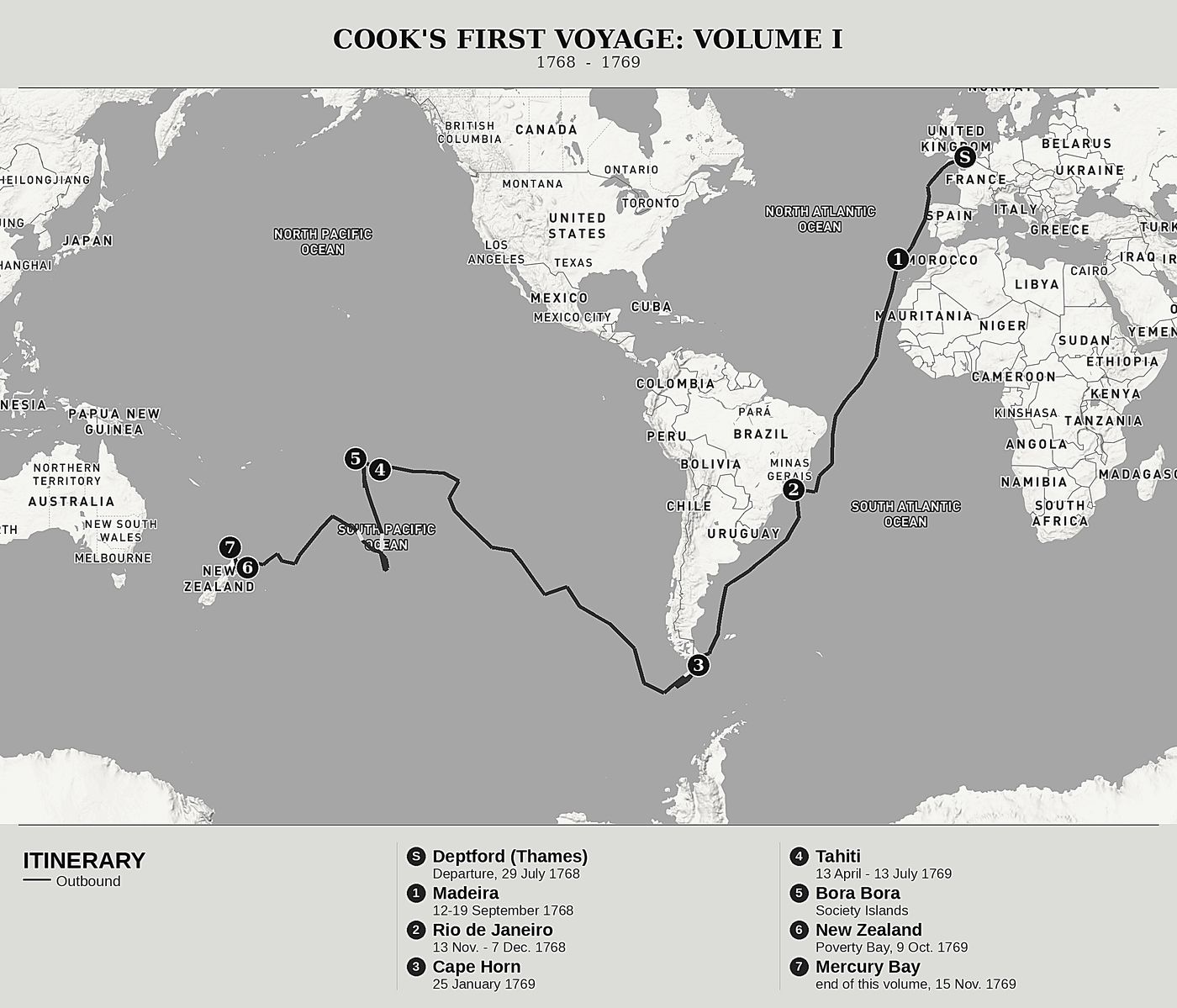
The journey mapped

Overview map of The Journal of the Endeavour, Volume I: Cape Horn, Tahiti and the Shores of New Zealand by James Cook, north at top: 1768  -  1769.
1768 - 1769. Overview map, from The Journal of the Endeavour, Volume I: Cape Horn, Tahiti and the Shores of New Zealand by James Cook (1768-1771).

By the middle of the eighteenth century, learned Europe believed it had measured almost everything. It had weighed the stars, charted its own coasts, arranged plants and beasts in long reasoned tables. One blank alone still resisted, immense, at the foot of the globe: the Pacific Ocean, an expanse so vast that no crossing could exhaust it, and where a southern continent, peopled and fertile, was presumed to lie in order to balance the lands of the North. The cabinets of London, Paris and Madrid each dreamed of it for their own king. To find that Southern Land would be to double an empire with a single cast of the lead. To this coveting there came, in 1769, an occasion the heavens offer only twice in a century: the transit of the planet Venus across the disc of the Sun, a phenomenon whose observation, carried out from several points of the Earth, was to yield at last the exact measure of the distance that separates us from our star. The Royal Society of London wanted its observatory in the heart of the Pacific. The Admiralty wanted its continent. From these two designs, the one declared, the other kept secret, was born the expedition of the Endeavour.

Available on

Coming soon on Amazon

The editor

Isabelle Perol

Isabelle Perol

Éditrice et traductrice

A sailor at heart and passionate about ancient civilisations, Isabelle Perol has roamed the coasts of South America, West Africa and the South Pacific. Trained in maritime anthropology, she is drawn to accounts in which the sea is not a mere backdrop but a character in its own right. She brings to the project a sensitivity for oceanic cultures and forgotten voyages. She works on the Wild Americas, Oceania & Pacific, Unexplored Africa and East Indies collections.

Tous les livres de Isabelle Perol →