Travel Journals in New France
In the spring of 1534, two ships of sixty tons leave Saint-Malo for a continent that has no name.
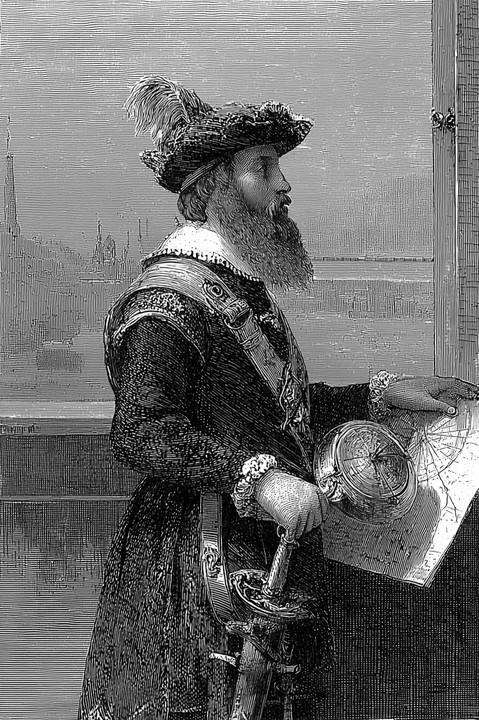
Aboard is Jacques Cartier, a forty-three-year-old captain from Saint-Malo, commissioned by Francis I to find gold and a passage to China. He will discover something else entirely: a vast gulf, a river that runs a thousand leagues into the land, peoples speaking unknown languages, and palisaded towns at the foot of mountains he will later name Royal. In three voyages, spread across eight years and ending in 1542, Cartier opens for France the way to a country his own century does not yet call Canada.
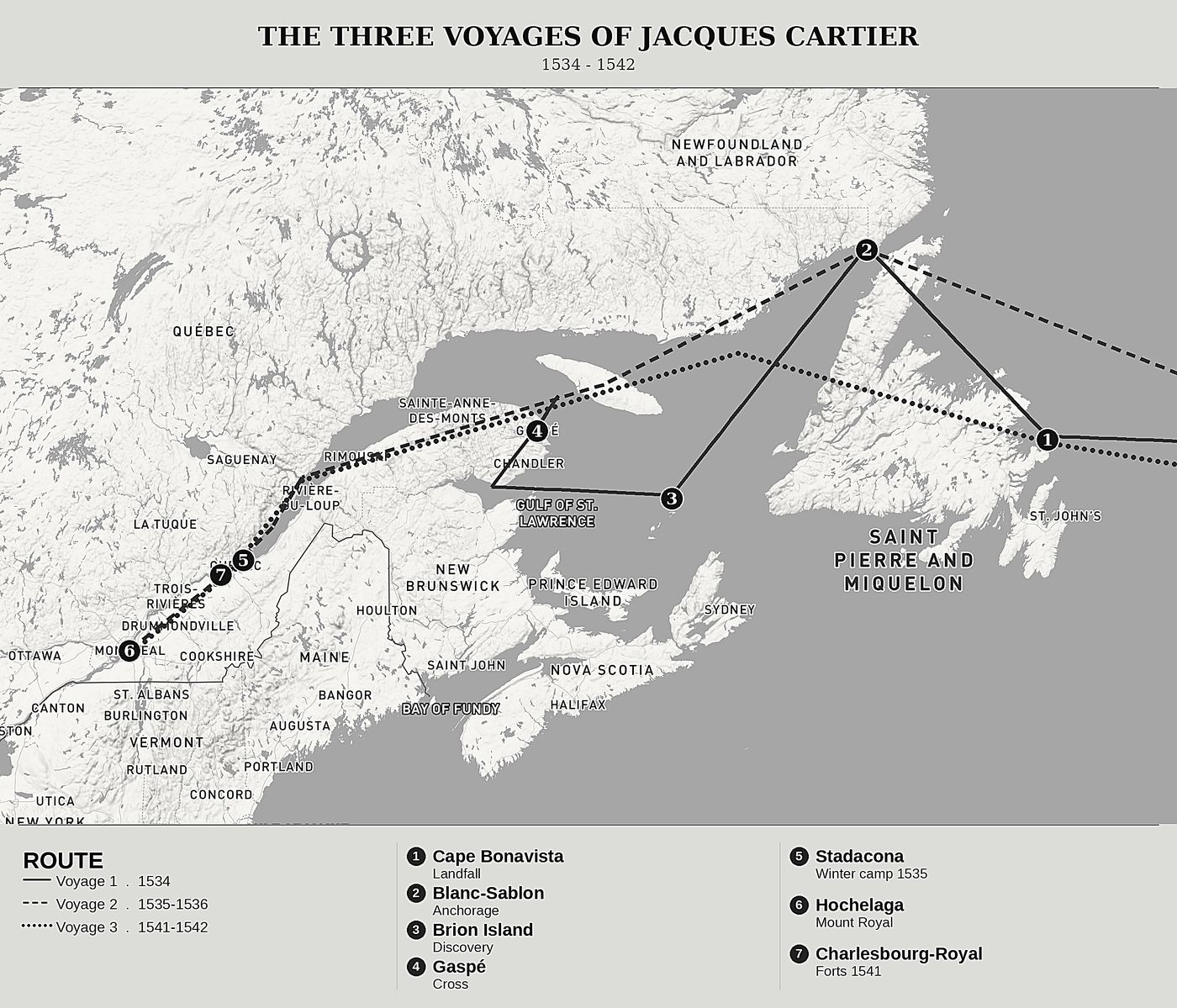
On his first crossing, he plants a cross thirty feet high at Gaspé, in full view of the people who watch it rise, and returns to Saint-Malo carrying two young men, Taignoagny and Domagaya, sons of the lord Donnacona. The following year he sails up the great river as far as Hochelaga, the fortified town that will become Montreal, and winters opposite Stadacona among the Iroquoians of the Saint Lawrence. Twenty-five of his men die of scurvy before Domagaya reveals the bark remedy, annedda, that saves the rest of the crew. Before sailing home, Cartier seizes Donnacona and several of his people; the lord will never see his country again, and dies in France.
Nearly five years pass before Cartier returns a last time, in 1541, sailing alone from Saint-Malo while Roberval, newly named viceroy by the king, prepares to follow with settlers. Cartier builds two forts at Cap-Rouge, meets Agona, who has succeeded Donnacona at Stadacona, and believes he has found gold and diamonds in the rock of the region; the ore proves worthless, and for a long time the phrase 'a diamond from Canada' becomes a byword for a false treasure. The account of this last voyage breaks off abruptly, its ending lost along with the original French manuscript.
Cartier's three accounts survive by different, and sometimes precarious, paths: the first from a manuscript held today at the Bibliothèque nationale de France, the second from a rare sixteenth-century printing rediscovered in London in 1843, the third only in the English translation that Richard Hakluyt published in 1600, the French original having disappeared. Together they form the earliest written record of French North America and the only surviving first-hand account of the Saint Lawrence Iroquoians, a people who vanished within a generation of Cartier's last voyage, well before the French returned to settle the river for good. This modernized and illustrated edition follows the original sixteenth-century manuscripts and prints, and is enriched with maps, an Iroquoian-Laurentian glossary, and the text of the royal privilege granted in 1544.