The World Tour of Francesco Carletti
Florence, 1591. An eighteen-year-old boy sets sail for Seville and will not return until 1606, having become the first man in history to circle the globe on his own account. Francesco Carletti is no captain, no ambassador, no conquistador: he is a literate merchant, driven as much by curiosity as by trade.
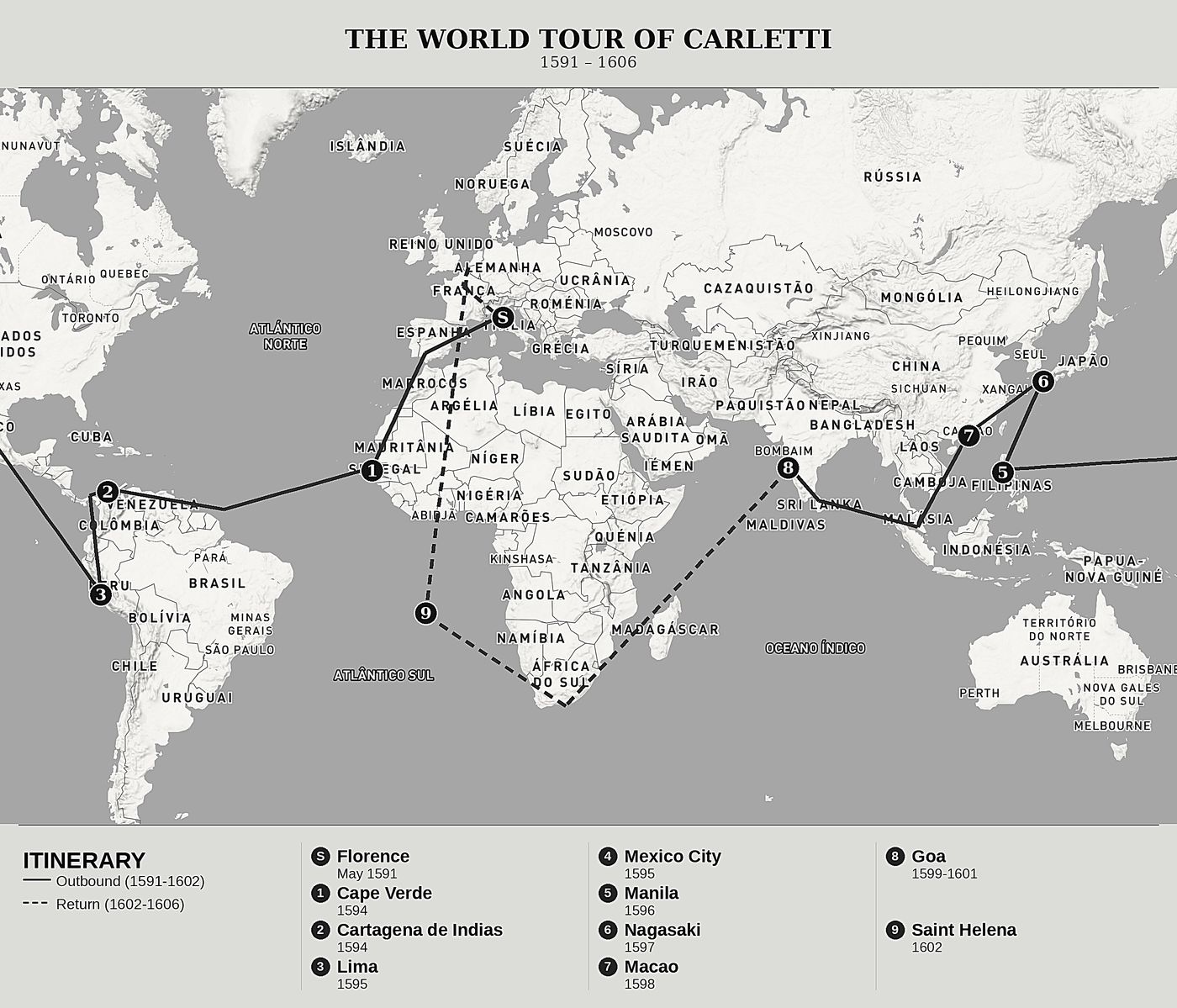
We follow him from Cape Verde, where he buys slaves with his father, to Cartagena de Indias and Peru, from the silver of Lima to the cacao of Mexico City, then across the immensity of the Pacific to the Philippines. He reaches Japan at the moment of the crosses of Nagasaki, crosses the China of the mandarin officials as far as Macao, where his father dies, spends twenty months in Portuguese Goa, and already crosses paths with the Dutch fleets upending Asia.
And then, off Saint Helena, disaster: the carrack attacked by Zeeland ships, the plunder, a lifetime's fortune swallowed in a single day. Ruined, he makes his way home through Paris, where Henry IV receives him at the Tuileries, and Carletti recounts from memory to the Grand Duke of Tuscany a world no European had yet crossed in a single unbroken journey: the first testimony of a planet suddenly linked by trade, between the silver of Peru and the silk of China.
The journey unfolds as a single crossing of the globe: from Seville to the Antilles, then Cartagena de Indias, the Isthmus of Panama and Peru, before the long Pacific route taken by the Manila galleon to the Philippines, then Macao, Japan, Goa, and finally the Atlantic crossing home. All along this itinerary, Carletti looks on as a merchant: he weighs currencies, compares prices, appraises goods, and maps the trading networks that already link four continents. He ranks among the very first Westerners to describe Japan and the trade of Ming China at first hand, with the eye of an accountant as much as that of a curious observer. Yet the disaster at Saint Helena changes everything: in the hold of the carrack seized by the Dutch privateers was also the cargo of slaves he was transporting for his own trade, a fact the account itself documents without evasion as an ordinary practice of the age. This loss, human in its consequences and financial in its scale, ruins the merchant and entirely upends the meaning of his voyage. This is what makes the text singular: neither a missionary's report nor an official relation, it is the account of a merchant who keeps his world like a ledger, blending business sense with an almost ethnographic curiosity, in counterpoint to the better-known accounts of the great navigators of his time.
The first complete modern rewriting for today's reader, making this account readable without betraying anything of the voyage. Twenty original illustrations and nine redrawn maps bring the itinerary to life, while a full apparatus of reference material (glossary, chronology, index, editor's note, afterword, original text, further reading) and selected passages from the original text illuminate the reading.